


ADP-glucose pyrophosphorylase is located in the plastid in developing tomato fruit
- PMID: 11351089
- PMCID: PMC102300
- DOI: 10.1104/pp.126.1.261
ADP-glucose pyrophosphorylase is located in the plastid in developing tomato fruit
Abstract
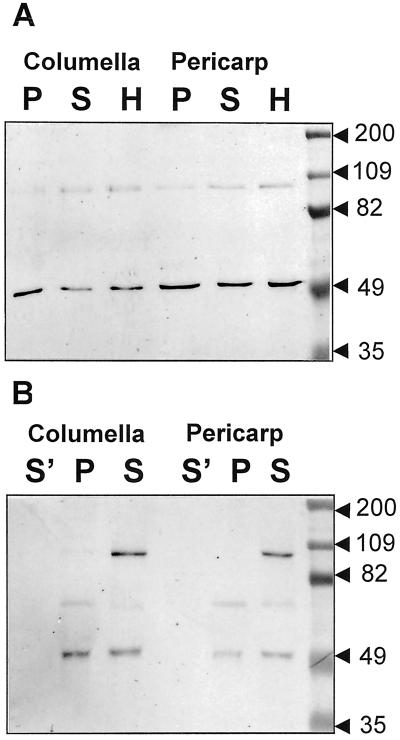
The subcellular location of activity and protein of ADP-glucose pyrophosphorylase (AGPase) in developing tomato (Lycopersicon esculentum) fruit was determined following a report that the enzyme might be present inside and outside the plastids in this organ. Plastids prepared from crude homogenates of columella and pericarp, the starch-accumulating tissues of developing fruit, contained 8% to 18% of the total activity of enzymes known to be confined to plastids, and 0.2% to 0.5% of the total activity of enzymes known to be confined to the cytosol. The proportion of the total activity of AGPase in the plastids was the same as that of the enzymes known to be confined to the plastid. When samples of plastid and total homogenate fractions were subjected to immunoblotting with an antiserum raised to AGPase, most or all of the protein detected was plastidial. Taken as a whole, these data provide strong evidence that AGPase is confined to the plastids in developing tomato fruit.
Figures
References
-
- ap Rees T. Where do plants make ADPglucose? In: Pontis HG, Salerno GL, Echeverria EJ, editors. Sucrose: Metabolism, Biochemistry, Physiology and Molecular Biology. Rockville, MD: American Society of Plant Physiologists; 1995. pp. 143–155.
-
- Beckles DM. The subcellular location of ADPglucose pyrophosphorylase in starch storing cells. PhD thesis. UK: University of Cambridge; 1999.
-
- Bhattacharyya MK, Smith AM, Ellis THN, Hedley C, Martin C. The wrinkled-seed character of pea described by Mendel is caused by a transposon-like insertion in a gene encoding starch branching enzyme. Cell. 1990;60:115–122. - PubMed
