. 2001 Jun;45(6):1761-70.
doi: 10.1128/AAC.45.6.1761-1770.2001.

Multidrug efflux pumps: expression patterns and contribution to antibiotic resistance in Pseudomonas aeruginosa biofilms

Affiliations

Multidrug efflux pumps: expression patterns and contribution to antibiotic resistance in Pseudomonas aeruginosa biofilms

T R De Kievit et al. Antimicrob Agents Chemother. 2001 Jun.

Abstract

Pseudomonas aeruginosa biofilms are intrinsically resistant to antimicrobial chemotherapies. At present, very little is known about the physiological changes that occur during the transition from the planktonic to biofilm mode of growth. The resistance of P. aeruginosa biofilms to numerous antimicrobial agents that are substrates subject to active efflux from planktonic cells suggests that efflux pumps may substantially contribute to the innate resistance of biofilms. In this study, we investigated the expression of genes associated with two multidrug resistance (MDR) efflux pumps, MexAB-OprM and MexCD-OprJ, throughout the course of biofilm development. Using fusions to gfp, we were able to analyze spatial and temporal expression of mexA and mexC in the developing biofilm. Remarkably, expression of mexAB-oprM and mexCD-oprJ was not upregulated but rather decreased over time in the developing biofilm. Northern blot analysis confirmed that these pumps were not hyperexpressed in the biofilm. Furthermore, spatial differences in mexAB-oprM and mexCD-oprJ expression were observed, with maximal activity occurring at the biofilm substratum. Using a series of MDR mutants, we assessed the contribution of the MexAB-OprM, MexCD-OprJ, MexEF-OprN, and MexXY efflux pumps to P. aeruginosa biofilm resistance. These analyses led to the surprising discovery that the four characterized efflux pumps do not play a role in the antibiotic-resistant phenotype of P. aeruginosa biofilms.


Figures
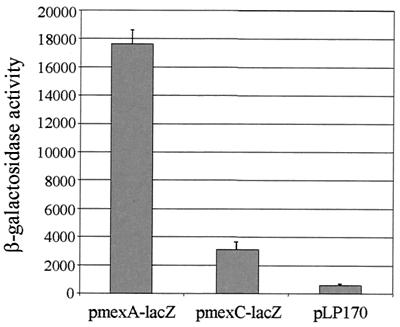
FIG. 1
FIG. 1
Comparison of mexA-lacZ and mexC-lacZ expression in P. aeruginosa strain PAO1 planktonic cultures. Note that while mexC is expressed at a much lower level than mexA, this level is still significantly higher than the background activity from the vector control.
FIG. 2
FIG. 2
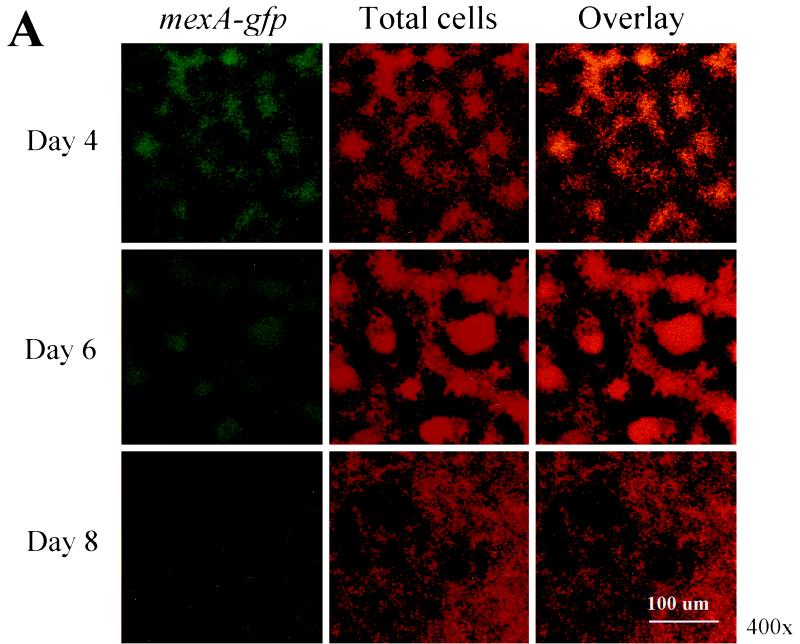
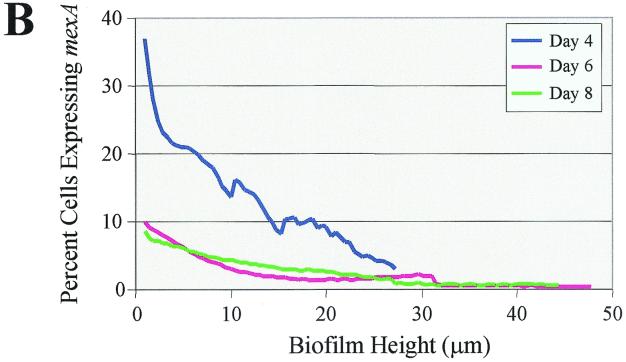
(A) Scanning confocal composite images of biofilms formed by P. aeruginosa strain PAO1 (mexA-gfp) grown for 8 days in a flowthrough chamber. Biofilms were examined on days 4, 6, and 8 to identify cells expressing mexA-gfp (green signal) relative to total cells (red signal). (B) The percentage of cells expressing mexA is plotted as a function of biofilm height. For quantitative analysis, images obtained by SCLM were analyzed using CellComp software.
FIG. 2
FIG. 2
(A) Scanning confocal composite images of biofilms formed by P. aeruginosa strain PAO1 (mexA-gfp) grown for 8 days in a flowthrough chamber. Biofilms were examined on days 4, 6, and 8 to identify cells expressing mexA-gfp (green signal) relative to total cells (red signal). (B) The percentage of cells expressing mexA is plotted as a function of biofilm height. For quantitative analysis, images obtained by SCLM were analyzed using CellComp software.
FIG. 3
FIG. 3
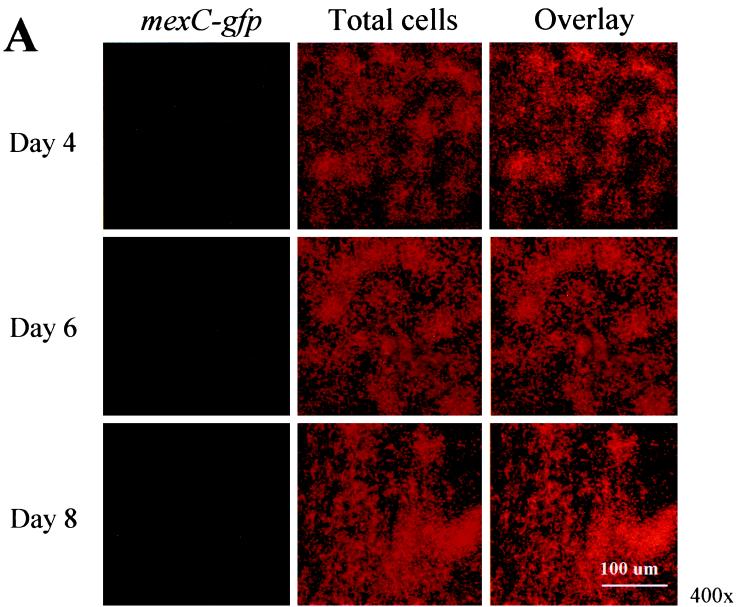
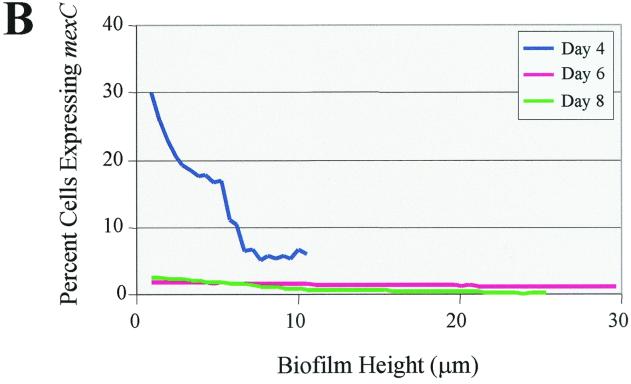
(A) Scanning confocal composite images of biofilms formed by P. aeruginosa strain PAO1 (mexC-gfp) grown for 8 days in a flowthrough chamber. Biofilms were examined on days 4, 6, and 8 to identify cells expressing mexC-gfp (green signal) relative to total cells (red signal). (B) The percentage of cells expressing mexC is plotted as a function of biofilm height.
FIG. 3
FIG. 3
(A) Scanning confocal composite images of biofilms formed by P. aeruginosa strain PAO1 (mexC-gfp) grown for 8 days in a flowthrough chamber. Biofilms were examined on days 4, 6, and 8 to identify cells expressing mexC-gfp (green signal) relative to total cells (red signal). (B) The percentage of cells expressing mexC is plotted as a function of biofilm height.
FIG. 4
FIG. 4
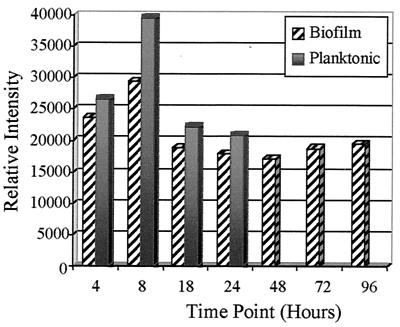
P. aeruginosa mexAB-oprM transcript accumulation. Biofilm and planktonic cultures of strain PAO1 were assayed for the mexAB-oprM message, and relative expression levels at various time points are shown.

References

    1. Aires J R, Kohler T, Nikaido H, Plesiat P. Involvement of an active efflux system in the natural resistance of Pseudomonas aeruginosa to aminoglycosides. Antimicrob Agents Chemother. 1999;43:2624–2628. - PMC - PubMed
    1. Allison D G, Gilbert P. Modification by surface association of antimicrobial susceptibility of bacterial populations. J Ind Microbiol. 1995;15:311–317. - PubMed
    1. Brooun A, Liu S, Lewis K. A dose-response study of antibiotic resistance in Pseudomonas aeruginosa biofilms. Antimicrob Agents Chemother. 2000;44:640–646. - PMC - PubMed
    1. Brown M R, Allison D G, Gilbert P. Resistance of bacterial biofilms to antibiotics: a growth-rate related effect? J Antimicrob Chemother. 1988;22:777–780. - PubMed
    1. Ceri H, Olson M E, Stremick C, Read R R, Morck D, Buret A. The Calgary Biofilm Device: new technology for rapid determination of antibiotic susceptibilities of bacterial biofilms. J Clin Microbiol. 1999;37:1771–1776. - PMC - PubMed

Publication types

Substances