


doi: 10.1128/AAC.45.6.1794-1798.2001.
Uptake, transport, and delivery of antimicrobial agents by human polymorphonuclear neutrophils
Affiliations
- PMID: 11353627
- PMCID: PMC90547
- DOI: 10.1128/AAC.45.6.1794-1798.2001
Item in Clipboard
Uptake, transport, and delivery of antimicrobial agents by human polymorphonuclear neutrophils
Antimicrob Agents Chemother.
2001 Jun.
Abstract
Polymorphonuclear neutrophils (PMN) are attracted to sites of infection. They have the potential to deliver antimicrobial agents to these sites if the agents enter the cells and do not alter migration. Penicillin G did not enter cells and was not transported by PMN. We found that azithromycin, ciprofloxacin, levofloxacin, moxifloxacin, and telithromycin were concentrated in PMN and transported toward a chemoattractant. These antimicrobial agents were released from the PMN and inhibited the growth of bacteria on test plates.
Figures
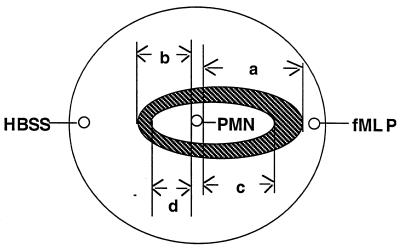
Cartoon of plate used for antimicrobial agent transport assay. The three small circles indicate 3-mm wells punched in agar plates. PMNs were placed in the center well and allowed to migrate toward the chemoattractant well (containing fMLP) or the medium well (containing HBSS). The striped oval indicates the pattern of PMN migration after 3 h. The inner oval indicates the area of inhibition of bacterial growth. a, directed PMN migration; b, nondirected PMN migration; c, inhibition of bacterial growth toward chemoattractant well; d, inhibition of bacterial growth toward medium well.
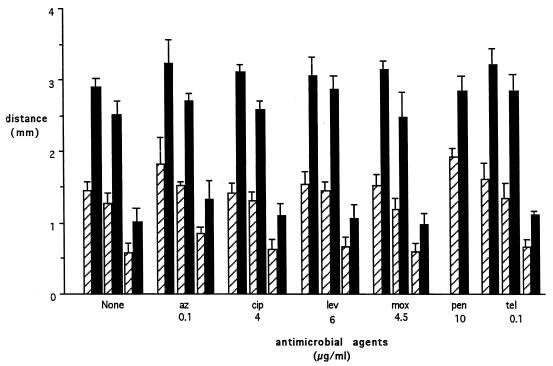
PMN movement toward fMLP (directed migration) or medium (nondirected migration). Hatched bars depict migration toward the HBSS well; and solid bars depict migration toward the fMLP well. Pairs for each condition were treated as follows (left to right): no additions, 1.0 μl of DMSO per well, and 1.12 μg of cytochalasin B plus 1.0 μl of DMSO per well. The antibiotics tested did not alter directed or nondirected migration. Bars are means ± SEM. At least three experiments were performed for each condition. Abbreviations: az, azithromycin; cip, ciprofloxacin; lev, levofloxacin; mox, moxifloxacin; pen, penicillin G; tel, telithromycin.
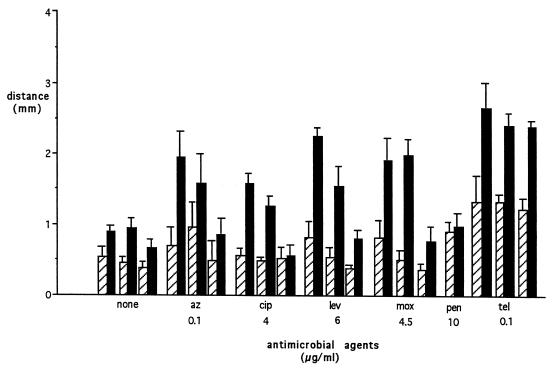
Inhibition of bacterial growth by migrating PMN loaded with antimicrobial agents. Hatched bars depict distance of inhibition of bacterial growth toward the HBSS well; solid bars depict distance of inhibition toward the fMLP well. Pairs for each condition were treated as described in the legend to Fig. 2. The penicillin G pair had no additions. Bars are means ± SEM. At least three experiments were performed for each condition. Abbreviations: az, azithromycin; cip, ciprofloxacin; lev, levofloxacin; mox, moxifloxacin; pen, penicillin G; tel, telithromycin.
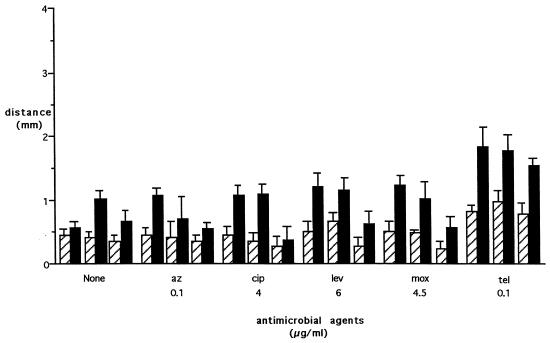
Effect of washing of wells after chemotaxis on inhibition of bacterial growth by migrating PMN loaded with antimicrobial agents. Results are similar to those shown in Fig. 3, but the zones of inhibition are smaller. Hatched bars depict distance of inhibition of bacterial growth toward HBSS; solid bars depict distance of inhibition toward fMLP. Triplet pairs for each condition were treated as described in the legend to Fig. 2. DMSO alone reduced inhibition of bacterial growth toward fMLP by 8.5% ± 6.9% and did not affect inhibition of growth toward HBSS. DMSO plus cytochalasin B reduced inhibition of growth toward fMLP by 34.5% ± 11.0% and inhibition of growth toward HBSS by 29.8% ± 8.2%. Bars are means ± SEM. At least three experiments were performed for each condition. Abbreviations: az, azithromycin; cip, ciprofloxacin; lev, levofloxacin; mox, moxifloxacin; tel, telithromycin.
References
-
- Amsden G. Tables of antimicrobial agent pharmacology. In: Mandell G, Bennett J, Dolin R, editors. Tables of antimicrobial agent pharmacology. 5th ed. Philadelphia, Pa: Churchill Livingstone; 2000. pp. 551–601.
-
- Ferrante A, Thong Y H. Optimal conditions for simultaneous purification of mononuclear and polymorphonuclear leucocytes from human blood by the Hypaque-Ficoll method. J Immunol. 1980;36:109–117. - PubMed
-
- Ganz T. Antimicrobial peptides of leukocytes. Curr Opin Hematol. 1997;4:53–58. - PubMed
Publication types
MeSH terms
Substances
LinkOut - more resources
Full Text Sources
Other Literature Sources
Medical
Molecular Biology Databases
