


Human malaria in immunocompromised mice: new in vivo model for chemotherapy studies
- PMID: 11353636
- PMCID: PMC90556
- DOI: 10.1128/AAC.45.6.1847-1853.2001
Human malaria in immunocompromised mice: new in vivo model for chemotherapy studies
Abstract
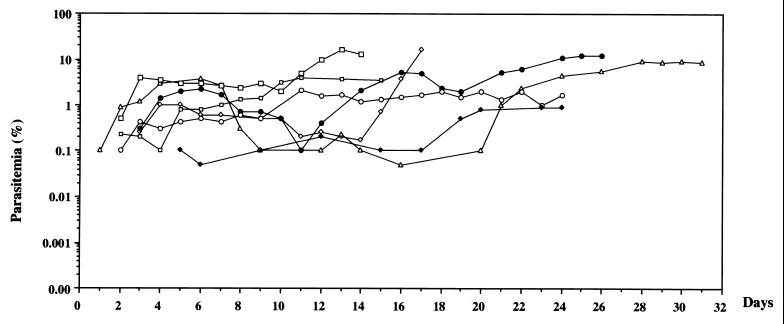
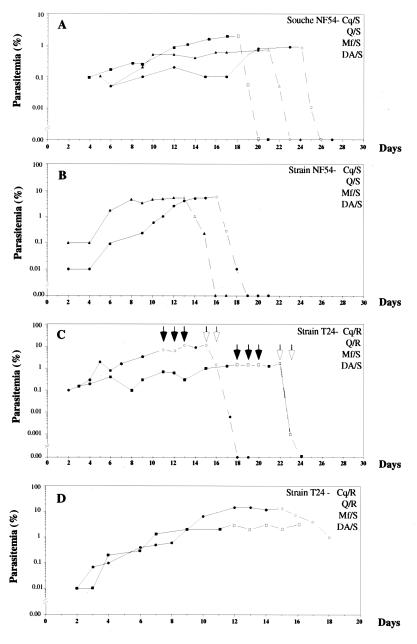
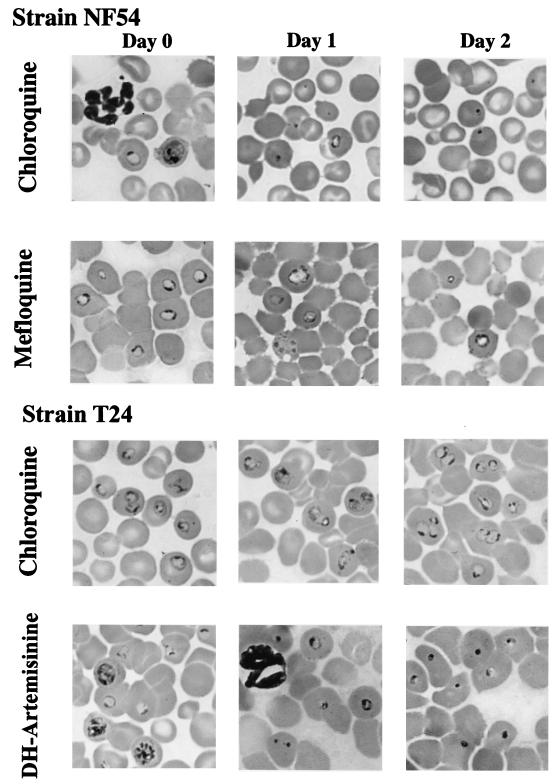
We have recently designed a new Plasmodium falciparum mouse model and documented its potential for the study of immune effector mechanisms. In order to determine its value for drug studies, we evaluated its response to existing antimalarial drugs compared to that observed in humans. Immunocompromised BXN (bg/bg xid/xid nu/nu) mice were infected with either the sensitive NF54 strain or the multiresistant T24 strain and then treated with chloroquine, quinine, mefloquine, or dihydroartemisinin. A parallelism was observed between previously reported human responses and P. falciparum-parasitized human red blood cell (huRBC)--BXN mouse responses to classical antimalarial drugs, measured in terms of speed of decrease in parasitemia and of morphological alterations of the parasites. Mice infected with the sensitive strain were successfully cured after treatment with either chloroquine or mefloquine. In contrast, mice infected with the multiresistant strain failed to be cured by chloroquine or quinine but thereafter responded to dihydroartemisinin treatment. The speed of parasite clearance and the morphological alterations induced differed for each drug and matched previously reported observations, hence stressing the relevance of the model. These data thus suggest that P. falciparum-huRBC-BXN mice can provide a valuable in vivo system and should be included in the short list of animals that can be used for the evaluation of P. falciparum responses to drugs.
Figures
References
-
- Badell E, Pasquetto V, Van Rooijen N, Druilhe P. A mouse model for human malaria erythrocytic stages. Parasitol Today. 1995;11:235–237. - PubMed
-
- Baptista J L, Das Neves I, D'Alessandro U, Hendrix L, Wery M. Plasmodium falciparum chloroquine and quinine sensitivity in asymptomatic and symptomatic children in Sao Tome Island. Trop Med Int Health. 1997;2:582–588. - PubMed
-
- Brasseur P, Druilhe P, Kouamouo J, Brandicourt O, Danis M, Moyou S R. High level of sensitivity to chloroquine of 72 Plasmodium falciparum isolates from southern Cameroon in January 1985. Am J Trop Med Hyg. 1986;35:711–716. - PubMed
-
- Brasseur P, Kouamouo J, Brandicourt O, Moyou-Somo R, Druilhe P. Patterns of in vitro resistance to chloroquine, quinine, and mefloquine of Plasmodium falciparum in Cameroon, 1985–1986. Am J Trop Med Hyg. 1988;39:166–172. - PubMed
Publication types
MeSH terms
Substances
LinkOut - more resources
Full Text Sources
Other Literature Sources
Research Materials
