


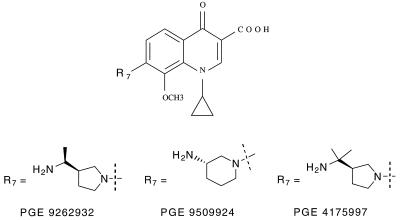
In vitro activities of three nonfluorinated quinolones against representative bacterial isolates
- PMID: 11353655
- PMCID: PMC90575
- DOI: 10.1128/AAC.45.6.1923-1927.2001
In vitro activities of three nonfluorinated quinolones against representative bacterial isolates
Abstract
In vitro susceptibility tests were performed to document the inhibitory activities of three nonfluorinated quinolone (NFQ) compounds (PGE 9262932, PGE 9509924, and PGE 4175997) compared to those of ciprofloxacin, levofloxacin, and trovafloxacin against 3,030 bacterial isolates. The spectra of the NFQ agents included most gram-positive species as well as quinolone-susceptible Enterobacteriaceae. Ciprofloxacin-resistant, methicillin-resistant Staphylococcus aureus strains were inhibited by the NFQ series at < or =1.0 microg/ml. The NFQ compounds were not very active against Pseudomonas aeruginosa and most other nonfermentative gram-negative bacilli. Against other species, the potency of the NFQ agents was similar to that of trovafloxacin. Continued investigation of the NFQ compounds seems to be warranted.
Figures
References
-
- Barry A L. In vitro activity of the quinolones and related compounds. In: Siporin C, Heifetz C L, Domagala J M, editors. The new generation of quinolones. New York, N.Y: Marcel Dekker, Inc; 1990. pp. 79–105.
-
- Hooper D C. New uses for new and old quinolones and the challenge of resistance. Clin Infect Dis. 2000;30:243–254. - PubMed
-
- Lipsky B A, Baker C A. Fluoroquinolone toxicity profiles: a review focusing on newer agents. Clin Infect Dis. 1999;28:352–364. - PubMed
-
- National Committee for Clinical Laboratory Standards. Methods for antimicrobial susceptibility tests of anaerobic bacteria, 4th ed. Approved standard M11–A4. Wayne, Pa: National Committee for Clinical Laboratory Standards; 1997.
-
- National Committee for Clinical Laboratory Standards. Methods for dilution antimicrobial susceptibility tests for bacteria that grow aerobically, 5th ed. Approved standard M7–A5. Wayne, Pa: National Committee for Clinical Laboratory Standards; 2000.
Publication types
MeSH terms
Substances
LinkOut - more resources
Full Text Sources
Other Literature Sources
