. 2001 May 22;98(11):6180-5.
doi: 10.1073/pnas.111133298. Epub 2001 May 15.

Mechanical stress is communicated between different cell types to elicit matrix remodeling

Affiliations

Mechanical stress is communicated between different cell types to elicit matrix remodeling

M A Swartz et al. Proc Natl Acad Sci U S A. .

Abstract

Tissue remodeling often reflects alterations in local mechanical conditions and manifests as an integrated response among the different cell types that share, and thus cooperatively manage, an extracellular matrix. Here we examine how two different cell types, one that undergoes the stress and the other that primarily remodels the matrix, might communicate a mechanical stress by using airway cells as a representative in vitro system. Normal stress is imposed on bronchial epithelial cells in the presence of unstimulated lung fibroblasts. We show that (i) mechanical stress can be communicated from stressed to unstressed cells to elicit a remodeling response, and (ii) the integrated response of two cell types to mechanical stress mimics key features of airway remodeling seen in asthma: namely, an increase in production of fibronectin, collagen types III and V, and matrix metalloproteinase type 9 (MMP-9) (relative to tissue inhibitor of metalloproteinase-1, TIMP-1). These observations provide a paradigm to use in understanding the management of mechanical forces on the tissue level.


Figures
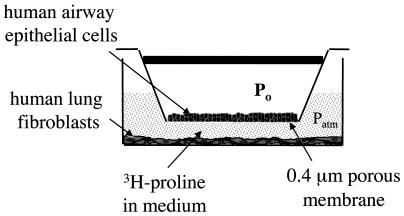
Figure 1
Figure 1
Schematic diagram of one well in the experimental setup. For each experiment, several of these wells are connected in parallel to a pressure reservoir with humid incubator air (5% CO2 and 20% O2).
Figure 2
Figure 2
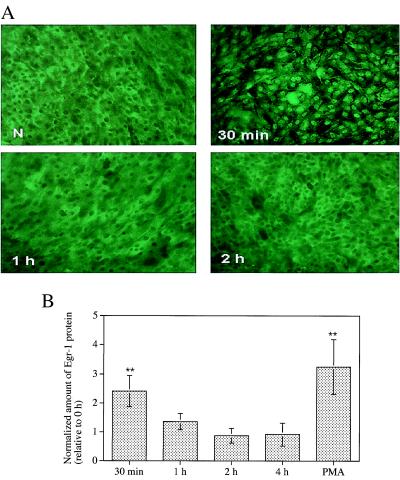
(A) Induction of Egr-1 protein in HBECs by transmembrane pressure of 30 cm H2O. Unstimulated cells (N) are compared to cells fixed after 0.5, 1, and 2 h of mechanical stimulation. (B) The relative amounts of Egr-1 protein detected in HBEC lysates by Western blot after the application of 30 cm H2O transmembrane pressure for 30 min, 1 h, 2 h, or 4 h, or after 30 min stimulation with PMA (mean ± SD, n = 5). Densitometry was used to quantify protein levels relative to the unstimulated cells (**, P < 0.005 in comparison to no pressure using ANOVA).
Figure 3
Figure 3
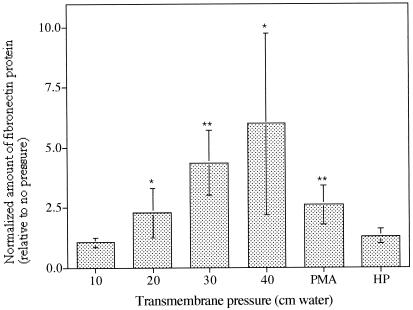
The effect of transepithelial pressure on the expression of FN proteins from lysed epithelial cells by using Western blot analysis. The densitometry results shown were calculated for pressure magnitudes of 10, 20, 30, and 40 cm H2O, PMA stimulation, and a uniform hydrostatic pressure (HP) of 30 cm H2O (applied to both sides of the membrane) for 4 h, relative to protein levels in unstimulated cells. For all data shown, significance was tested for each sample relative to the unstimulated cells (*, P < 0.05 and **, P < 0.005, ANOVA); furthermore, the dose dependence was significant from 0 to 40 cm H2O (P = 0.01).
Figure 4
Figure 4
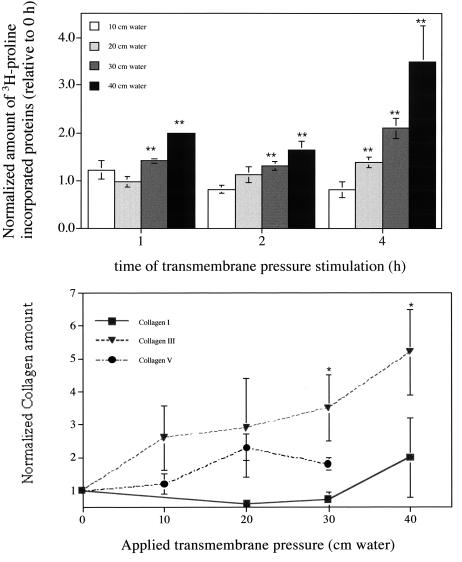
(A) Effect of normal stress on the neosynthesis of fibrous proteins: magnitude (normalized to the unstimulated cocultures) vs. time (h) for transmembrane pressures of 10, 20, 30, or 40 cm H2O. Both a time dependence was seen for 20, 30, and 40 cm H2O (P < 105, ANOVA) as well as a pressure magnitude dependence for 1-, 2-, and 4-h stimulation (P < 106). (B) The effect of transepithelial pressure (4-h stimulation) on the presence of collagen types I (■), III (▴), and V (●) protein in pooled, concentrated media samples by using Western blot analysis.
Figure 5
Figure 5
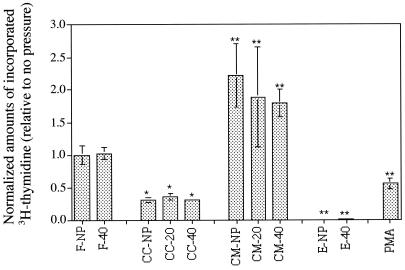
Fibroblast proliferation under various experimental conditions as measured by incorporation of [3H]thymidine. The levels are normalized to fibroblast-only samples. Significance was calculated relative to fibroblast-only samples (with no pressure) and was calculated by using ANOVA. CC, coculture; CM, conditioned media; F, fibroblast only samples; E, epithelial-only samples; PMA, PMA-stimulated (coculture); NP, no pressure; and 20 or 40, applied transmembrane pressure of 20 or 40 cm H2O.
Figure 6
Figure 6
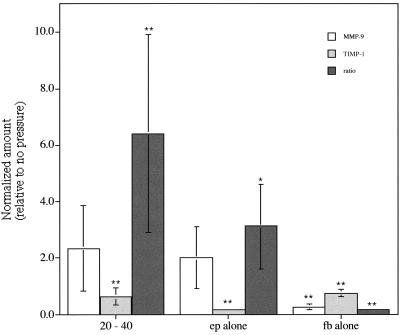
Average protein levels of MMP-9, TIMP-1, and their ratio MMP-9/TIMP-1 in concentrated medium samples after 4-h stimulation as detected by Western blot (*, P < 0.05 and **, P < 0.005, ANOVA). Average values represent normalized amounts of protein relative to unstressed coculture conditions. Average values were taken from all samples stimulated with 20, 30, or 40 cm H2O because no statistically significant differences were detected among these levels.

References

    1. Chetta A, Foresi A, del Donno M, Bertorelli G, Pesci A, Olivieri D. Chest. 1997;111:852–857. - PubMed
    1. Laitinen A, Laitinen L A. Am J Respir Crit Care Med. 1994;150:S14–S17. - PubMed
    1. Kuwano K, Bosken C H, Pare P D, Bai T R, Wiggs B R, Hogg J C. Am Rev Respir Dis. 1993;148:1220–1225. - PubMed
    1. Jeffery P K. Respiration. 1992;59, Suppl. 1:13–16. - PubMed
    1. Brewster C E, Howarth P H, Djukanovic R, Wilson J, Holgate S T, Roche W R. Am J Respir Cell Mol Biol. 1990;3:507–511. - PubMed

Publication types

MeSH terms