


DEG/ENaC ion channels involved in sensory transduction are modulated by cold temperature
- PMID: 11353858
- PMCID: PMC33490
- DOI: 10.1073/pnas.111155398
DEG/ENaC ion channels involved in sensory transduction are modulated by cold temperature
Abstract
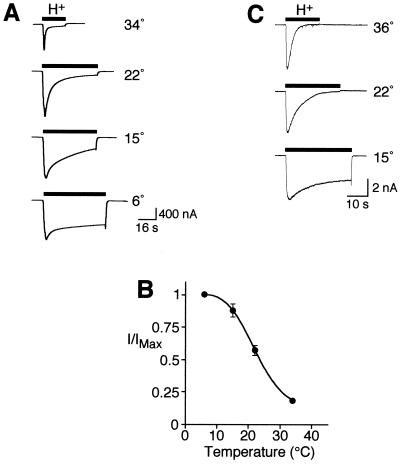
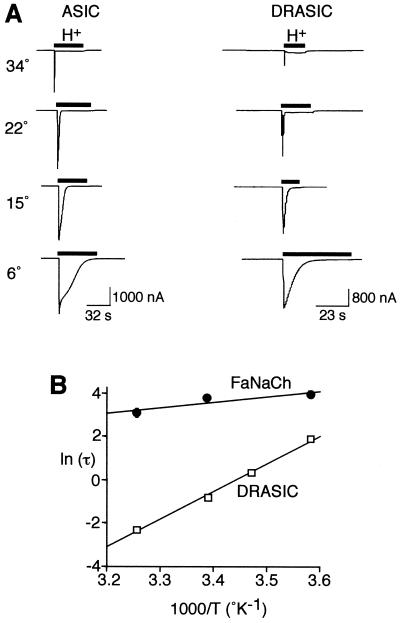
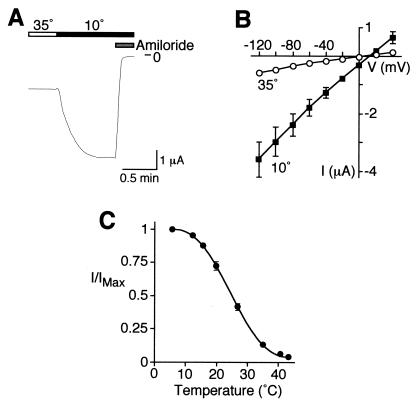
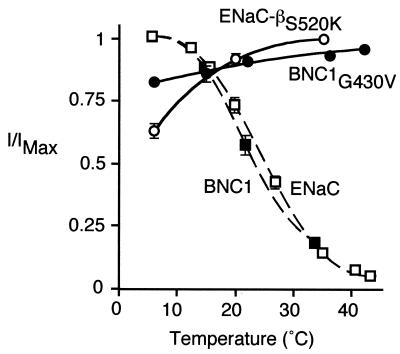
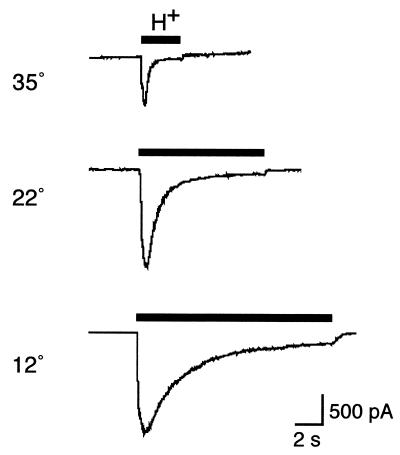
Several DEG/ENaC cation channel subunits are expressed in the tongue and in cutaneous sensory neurons, where they are postulated to function as receptors for salt and sour taste and for touch. Because these tissues are exposed to large temperature variations, we examined how temperature affects DEG/ENaC channel function. We found that cold temperature markedly increased the constitutively active Na(+) currents generated by epithelial Na(+) channels (ENaC). Half-maximal stimulation occurred at 25 degrees C. Cold temperature did not induce current from other DEG/ENaC family members (BNC1, ASIC, and DRASIC). However, when these channels were activated by acid, cold temperature potentiated the currents by slowing the rate of desensitization. Potentiation was abolished by a "Deg" mutation that alters channel gating. Temperature changes in the physiologic range had prominent effects on current in cells heterologously expressing acid-gated DEG/ENaC channels, as well as in dorsal root ganglion sensory neurons. The finding that cold temperature modulates DEG/ENaC channel function may provide a molecular explanation for the widely recognized ability of temperature to modify taste sensation and mechanosensation.
Figures
References
-
- Mano I, Driscoll M. BioEssays. 1999;21:568–578. - PubMed
-
- Waldmann R, Lazdunski M. Curr Opin Neurobiol. 1998;8:418–424. - PubMed
-
- Tavernarakis N, Driscoll M. Annu Rev Physiol. 1997;59:659–689. - PubMed
-
- Price M P, Snyder P M, Welsh M J. J Biol Chem. 1996;271:7879–7882. - PubMed
-
- Waldmann R, Champigny G, Voilley N, Lauritzen I, Lazdunski M. J Biol Chem. 1996;271:10433–6. - PubMed
Publication types
MeSH terms
Substances
Grants and funding
LinkOut - more resources
Full Text Sources
