


Negative frequency-dependent selection maintains a dramatic flower color polymorphism in the rewardless orchid Dactylorhiza sambucina (L.) Soo
- PMID: 11353863
- PMCID: PMC33454
- DOI: 10.1073/pnas.111162598
Negative frequency-dependent selection maintains a dramatic flower color polymorphism in the rewardless orchid Dactylorhiza sambucina (L.) Soo
Erratum in
- Proc Natl Acad Sci U S A. 2004 May 18;101(20):7839
Abstract
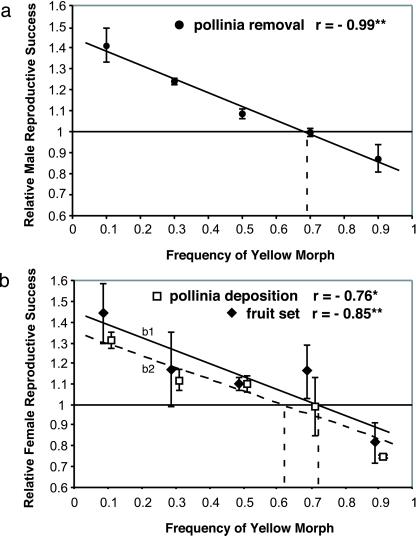
The orchid Dactylorhiza sambucina shows a stable and dramatic flower-color polymorphism, with both yellow- and purple-flowered individuals present in natural populations throughout the range of the species in Europe. The evolutionary significance of flower-color polymorphisms found in many rewardless orchid species has been discussed at length, but the mechanisms responsible for their maintenance remain unclear. Laboratory experiments have suggested that behavioral responses by pollinators to lack of reward availability might result in a reproductive advantage for rare-color morphs. Consequently, we performed an experiment varying the relative frequency of the two color morphs of D. sambucina to test whether rare morph advantage acted in the natural habitat of the species. We show here clear evidence from this manipulative experiment that rare-color morphs have reproductive advantage through male and female components. This is the first demonstration, to our knowledge, that negative frequency-dependent selection through pollinator preference for rare morphs can cause the maintenance of a flower-color polymorphism.
Figures

References
-
- Darwin C. The Effects of Cross and Self Fertilisation in the Vegetable Kingdom. London: Murray; 1876.
-
- Waser N M. In: Pollination Biology. Real L-A, editor. New York: Academic; 1983. pp. 242–285.
-
- Chittka L, Menzel R. J Comp Physiol A. 1992;171:171–181. - PubMed
-
- Kay Q O N. The Pollination of Flowers by Insects. 1978. , Linnean Society Symposium Series No. 6, ed. Richards, A.-J. (Academic, London), pp. 175–190.
-
- Waser N M, Price M-V. Evolution (Lawrence, Kans) 1981;35:376–390. - PubMed
Publication types
MeSH terms
LinkOut - more resources
Full Text Sources
