Nongenic, bidirectional transcription precedes and may promote developmental DNA deletion in Tetrahymena thermophila
- PMID: 11358871
- PMCID: PMC313804
- DOI: 10.1101/gad.884601
Nongenic, bidirectional transcription precedes and may promote developmental DNA deletion in Tetrahymena thermophila
Abstract
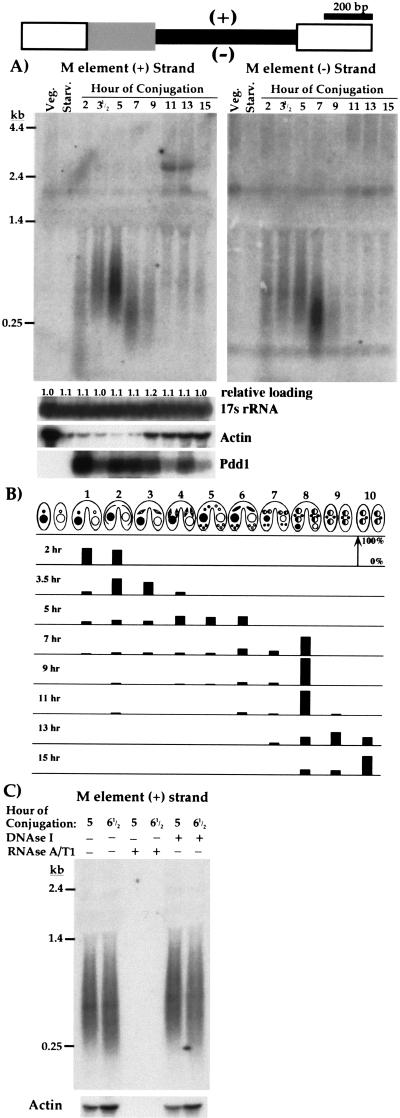
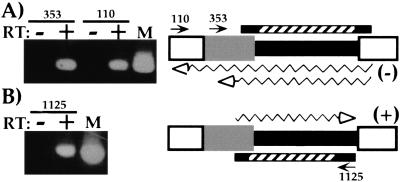
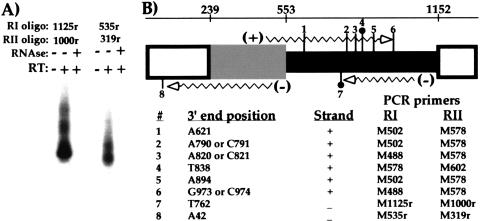
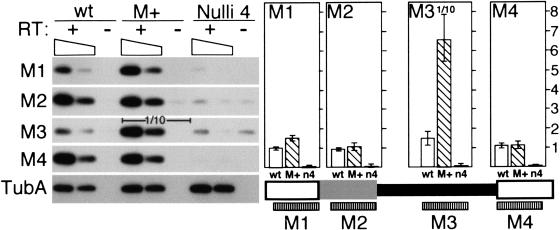
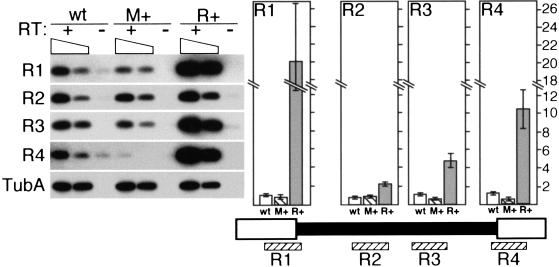
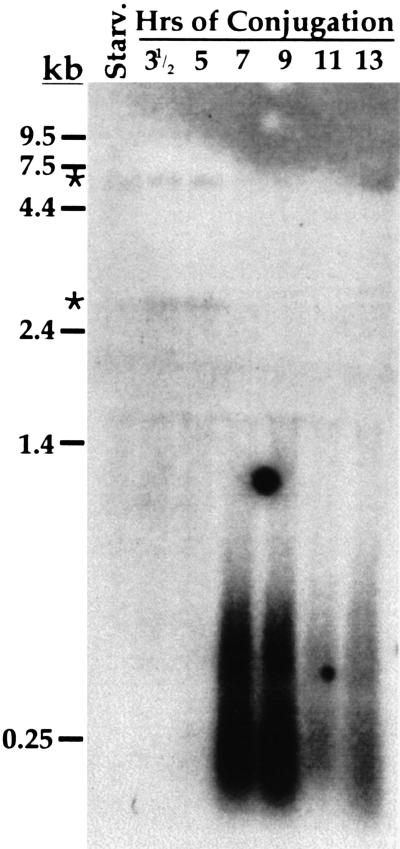
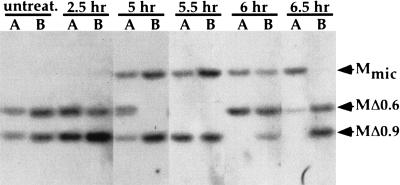
A large number of DNA segments are excised from the chromosomes of the somatic nucleus during development of Tetrahymena thermophila. How these germline-limited sequences are recognized and excised is still poorly understood. We have found that many of these noncoding DNAs are transcribed during nuclear development. Transcription of the germline-limited M element occurs from both DNA strands and results in heterogeneous transcripts of < 200 b to > 1 kb. Transcripts are most abundant when developing micro- and macronuclei begin their differentiation. Transcription is normally restricted to unrearranged DNA of micronuclei and/or developing nuclei, but germline-limited DNAs can induce their own transcription when placed into somatic macronuclei. Brief actinomycin D treatment of conjugating cells blocked M-element excision, providing evidence that transcription is important for efficient DNA rearrangement. We propose that transcription targets these germline-limited sequences for elimination by altering chromatin to ensure their accessibility to the excision machinery.
Figures
References
-
- Akhtar A, Zink D, Becker PB. Chromodomains are protein-RNA interaction modules. Nature. 2000;407:405–409. - PubMed
-
- Amrein H, Axel R. Genes expressed in neurons of adult male Drosophila. Cell. 1997;88:459–469. - PubMed
-
- Asai DJ, Forney JD. Tetrahymena thermophila. In: Wilson L, Matsudaira P, editors. Methods in cell biology. San Diego, CA: Academic Press; 1999.
Publication types
MeSH terms
Substances
Grants and funding
LinkOut - more resources
Full Text Sources
Other Literature Sources