. 2001 Jun;183(12):3623-30.
doi: 10.1128/JB.183.12.3623-3630.2001.

Analysis of promoter recognition in vivo directed by sigma(F) of Bacillus subtilis by using random-sequence oligonucleotides

Affiliations

Analysis of promoter recognition in vivo directed by sigma(F) of Bacillus subtilis by using random-sequence oligonucleotides

E Amaya et al. J Bacteriol. 2001 Jun.

Abstract

Formation of spores from vegetative bacteria by Bacillus subtilis is a primitive system of cell differentiation. Critical to spore formation is the action of a series of sporulation-specific RNA polymerase sigma factors. Of these, sigma(F) is the first to become active. Few genes have been identified that are transcribed by RNA polymerase containing sigma(F) (E-sigma(F)), and only two genes of known function are exclusively under the control of E-sigma(F), spoIIR and spoIIQ. In order to investigate the features of promoters that are recognized by E-sigma(F), we studied the effects of randomizing sequences for the -10 and -35 regions of the promoter for spoIIQ. The randomized promoter regions were cloned in front of a promoterless copy of lacZ in a vector designed for insertion by double crossover of single copies of the promoter-lacZ fusions into the amyE region of the B. subtilis chromosome. This system made it possible to test for transcription of lacZ by E-sigma(F) in vivo. The results indicate a weak sigma(F)-specific -10 consensus, GG/tNNANNNT, of which the ANNNT portion is common to all sporulation-associated sigma factors, as well as to sigma(A). There was a rather stronger -35 consensus, GTATA/T, of which GNATA is also recognized by other sporulation-associated sigma factors. The looseness of the sigma(F) promoter requirement contrasts with the strict requirement for sigma(A)-directed promoters of B. subtilis. It suggests that additional, unknown, parameters may help determine the specificity of promoter recognition by E-sigma(F) in vivo.


Figures
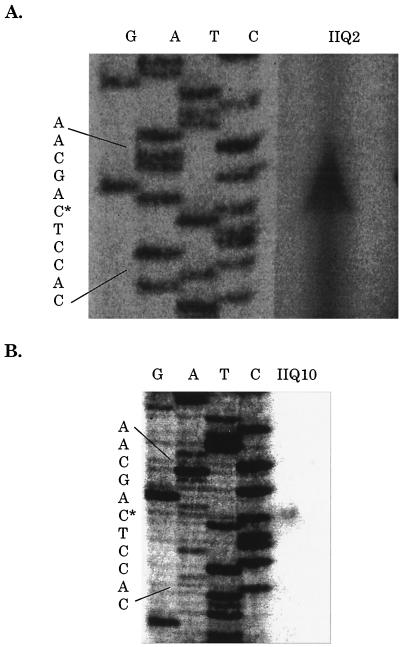
FIG. 1
FIG. 1
Determination of the 5′ end of spoIIQ mRNA by primer extension analysis. RNA was extracted from strain SL5618 (spoIIIGΔ1) 4 h after the end of exponential growth. Primer extension analysis was done with primer IIQ2 (TCAGCCAACGGATCCTTTACC, positions +161 to +181 from the inferred transcription start point) (A) and primer IIQ10 (CTGATTGATACCAAAGGAC, positions +128 to +147 from the inferred transcription start point) (B). Sequencing ladders using the same primers are also shown. The likely transcription start site is indicated by an asterisk.
FIG. 2
FIG. 2
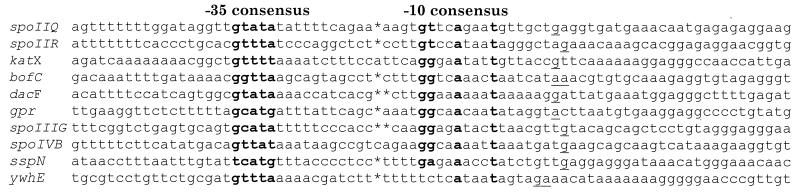
Sequence alignment of promoter regions for E-ςF-transcribed genes for which the transcription start site has been inferred by primer extension analysis. Of these, only spoIIQ, spoIIR, and katX are not also recognized by E-ςF (–, , , , , , –39). Asterisks indicate spaces introduced to adjust the spacing between the −10 and −35 consensuses. The underlined bases indicate the inferred transcription start points.
FIG. 3
FIG. 3
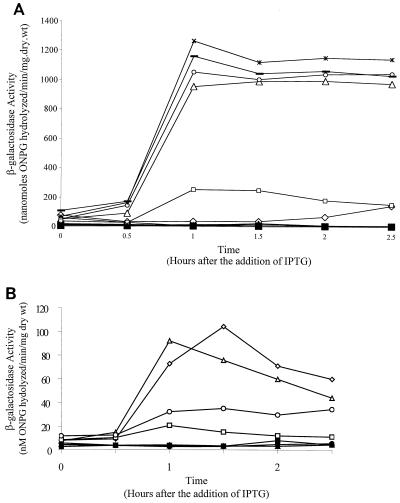
Effect of induction of ςF on expression of lacZ associated with different spoIIQ promoter regions. Synthesis of ςF was induced by addition of IPTG to strains containing the structural gene for ςF, spoIIAC, under the control of the Pspac promoter (41). Shown are strains with alterations to the −10 region (A) and the −35 region (B) of the promoter directing lacZ. Cultures were grown in MSSM to an optical density at 600 nm of 0.3. They were then divided in two, and 1 mM IPTG was added to one of each pair. None of the cultures displayed significant β-galactosidase activity in the absence of IPTG. (A) SL7472/EIA100 (PspoIIQ [−200 to −38]) symbols: ⧫, no IPTG; ◊, 1 mM IPTG. SL7472/R10-103 symbols: ▴, no IPTG; ▵, 1mM IPTG. SL7472/R10-333 symbols: ●, no IPTG; ○, 1 mM IPTG. SL7472/R10-435 symbols: ■, no IPTG; □, 1 mM IPTG. SL7472/R10-901 symbols: ×, no IPTG; ∗, 1 mM IPTG. SL7472/R10-1024 symbols: +, no IPTG; −, 1 mM IPTG. Samples grown in the absence of IPTG produced little or no β-galactosidase, and symbols for the different cultures largely mask each other. (B) SL7472/R35-10 symbols: ⧫, no IPTG; ◊, 1 mM IPTG. SL7472/R35-20 symbols: ▴, no IPTG; ▵, 1 mM IPTG. SL7472/R35-43 symbols: ■, no IPTG; □, 1 mM IPTG. SL7472/R35-53 symbols: ●, no IPTG; ○, 1 mM IPTG. wt, weight.

References

    1. Bagyan I, Casillas-Martinez L, Setlow P. The katX gene, which codes for the catalase in spores of Bacillus subtilis, is a forespore-specific gene controlled by ςF, and KatX is essential for hydrogen peroxide resistance of the germinating spore. J Bacteriol. 1998;180:2057–2062. - PMC - PubMed
    1. Bagyan I, Noback M, Bron S, Paidhungat M, Setlow P. Characterization of yhcN, a new forespore-specific gene of Bacillus subtilis. Gene. 1998;212:179–188. - PubMed
    1. Cabrera-Hernandez A, Sanchez-Salas J-L, Paidhungat M, Setlow P. Regulation of four genes encoding small, acid-soluble spore proteins in Bacillus subtilis. Gene. 1999;232:1–10. - PubMed
    1. Coppolecchia R, DeGrazia H, Moran C P., Jr Deletion of spoIIAB blocks endospore formation in Bacillus subtilis at an early stage. J Bacteriol. 1991;173:6678–6685. - PMC - PubMed
    1. Decatur A, Losick R. Identification of additional genes under the control of the transcription factor ςF of Bacillus subtilis. J Bacteriol. 1996;178:5039–5041. - PMC - PubMed

Publication types

MeSH terms

LinkOut - more resources