. 2001 Jun;67(6):2610-6.
doi: 10.1128/AEM.67.6.2610-2616.2001.

Cloning of a phenol oxidase gene from Acremonium murorum and its expression in Aspergillus awamori

Affiliations

Cloning of a phenol oxidase gene from Acremonium murorum and its expression in Aspergillus awamori

R J Gouka et al. Appl Environ Microbiol. 2001 Jun.

Abstract

Fungal multicopper oxidases have many potential industrial applications, since they perform reactions under mild conditions. We isolated a phenol oxidase from the fungus Acremonium murorum var. murorum that was capable of decolorizing plant chromophores (such as anthocyanins). This enzyme is of interest in laundry-cleaning products because of its broad specificity for chromophores. We expressed an A. murorum cDNA library in Saccharomyces cerevisiae and subsequently identified enzyme-producing yeast colonies based on their ability to decolor a plant chromophore. The cDNA sequence contained an open reading frame of 1,806 bp encoding an enzyme of 602 amino acids. The phenol oxidase was overproduced by Aspergillus awamori as a fusion protein with glucoamylase, cleaved in vivo, and purified from the culture broth by hydrophobic-interaction chromatography. The phenol oxidase is active at alkaline pH (the optimum for syringaldazine is pH 9) and high temperature (optimum, 60 degrees C) and is fully stable for at least 1 h at 60 degrees C under alkaline conditions. These characteristics and the high production level of 0.6 g of phenol oxidase per liter in shake flasks, which is equimolar with the glucoamylase protein levels, make this enzyme suitable for use in processes that occur under alkaline conditions, such as laundry cleaning.


Figures
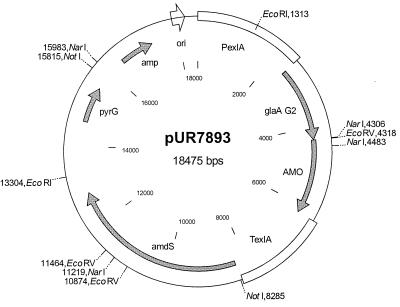
FIG. 1
FIG. 1
Plasmid pUR7893. Open bars, A. awamori 5′ and 3′ regulatory sequences; filled arrows, coding sequences. Abbreviations and designations: glaA, glucoamylase gene; amdS, acetamidase gene; pyrG, orotidine 5′-monophosphate decarboxylase gene; amp, β-lactamase gene, exlA, β-1,4-endoxylanase gene; ori, origin of replication. Only relevant restriction sites are indicated.
FIG. 2
FIG. 2
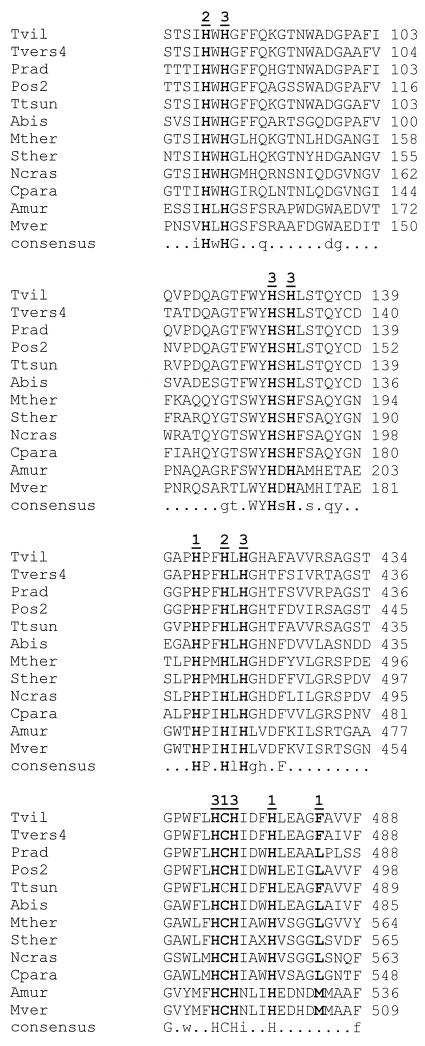
Amino acid sequence alignment of AMO with other blue copper enzymes. Only those areas that contain the types I, II, and III copper ligands (marked in bold as 1, 2, and 3) are shown. Amino acid sequence data were obtained as described in Table 1. For abbreviations on left, see Table 1, footnote b. T. tsunodae bilirubin oxidase has GenBank accession number AB006824. A consensus sequence is given below each 13-row set. An amino acid identity of 100% among all enzymes is shown in uppercase, and an identity between 80% and 100% is in lowercase.
FIG. 3
FIG. 3
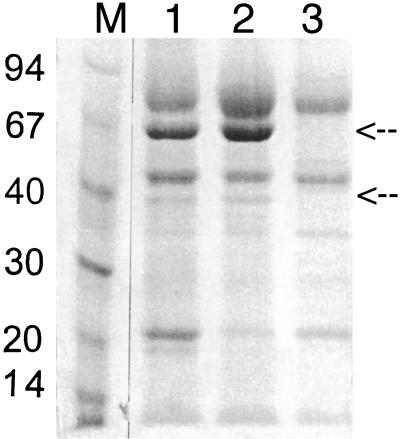
SDS–8 to 18% gradient PAGE from supernatants of AWC-7893 transformants cultivated in shake flasks. The samples were boiled without reducing agent. The gel was stained with Coomassie brilliant blue. The arrows indicate the position of the phenol oxidase. Lane 1, AWC-7893-5p; lane 2, AWC-7893-10A; lane 3, AWGLA, which contains a single copy of the A. niger glucoamylase gene (7). M, molecular size marker (kDa).
FIG. 4
FIG. 4
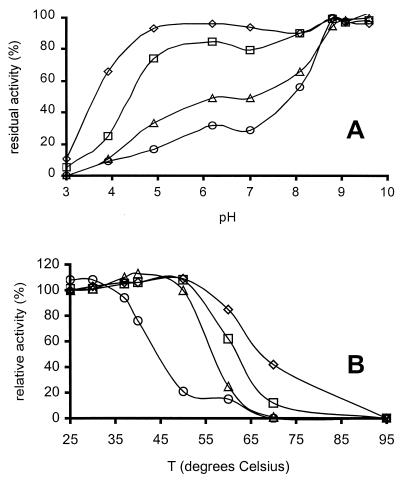
Dependence of AMO activity on pH and temperature. (A) AMO activity as a function of pH (normalized to the optimum activity) with ABTS (2 mM) as substrate (□) and SGZ (100 μM) as substrate (⋄). Assays were performed in B&R buffer at the indicated pH at 30°C. (B) AMO activity as a function of temperature (normalized to the activity at 20°C) with ABTS (2 mM) as substrate in B&R buffer, pH 4.5. Both experiments were carried out in duplicate; standard errors were <10%.
FIG. 5
FIG. 5
The effect of pH and temperature on AMO stability. (A) AMO stability as a function of pH. AMO was incubated at different pHs (–10) in B&R buffer at 4°C, and the residual activity (normalized to t = 0 h) was analyzed after 3 (⋄), 20 (□), 168 (▵), and 280 (○) h in B&R buffer (pH 6) with 2 mM ABTS. (B) AMO stability as a function of temperature and time. AMO was incubated at different temperatures in B&R buffer (pH 8.5), and the residual activity (normalized to t = 0 h) was analyzed after 0.3 (⋄), 1 (□), 3 (▵), and 21 (○) h in B&R buffer (pH 6) with 2 mM ABTS. Both experiments were carried out in duplicate; standard errors were <10%.

References

    1. Bennett J W, Lasure L L. Growth media. In: Bennett J W, Lasure L L, editors. More gene manipulations in fungi. San Diego, Calif: Academic Press, Inc.; 1991. pp. 441–458.
    1. Bourbonnais R, Paice M G, Reid I D, Lanthier P, Yaguchi M. Lignin oxidation by laccase isozymes from Trametes versicolor and the role of the mediator 2,2′-azinobis(3-ethylbenzthiazoline-6-sulfonate) in kraft lignin depolymerization. Appl Environ Microbiol. 1995;61:1876–1880. - PMC - PubMed
    1. Britton H T S, Robinson R. Universal buffer solutions and the dissociation constant of veronal. J Chem Soc. 1931;458:1456.
    1. Cullen D. Recent advances on the molecular genetics of lignolytic fungi. J Biotechnol. 1997;53:273–289. - PubMed
    1. Gietz R D, Woods R A. Transformation of yeast by the lithium acetate/single stranded carrier DNA/PEG method. Methods Microbiol. 1998;26:53–66.

Substances

Associated data

LinkOut - more resources