


Comment
doi: 10.1172/JCI13073.
Osteolysis and cancer
Affiliations
- PMID: 11375409
- PMCID: PMC209307
- DOI: 10.1172/JCI13073
Item in Clipboard
Comment
Osteolysis and cancer
J Clin Invest.
2001 May.
No abstract available
Figures
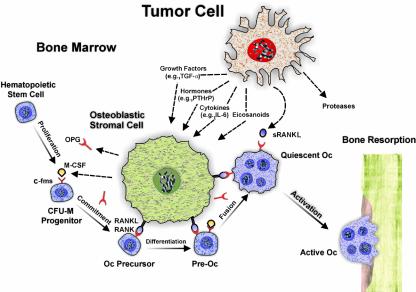
Schematic representation of tumor-cell induced osteolysis. A tumor cell may release soluble mediators such as hormones (e.g., PTHrP), eicosanoids, cytokines (e.g., IL-6), or growth factors (e.g., TGF-α) that act on an osteoblastic stromal cell. The stromal cell produces RANKL, which binds to its cognate receptor, RANK, expressed on osteoclast (Oc) precursors. In the presence of M-CSF, which acts on its receptor, c-fms, RANKL can enhance the formation of active osteoclasts that carry out bone resorption. Tumor cells have also been occasionally reported to directly release sRANKL, a soluble form of RANKL. Additionally, proteases can be produced by tumor cells and facilitate their invasion of nonmineralized tissue.
Comment on
-
Osteoprotegerin inhibits prostate cancer-induced osteoclastogenesis and prevents prostate tumor growth in the bone.J Clin Invest. 2001 May;107(10):1235-44. doi: 10.1172/JCI11685. J Clin Invest. 2001. PMID: 11375413 Free PMC article.
References
-
- Goltzman D. Mechanisms of the development of osteoblastic metastases. Cancer. 1997;80:1581–1587. - PubMed
-
- Goltzman D, Karaplis AC, Kremer R, Rabbani SA. Molecular basis of the spectrum of skeletal complications of neoplasia. Cancer. 2000;88:2903–2908. - PubMed
-
- Eilon G, Mundy GR. Direct resorption of bone by human breast cancer cells in vitro. Nature. 1978;276:726–728. - PubMed
-
- Suda T, Kobayashi K, Jimi E, Udagawa N, Takahashi N. The molecular basis of osteoclast differentiation and activation. Novartis Found Symp. 2001;232:235–247; discussion 247–250. - PubMed
-
- Kong YY, Boyle WJ, Penninger JM. Osteoprotegerin ligand: a regulator of immune responses and bone physiology. Immunol Today. 2000;21:495–502. - PubMed
