Comparative Study
. 2001 Jun 1;29(11):2303-13.
doi: 10.1093/nar/29.11.2303.

Parallel multiplex thermodynamic analysis of coaxial base stacking in DNA duplexes by oligodeoxyribonucleotide microchips

Affiliations
Comparative Study

Parallel multiplex thermodynamic analysis of coaxial base stacking in DNA duplexes by oligodeoxyribonucleotide microchips

V A Vasiliskov et al. Nucleic Acids Res. .

Abstract

Parallel thermodynamic analysis of the coaxial stacking effect of two bases localized in one strand of DNA duplexes has been performed. Oligonucleotides were immobilized in an array of three-dimensional polyacrylamide gel pads of microchips (MAGIChips'). The stacking effect was studied for all combinations of two bases and assessed by measuring the increase in melting temperature and in the free energy of duplexes formed by 5mers stacked to microchip-immobilized 10mers. For any given interface, the effect was studied for perfectly paired bases, as well as terminal mismatches, single base overlaps, single and double gaps, and modified terminal bases. Thermodynamic parameters of contiguous stacking determined by using microchips closely correlated with data obtained in solution. The extension of immobilized oligonucleotides with 5,6-dihydroxyuridine, a urea derivative of deoxyribose, or by phosphate, decreased the stacking effect moderately, while extension with FITC or Texas Red virtually eliminated stacking. The extension of the immobilized oligonucleotides with either acridine or 5-nitroindole increased stacking to mispaired bases and in some GC-rich interfaces. The measurements of stacking parameters were performed in different melting buffers. Although melting temperatures of AT- and GC-rich oligonucleotides in 5 M tetramethylammonium chloride were equalized, the energy of stacking interaction was significantly diminished.


Figures
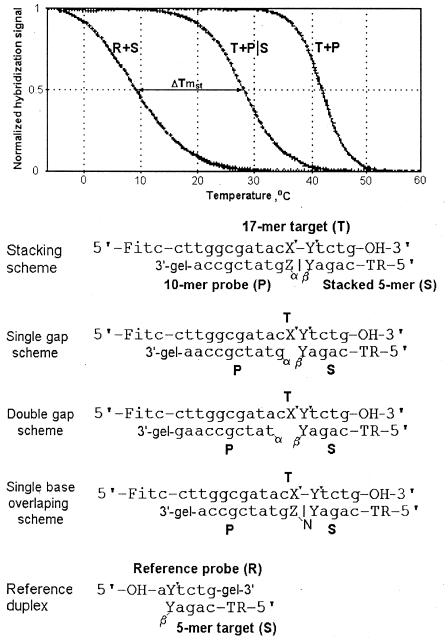
Figure 1
Figure 1
Typical melting curves and CSH hybridization schemes. For every pair X and Y, 1 µmol of 17mer target oligonucleotide T and 5 µmol of perfectly matched pentamer S were hybridized simultaneously in large excess to oligonucleotides P and reference pentamers R immobilized in gel pads of the microchip. Bases X, Y, Z, N = A, T, G, C, where base X′ is complementary to X, and Y′ is complementary to Y. Equilibrium melting curves of first transitions were registered using computer guided fluorescent microscope and excitation and emission filters for TR (curves R + S and T + P|S). Then melting curves of second transitions were registered on the same microchip in an independent experiment using microscope filters for FITC band (curve T + P). Melting curves represent coaxial stacking combination of perfectly matched interface bases (X, Y, Z = A; α, β = OH). Hybridization bufferi (see Materials and Methods).
Figure 2
Figure 2
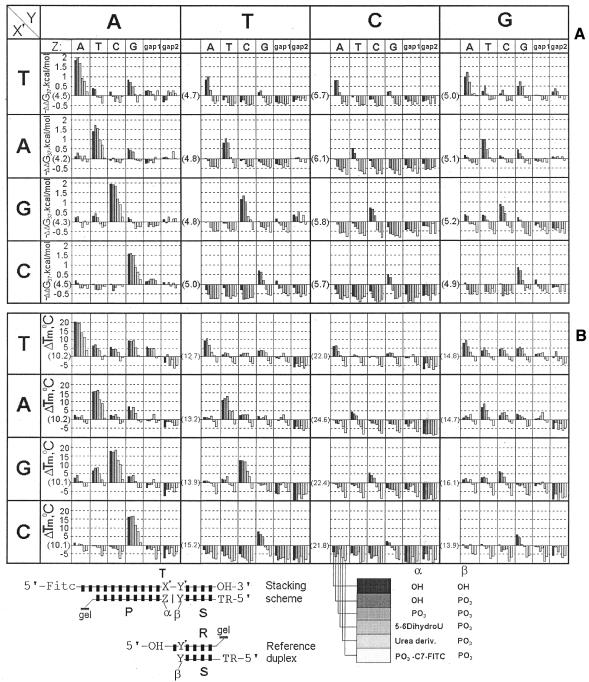
Parameters of the stacking effect in the presence of different 5′- and 3′-modifications. (A) Free energies ΔΔG37; (B) melting temperatures Tm. For a given pair X, Y, 1 µmol of 17mer target T (5′-FITC-C7-cttggcgatacX′Y′tctg-OH-3′) and 5 µmol of perfectly matched pentamer S (3′-βYagac-C7-TR-5′) were hybridized simultaneously in large excess with the microchip. Data are shown for five rows of six immobilized oligonucleotides P only, ranged by α. P1–P4 have the following structure: gel-accgctatgZα-5′; P5, gel-aaccgctatgα-5′; P6, gel-gaaccgctatα-5′; and four reference pentamers R1–R4, 5′-OH-aY′tctg-gel. Bases X, Y, Z = [A, T, G, C], where base X′ is complementary to X and Y′ to Y. The residue α = (i) OH, (ii) PO3, (iii) 5,6-dihydroU, (iv) urea derivative from deoxyribose, or (v) PO3-C7-FITC. Equilibrium melting curves of the first transition were registered by a computer guided fluorescent microscope with TR settings. The melting experiment was repeated 16 times using all possible combinations of bases 5′….X′Y′/Z|Y….5′ adjacent to the stacking zone. These series were done for α = OH (data shown only for α = OH) and for β = PO3 (for all α). Hybridization buffer i (see Materials and Methods). All melting curves were approximated by ideal S-shaped transition curves using regression analysis, and relative ΔΔG37 and ΔTm values obtained from each experiment were calculated as shown below and plotted as bar graphs: (i) ΔΔG37 (X, Y, Z, α, β) = ΔG37 stacking (X, Y, Z, α, β) – ΔG37reference duplex (Y, β), and (ii) ΔTm (X, Y, Z, α, β) = Tm stacking (X, Y, Z, α, β) – Tm reference duplex (Y, β). Absolute values of ΔG37 and Tm of the reference duplex (Y, β = PO3) are indicated near each zero line in parentheses. Mean square errors were 0.2 kcal/mol and 1°C, correspondingly.
Figure 3
Figure 3
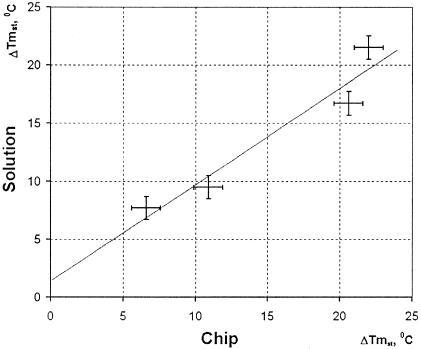
Correlation between measurements of the stacking effect (ΔTm) on microchips and in solution. Abscissa corresponds to the results obtained on microchips, ordinate in solution. For the experiments on microchips, 1 µmol of target 17mer T 5′-FITC-C7-cttggcgatacX′Y′tctg-OH-3′ and 5 µmol of perfectly matched pentamer S 3′-OH-Yagac-C7-TR-5′ were hybridized simultaneously in large excess with microchip. For the graph shown here, only data from pads containing oligonucleotides gel-accgctatgZ-OH-5′ were used. Stacking interface bases were perfectly paired (Z = X) for base combinations [X, Y] = [T, A], [C, A], [C, G], [G, C]. Base X′ is complementary to X, and Y′ to Y. Equilibrium melting curves of the first transition were registered by a computer guided fluorescent microscope with TR settings. For the experiments in solution, 10 µmol of hairpin oligonucleotide 5′-OH-Xgtatcgccaag-tttt-cttggcgatacX′Y′tctg-OH-3′ and 10 µmol of perfectly matched pentamer 3′-OH-Yagac-C7-TR-5′ were mixed and hybridized in a cuvette for [X, Y] = [T, A], [C, A], [C, G], [G, C]. Ten micromoles of two pentamers, which were used on the microchip, 3′-OH-Yagac-C7-TR-5′ and 5′-OH-Y′tctg-C7-NH-3′, were hybridized in a cuvette to serve as reference duplexes. Equilibrium melting curves of transitions were registered by UV spectrophotometer. All melting curves were obtained in hybridization buffer 1 and approximated by ideal S-shaped transition curves, using regression analysis, and relative ΔTm values obtained from each experiment were calculated and plotted as shown below: ΔTm stacking [X, Y] = Tm stacking [X, Y] – Tm reference duplex [Y]. Mean square error was 1°C.
Figure 4
Figure 4
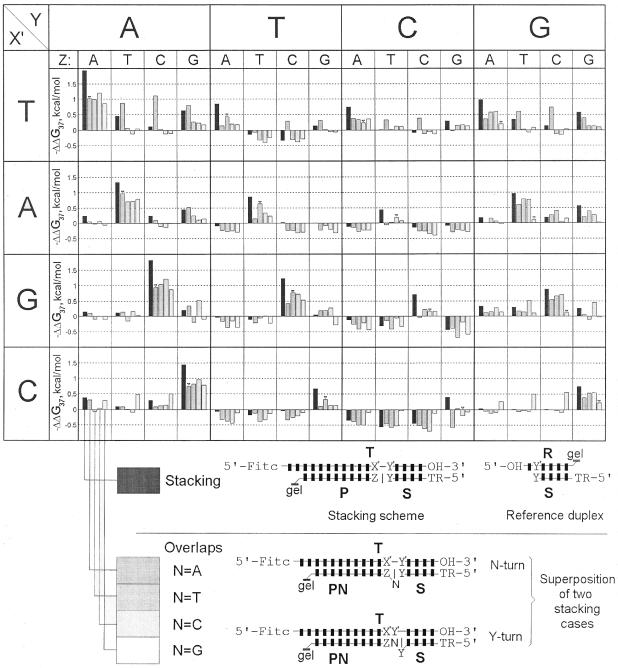
Stacking effect at interfaces with single base overlaps. For a given pair X, Y, 1 µmol of 17mer target T 5′-FITC-C7-cttggcgatacX′Y′tctg-OH-3′ and 5 µmol of perfectly matched pentamer S 3′-OH-Yagac-C7-TR-5′ were hybridized simultaneously in large excess with microchip. For a given Z, the first dark bar among all five bars in each sub-cell represents the data for coaxial stacking to perfect and mismatched bases of the four immobilized oligonucleotides P1–P4 gel-accgctatgZ-OH-5′ without overlaps. For all combinations of X and Y, the strongest stacking effect is observed between two perfectly paired bases. The remaining four light bars correspond to stacking of pentamers S to 16 different oligonucleotides PN1–PN16 (gel-accgctatgZN-OH-5′) containing one additional terminal base N overlapping with base Y of pentamer S to test whether it can reduce stacking. For given X and Y, the competition between two perfectly paired overlapping bases Y = N is shown by a small triangle over the bar. To assess the relative stacking effect, four reference pentamers R1–R4 (5′-OH-aY′tctg-gel) were immobilized on the same microchip. Bases X, Y, Z are A, T, G, or C; X′ is complementary to X, and Y′ to Y. Equilibrium melting curves of the first transition were registered using TR settings as described in the Materials and Methods. Melting experiments were repeated 16 times in hybridization buffer 1 with all possible combinations of bases 5′….X′Y′/ZN|Y….5′ adjacent to the stacking zone. Melting curves were approximated by ideal S-shaped transition curves using regression analysis, and relative ΔΔG37 values obtained for each experiment were calculated as shown below and plotted as bar graphs: ΔΔG37(X, Y, Z, N) = ΔG37 stacking (X, Y, Z, N) – ΔG37reference duplex(Y). Mean square error was 0.2 kcal/mol.

References

    1. Saenger W. (1984) Principles of Nucleic Acid Structure. Springer Advanced Texts in Chemistry, Springer-Verlag, NY.
    1. Pieters J.M., Mans,R.M., van den Elst,H., van der Marel,G.A., van Boom,J.H. and Altona,C. (1989) Conformational and thermodynamic consequences of the introduction of a nick in duplexed DNA fragments: an NMR study augmented by biochemical experiments. Nucleic Acids Res., 17, 4551–4565. - PMC - PubMed
    1. Snowden-Ifft E.A. and Wemmer,D.E. (1990) Characterization of the structure and melting of DNAs containing backbone nicks and gaps. Biochemistry, 29, 6017–6025. - PubMed
    1. Walter A.E. and Turner,D.H. (1994) The stability and structure of tandem GA mismatches in RNA depend on closing base pairs. Biochemistry, 33, 12715–12719. - PubMed
    1. Walter A.E., Turner,D.H., Kim,J, Lyttle,M.H., Muller,P., Mathews,D.H. and Zuker,M. (1994) Coaxial stacking of helixes enhances binding of oligoribonucleotides and improves predictions of RNA folding. Proc. Natl Acad. Sci. USA, 91, 9218–9222. - PMC - PubMed

Publication types