. 2001 Jun 1;20(11):2655-65.
doi: 10.1093/emboj/20.11.2655.

C26-CoA-dependent ceramide synthesis of Saccharomyces cerevisiae is operated by Lag1p and Lac1p

Affiliations

C26-CoA-dependent ceramide synthesis of Saccharomyces cerevisiae is operated by Lag1p and Lac1p

I Guillas et al. EMBO J. .

Abstract

Lag1p and Lac1p are two highly homologous membrane proteins of the endoplasmic reticulum (ER). When both genes are deleted, cells cannot transport glycosylphosphatidylinositol (GPI)-anchored proteins from the ER to the Golgi at a normal rate. Here we show that microsomes or detergent extracts from lag1lac1 double mutants lack an activity transferring C26 fatty acids from C26-coenzyme A onto dihydrosphingosine or phytosphingosine. As a consequence, in intact cells, the normal ceramides and inositolphosphorylceramides are drastically reduced. lag1lac1 cells compensate for the lack of normal sphingolipids by making increased amounts of C26 fatty acids, which become incorporated into glycerophospholipids. They also contain 20- to 25-fold more free long chain bases than wild type and accumulate very large amounts of abnormally polar ceramides. They make small amounts of abnormal mild base-resistant inositolphospholipids. The lipid remodelling of GPI-anchored proteins is severely compromised in lag1lac1 double mutants since only few and mostly abnormal ceramides are incorporated into the GPI anchors. The participation of Lag1p and Lac1p in ceramide synthesis may explain their role in determining longevity.


Figures
None
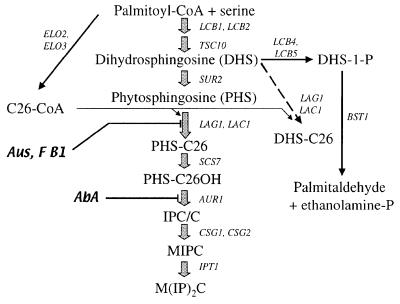
Fig. 1. A simplified scheme of sphingolipid biosynthesis in S.cerevisiae. The dashed arrow indicates the reaction observed in microsomes (see Figures 4 and 5). Aus, australifungin; AbA, aureobasidin A; F B1, fumonisin B1.
None
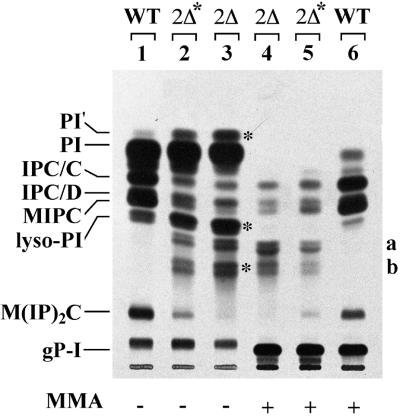
Fig. 2. Deletion of LAG1 and LAC1 strongly reduces the amounts of IPCs. Ten OD of W303-1A (WT), YPK9 lag1Δlac1Δ harbouring pBM150:LAG1 (2Δ*), depleted of Lag1p by pre-culture on glucose for 30 h, and W303-1A lag1Δlac1Δ (2Δ) strains were radiolabelled with [3H]inositol at 30°C. The lipids were extracted, desalted, treated with monomethylamine (MMA) for saponification as indicated, and analysed on TLC using solvent system 2. Glycerolphosphorylinositol (gP-I) visible in lanes 4–6 was generated by saponification. The asterisks mark some abnormal lipids of 2Δ* and 2Δ.
None
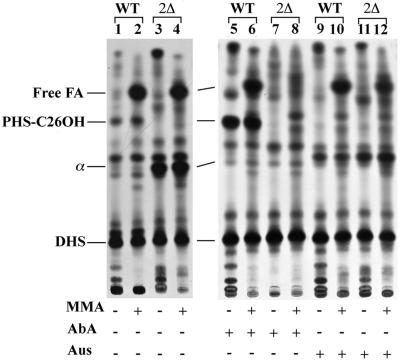
Fig. 3. The lag1Δlac1Δ cells cannot make PHS-C26OH. Two and a half OD of W303-1A (WT) and W303-1A lag1Δlac1Δ (2Δ) strains were pre-incubated with Aus, AbA or solvent for 10 min and were radiolabelled with 25 µCi of [3H]DHS at 30°C for 1 h. Lipid extracts were then O-deacylated with MMA or control incubated and analysed by TLC in solvent system 1.
None
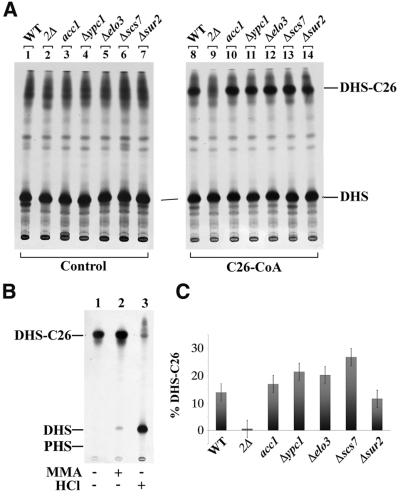
Fig. 4. Microsomes of lag1Δlac1Δ mutants lack DHS-C26 synthase activity. (A) Microsomes of W303-1A (WT), W303-1A lag1Δlac1Δ (2Δ) and the other mutants indicated at the top were radiolabelled with [3H]DHS without (Control) or in the presence of C26-CoA (0.2 mM). The thermosensitive acc1 cells were pre-incubated for 2 h at 37°C before preparing microsomes. The radiolabelled lipids were extracted, treated with MMA and analysed by TLC developed in solvent system 1. (B) The band labelled DHS-C26 in (A) was purified by two successive rounds of preparative TLC. The extract was divided into three aliquots, one of which remained untreated, one was MMA treated and the third was treated with MMA followed by strong acid hydrolysis. The three samples were then analysed by TLC developed in solvent system 1. (C) The amount of radioactivity in the spots of DHS-C26 of (A) lanes 8–14 was quantified by radioscanning and the results were expressed as the percentage of counts in [3H]DHS-C26 as compared with total radioactivity in that lane. Error bars indicate standard deviations in two entirely independent experiments.
None
Fig. 5. Biosynthesis of DHS-C26 is sensitive to Aus and fumonisin B1 (F B1). (A) Microsomes of W303-1A, W303-1A lag1Δlac1Δ containing a suppressor mutation (2Δsup) and acc1 were labelled with [3H]DHS in the presence of C26-CoA (0.2 mM). Microsomes were pre-incubated for 10 min with Aus, F B1 or without inhibitor (control). Lipids were extracted, MMA treated and analysed by TLC in solvent system 1. (B) The MMA-treated DHS-C26-like lipid from 2Δsup was purified by two successive rounds of preparative TLC and treated with strong HCl before being analysed by TLC with solvent system 1. (C) Microsomes of W303-1A cells were labelled with [3H]DHS under standard conditions (Materials and methods) but in the presence of C26-CoA, C26, C16-CoA, C16 and CoA as indicated.
None
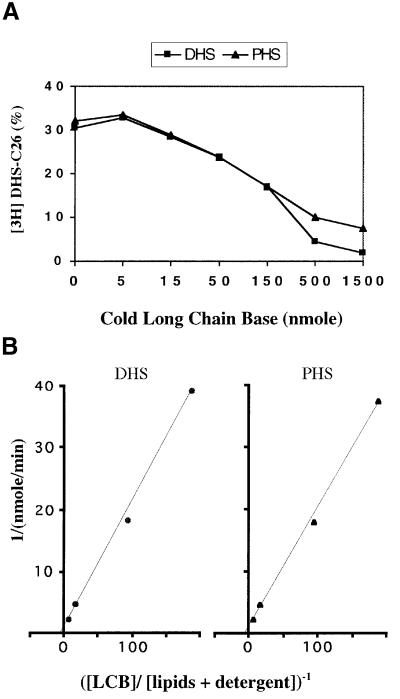
Fig. 6. Km and Vmax of microsomal DHS-C26 synthase activity. (A) Microsomes were lysed in 1% digitonin. A 100 µg aliquot of solubilized microsomal extract was assayed in the presence of 5 nmol of [3H]DHS, 200 nmol of C26-CoA and variable amounts (5–1500 nmol) of cold DHS or PHS in the presence of 1% digitionin. The products were extracted and analysed by TLC in solvent 1. [3H]DHS-C26 was quantitated by radioscanning and expressed as a percentage of total radioactivity in the corresponding lane. (B) The data of (A) were used to calculate enzymatic activities by calculating the total amounts of DHS-C26 made during incubations. DHS or PHS concentrations of the assays were expressed as mol/mol ratios of [long chain bases]/[total phospholipids + detergent]. The data were then transformed in double reciprocal plots according to Lineweaver–Burk. [Assays contained 120 nmol of phospholipids (estimated based on the amount of microsomal protein) and 820 nmol of detergent.]
None
Fig. 7. Overexpression of Lag1p does not confer resistance to Aus. YPK9 cells containing pBM150 either without an insert or harbouring LAC1 or LAG1 under the control of the GAL1 promoter were cultured on yeast nitrogen base with 2% galactose but lacking uracil, and were seeded at 5500 cells per plate containing the same medium. Then a filter paper with either solvent alone or 20 µg of Aus was placed in the centre. Plates were photographed after 3 days of incubation at 24°C.
None
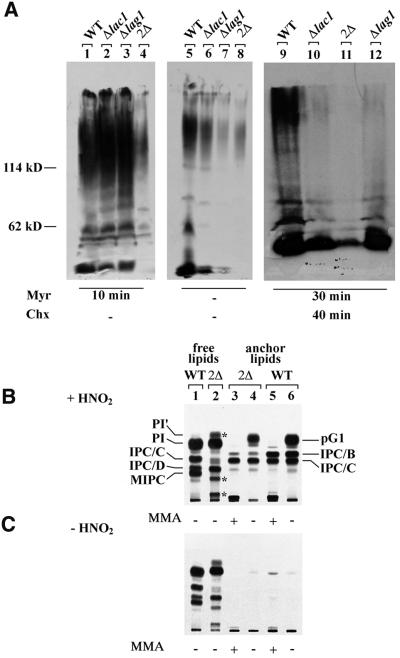
Fig. 8. lag1Δlac1Δ utilizes abnormal ceramides to remodel the lipid moiety of GPI anchors. (A) Two and a half OD of W303-1A (WT), W303-1A lac1Δ, W303-1A lag1Δ and W303-1A lag1Δlac1Δ were radiolabelled at 30°C with 25 µCi of [3H]DHS, and proteins were analysed by SDS–PAGE/fluorography. Before addition of the label, cells were pre-incubated for the indicated times with the inhibitors myriocin (myr) or cycloheximide (Chx). (B and C) Ten OD600 of W303-1A (WT) and W303-1A lag1Δlac1Δ (2Δ) were radiolabelled with [3H]inositol at 30°C and GPI-anchored peptides free of contaminating lipids were prepared. Anchor peptides were treated with HNO2 (B) or control incubated (C). The liberated lipids were desalted by butanol extraction and incubated with our without MMA. Anchor lipids (lanes 3–6) together with the free lipids obtained by the delipidation procedure (lanes 1 and 2) were analysed on TLC using solvent system 3. pG1 indicates the typical phosphatidylinositol found on GPI anchors. The asterisks marks the several abnormal lipids of 2Δ already pointed out in Figure 2. The absence of anchor lipids in lanes 3–6 of (C) indicates that the delipidation of GPI-anchored proteins was complete.

References

    1. Barz W.P. and Walter,P. (1999) Two endoplasmic reticulum (ER) membrane proteins that facilitate ER-to-Golgi transport of glycosylphosphatidylinositol-anchored proteins. Mol. Biol. Cell, 10, 1043–1059. - PMC - PubMed
    1. Beeler T.J., Fu,D., Rivera,J., Monaghan,E., Gable,K. and Dunn, T.M. (1997) SUR1 (CSG1/BCL21), a gene necessary for growth of Saccharomyces cerevisiae in the presence of high Ca2+ concentrations at 37°C, is required for mannosylation of inositolphosphorylceramide. Mol. Gen. Genet., 255, 570–579. - PubMed
    1. Beeler T., Bacikova,D., Gable,K., Hopkins,L., Johnson,C., Slife,H. and Dunn,T. (1998) The Saccharomyces cerevisiae TSC10/YBR265w gene encoding 3-ketosphinganine reductase is identified in a screen for temperature-sensitive suppressors of the Ca2+-sensitive csg2Δ mutant. J. Biol. Chem., 273, 30688–30694. - PubMed
    1. Benghezal M., Benachour,A., Rusconi,S., Aebi,M. and Conzelmann,A. (1996) Yeast Gpi8p is essential for GPI anchor attachment onto proteins. EMBO J., 15, 6575–6583. - PMC - PubMed
    1. Brandwagt B.F., Mesbah,L.A., Takken,F.L., Laurent,P.L., Kneppers,T.J., Hille,J. and Nijkamp,H.J. (2000) A longevity assurance gene homolog of tomato mediates resistance to Alternaria alternata f. sp. lycopersici toxins and fumonisin B1. Proc. Natl Acad. Sci. USA, 97, 4961–4966. - PMC - PubMed

Publication types

MeSH terms