. 2001 Jun 1;20(11):2878-84.
doi: 10.1093/emboj/20.11.2878.

Requirement of Hsp90 for centrosomal function reflects its regulation of Polo kinase stability

Affiliations

Requirement of Hsp90 for centrosomal function reflects its regulation of Polo kinase stability

G de Cárcer et al. EMBO J. .

Abstract

We have previously shown that the molecular chaperone heat shock protein 90 (Hsp90) is required to ensure proper centrosome function in Drosophila and vertebrate cells. This observation led to the hypothesis that this chaperone could be required for the stability of one or more centrosomal proteins. We have found that one of these is Polo, a protein kinase known to regulate several aspects of cell division including centrosome maturation and function. Inhibition of Hsp90 results in the inactivation of Polo kinase activity. It also leads to a loss in the ability of cytoplasmic extracts to complement the failure of salt-stripped preparations of centrosomes to nucleate microtubules. This effect can be rescued upon addition of active recombinant POLO: We also show that Polo and Hsp90 are part of a complex and conclude that stabilization of Polo is one of the mechanisms by which Hsp90 contributes to the maintenance of functional centrosomes.


Figures
None
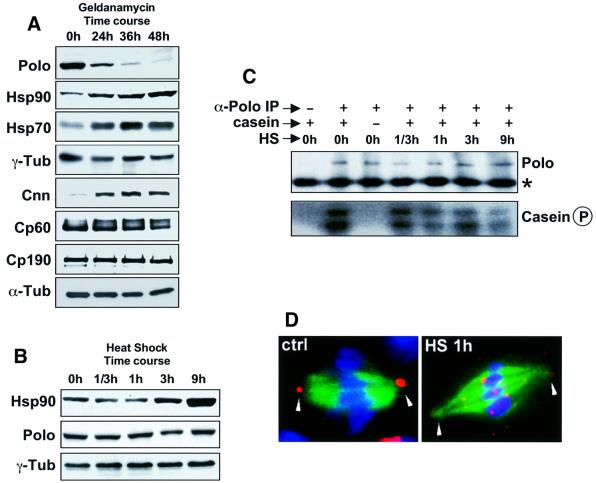
Fig. 1. Stability of centrosomal proteins following inhibition of Hsp90 and heat shock. Cell extracts obtained from Drosophila SL2 cells treated with the Hsp90 inhibitor geldanamycin (A) or heat shock (B) were prepared at different time points, run in SDS–PAGE gels and blotted with antibodies against a panel of centrosomal proteins. Of 15 centrosomal proteins examined, Polo was destabilized following geldanamycin treatment, Hsp90, Hsp70 and Cnn increased slightly and the rest of the proteins did not change. Heat shock, which also leads to an increase in Hsp90, does not have any noticeable effect on the levels of Polo (B). Immunoprecipitated Polo from heat shocked cells maintains kinase activity (C). Heat shock-induced centrosome dispersion can be observed as early as 1 h (D). The centrosomal marker CP190, microtubules and DNA are shown in red, green and blue. The spindle poles are labelled with arrowheads.
None
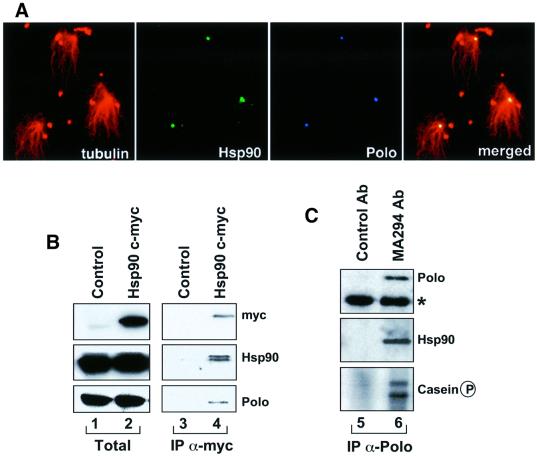
Fig. 2. Polo co-localizes with Hsp90 in purified centrosomes and co-immunoprecipitates with Hsp90. (A) Immunofluorescence showing co-localization of Hsp90 (green) and Polo (blue) in purified Drosophila centrosomes that are competent to organize microtubule asters (red). (B) Total homogenate and a fraction immunoprecipitated with an anti-myc antibody (IP α-myc) prepared from control cells (lanes 1 and 3) and cells carrying a myc-tagged version of Hsp90 (lanes 2 and 4). These samples were blotted with antibodies against myc, Hsp90 and Polo. Polo co-immunoprecipitates with overexpressed myc-Hsp90 (lane 4). (C) A fraction immunoprecipitated with an anti-Polo (IP α-Polo) prepared from SL2 cells, and blotted with anti-Hsp90 antibodies. The asterisk corresponds to the heavy chain of immunoglobulin. The IP α-Polo fraction was also assayed for kinase activity. Hsp90 co-immunoprecipitates with the endogenous Polo (lane 6).
None
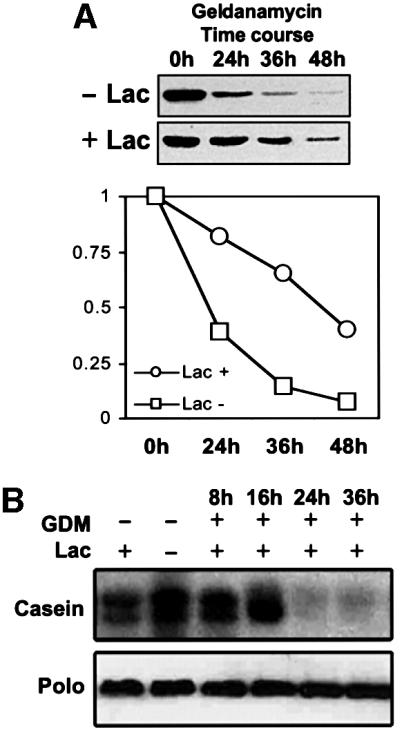
Fig. 3. Polo degradation is mediated by the proteasome. (A) Inhibition of the proteasome with lactacystin significantly slows down the rate of Polo degradation in geldanamycin-treated cells. (B) The kinase activity of Polo drops dramatically as early as 24 h after geldanamycin treatment, even when Polo degradation is retarded by lactacystin.
None
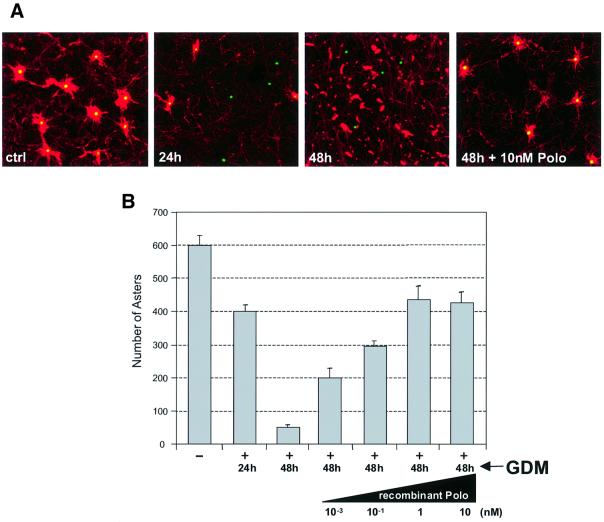
Fig. 4. The complementing activity of cytoplasmic extracts required to restore microtubule polymerization in salt-stripped centrosomes is inhibited by geldanamycin and rescued by Polo. (A) Immunofluorescence showing the ability of SL2 cell extracts to complement KI-extracted centrosomes (ctrl). Treatment with geldanamycin progressively inhibits the complementation activity (24 h, 48 h), but the effect can be reversed by the addition of 10 nM recombinant Polo (48 h +10 nM Polo). Centrosomes and microtubules were stained with anti-γ-tubulin (green) and anti-α-tubulin (red), respectively. (B) Quantification of the inhibition produced by geldanamycin and the effect of recombinant Polo added to the extracts. Geldanamycin treatment reduces the complementing activity of cell extracts by 30% after 24 h and >90% after 48 h. Increasing concentrations of Polo added to these extracts can rescue up to 70% of the control complementing activity.

References

    1. Aligue R., Akhavan-Niak,H. and Russell,P. (1994) A role for Hsp90 in cell cycle control: Wee1 tyrosine kinase activity requires interaction with Hsp90. EMBO J., 13, 6099–6106. - PMC - PubMed
    1. Avides M.C. and Glover,D.M. (1999) Abnormal spindle protein, Asp and the integrity of mitotic centrosomal microtubule organizing centres. Science, 283, 1733–1735. - PubMed
    1. Barnett C.A., Palmour,R.M., Litwack,G. and Seegmiller,J.E. (1983) In vitro stabilization of the unoccupied glucocorticoid receptor by adenosine 5′-diphosphate. Endocrinology, 112, 2059–2068. - PubMed
    1. Baulieu E.E. and Jung,I. (1972) Aprostatic cytosol ‘receptor’ in the rat levator ani muscle. Nature New Biol., 237, 24–26. - PubMed
    1. Buchner J. (1999) Hsp90 & Co. a holding for folding. Trends Biochem. Sci., 24, 136–141. - PubMed

Publication types

MeSH terms

LinkOut - more resources