Comparative Study
. 2001 Jun 1;20(11):2914-22.
doi: 10.1093/emboj/20.11.2914.

Altered nucleotide misinsertion fidelity associated with poliota-dependent replication at the end of a DNA template

Affiliations
Comparative Study

Altered nucleotide misinsertion fidelity associated with poliota-dependent replication at the end of a DNA template

E G Frank et al. EMBO J. .

Abstract

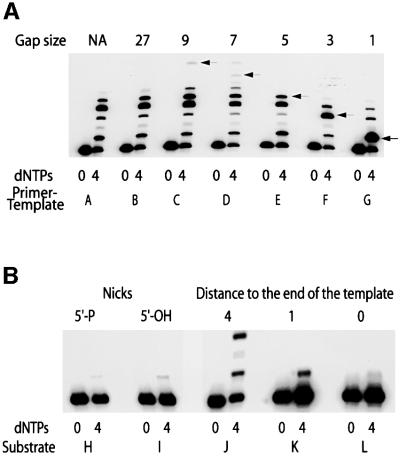
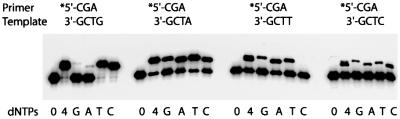
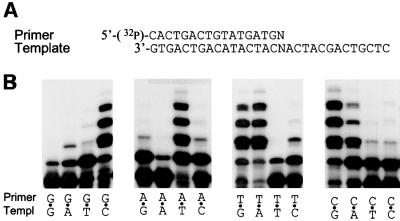
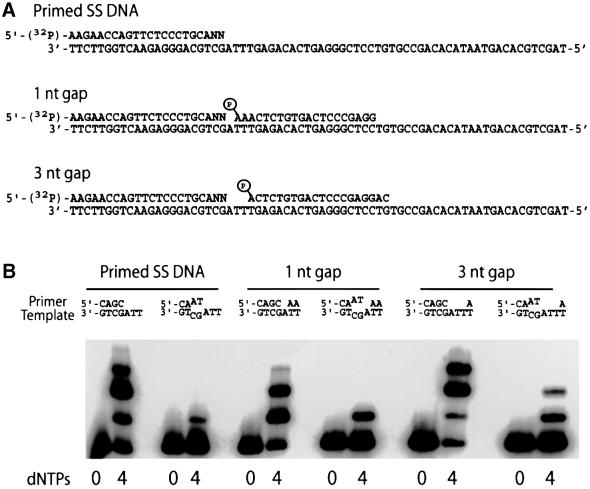
A hallmark of human DNA polymerase iota (poliota) is the asymmetric fidelity of replication at template A and T when the enzyme extends primers annealed to a single-stranded template. Here, we report on the efficiency and accuracy of poliota-dependent replication at a nick, a gap, the very end of a template and from a mispaired primer. Poliota cannot initiate synthesis on a nicked DNA substrate, but fills short gaps efficiently. Surprisingly, poliota's ability to blunt-end a 1 bp recessed terminus is dependent upon the template nucleotide encountered and is highly erroneous. At template G, both C and T are inserted with roughly equal efficiency, whilst at template C, C and A are misinserted 8- and 3-fold more often than the correct base, G. Using substrates containing mispaired primer termini, we show that poliota can extend all 12 mispairs, but with differing efficiencies. Poliota can also extend a tandem mispair, especially when it is located within a short gap. The enzymatic properties of poliota appear consistent with that of a somatic hypermutase and suggest that poliota may be one of the low-fidelity DNA polymerases hypothesized to participate in the hypermutation of immunoglobulin variable genes in vivo.


Figures
None
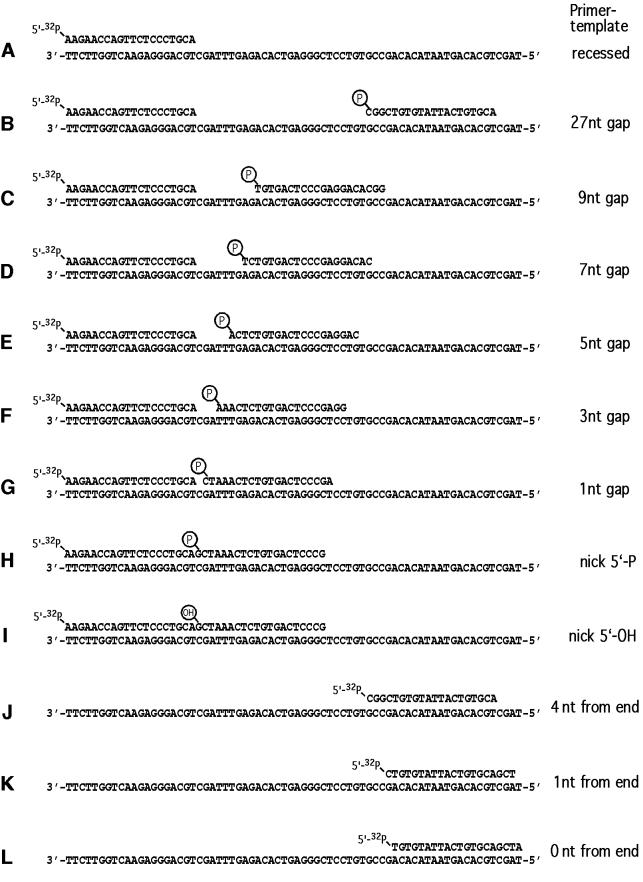
Fig. 1. Nucleotide sequence and structure of DNA templates used in the replication assays described in Figure 2. The various primer–templates are labeled A–L on the left of the figure for ease of reference. The ‘class’ of substrate, i.e. which ones measure recessed, gapped or end-filling reactions, is given on the right of the figure.
None
Fig. 2. (A) Comparison of polι’s ability to replicate primed single-stranded DNA and gapped templates. For each template, polι was incubated for 30 min with the substrate in the absence (0) or presence of all four (4) deoxynucleoside triphosphates (100 µM each). The primer–template used in each reaction is denoted by a letter, A–G, under each pair of reactions, and this refers to the sequence and structure of each primer–template shown in Figure 1. Where appropriate, the gap size is indicated above each reaction. The exception are the lanes denoted ‘NA’, which represent a singly primed template in which no gap exists. In the case of the gapped substrates, the size of the expected product is indicated by an arrow at the right hand side of each pair of reactions. (B) Ability of polι to initiate synthesis at a nick or the end of a DNA template. For each template, polι was incubated for 30 min with the substrate in the absence (0) or presence of all four (4) deoxynucleoside triphosphates (100 µM each). The primer–template used in each reaction is denoted by a letter, H–L, under each pair of reactions, and this refers to the sequence and structure of each primer–template shown in Figure 1. Where appropriate, the presence of a 5′-phosphate or 5′-hydroxyl in the nicked substrate is indicated, as is the distance to the end of the template in substrates J–L, which were used to measure the efficiency of end filling.
None
Fig. 3. Ability of polι to incorporate nucleotides at the end of a DNA template. The primer for each reaction was a radiolabeled 16mer with the sequence 5′-CTTGAAAACATAGCGA-3′. The template was a 22mer with the sequence 5′-XTCGCTATGTTTTCAAGGATTC-3′, where X was either G, A, T or C. The position of the hybridized primer on the template is underlined. The local sequence context of each primer–template is given above each panel. The extent of polι-dependent (mis)incorporation was measured at each template site in the absence of dNTPs (0), with all four dNTPs (4) or with each individual dNTP (100 µM) (G, A, T or C). Reactions were for 30 min at 37°C.
None
Fig. 4. (A) Nucleotide sequence of the primer and templates utilized to measure polι-dependent primer extension. In both cases, N is either G, A, T or C. (B) Comparison of polι’s ability to extend a correctly paired or mispaired primer terminus. The sequence of the pair/mispair is given below each track. These reactions were performed for 15 min in the presence of all four dNTPs.
None
Fig. 5. (A) Nucleotide sequence and structure of DNA templates used in replication assays to measure polι-dependent extension from a correctly paired 22mer and a 22mer with two terminal mismatches. (B) Ability of polι to extend a tandem mispair. For each template, polι was incubated for 30 min with the substrate in the absence (0) or presence of all four (4) deoxynucleoside triphosphates (100 µM each).
None
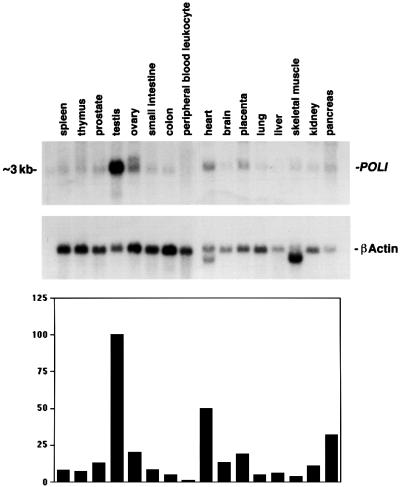
Fig. 6. Northern blot analysis of POLI mRNA in adult tissues. Upper panel: human POLI cDNA probes were hybridized with 2 µg of poly(A)+ RNA from each tissue as indicated. A β-actin cDNA was used as a control. Lower panel: autoradiograms were quantitated and relative expression was normalized to the level of β-actin in each tissue. The extent of POLI expression in the various tissue sources is indicated as a percentage of that observed in the testis (100%).

References

    1. Bebenek K., Tissier,A., Frank,E.G., McDonald,J.P., Prasad,R., Wilson,S.H., Woodgate,R. and Kunkel,T.A. (2001) 5′-deoxyribose phosphate lyase activity of human DNA polymerase ι in vitro. Science, 291, 2156–2159. - PubMed
    1. Berman J.E. et al. (1988) Content and organization of the human Ig VH locus: definition of three new VH families and linkage to the Ig CH locus. EMBO J., 7, 727–738. - PMC - PubMed
    1. Betz A.G., Rada,C., Pannell,R., Milstein,C. and Neuberger,M.S. (1993) Passenger transgenes reveal intrinsic specificity of the antibody hypermutation mechanism: clustering, polarity and specific hot spots. Proc. Natl Acad. Sci. USA, 90, 2385–2388. - PMC - PubMed
    1. Betz A.G., Milstein,C., Gonzalez-Fernandez,A., Pannell,R., Larson,T. and Neuberger,M.S. (1994) Elements regulating somatic hypermutation of an immunoglobulin κ gene: critical role for the intron enhancer/matrix attachment region. Cell, 77, 239–248. - PubMed
    1. Boosalis M.S., Petruska,J. and Goodman,M.F. (1987) DNA polymerase insertion fidelity. Gel assay for site-specific kinetics. J. Biol. Chem., 262, 14689–14696. - PubMed

Publication types