


doi: 10.1097/00125817-200105000-00011.
American College of Medical Genetics statement of diagnostic testing for uniparental disomy
Affiliations
- PMID: 11388763
- PMCID: PMC3111049
- DOI: 10.1097/00125817-200105000-00011
Item in Clipboard
American College of Medical Genetics statement of diagnostic testing for uniparental disomy
Genet Med.
2001 May-Jun.
No abstract available
Figures
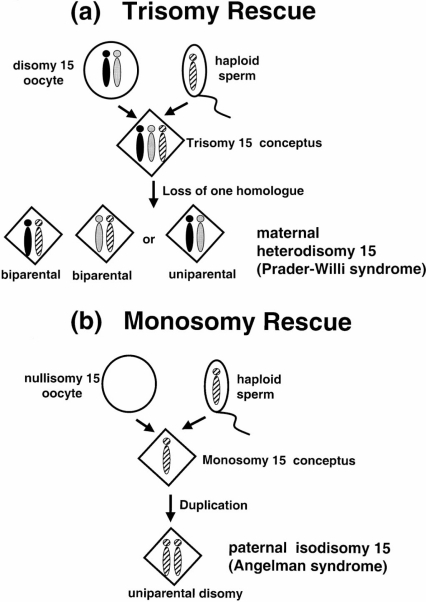
Common mechanisms resulting in uniparental disomy. (a) Trisomy rescue mechanism. Loss of one homologue in a trisomy conceptus theoretically results in UPD in one-third of cases. The example shown is that of a trisomy 15 conceptus, through which rescue may result in maternal heterodisomy 15 and Prader-Willi syndrome. (b) Monosomy rescue mechanism. Duplication of the only copy of that chromosome in a monosomic conceptus will result in UPD. The example shown is that of a monosomy 15 conceptus in which rescue would result in paternal isodisomy and Angelman syndrome.

Common mechanisms resulting in uniparental disomy involving acrocentric chromosomal rearrangements. (a) Trisomy rescue of a trisomy conceptus from a Robertsonian translocation carrier results theoretically in UPD in 50% of cases. Since the non-disjunction must occur in meiosis I, the resulting UPD would be heterodisomic. (b) Monosomy rescue of a monosomic conceptus resulting from meiosis I nondisjunction and fertilization of a nullisomic gamete. Duplication (through isochromosome formation) of the only copy of a homologue would result in isodisomy in 100% of cases. Since the majority of nondisjunction occurs in maternal meiosis, most cases of isochromosomes arising through this mechanism would result in paternal isodisomy.

Schematic representation of UPD cases reported in the literature. Solid black indicates chromosomes in which UPD has not been described. Solid, dark pink or dark blue indicate chromosomes in which maternal or paternal UPD has been described, respectively, and an abnormal phenotype due to imprinting has been established. Solid light pink or light blue indicate chromosomes in which maternal or paternal UPD has been described, respectively, and an abnormal phenotype due to imprinting has not been clearly defined. Hatched pink or blue indicates chromosomes in which maternal or paternal UPD has been described, respectively, and no abnormal phenotype has been identified that could be attributed to imprinting. (Adapted, by permission of Oxford University Press, from Ledbetter and Engel, 1995.2)
Comment in
-
Adding another "hatched pink" chromosome.Genet Med. 2002 Mar-Apr;4(2):95. doi: 10.1097/00125817-200203000-00008. Genet Med. 2002. PMID: 11922039 No abstract available.
References
-
- Engel E. A new genetic concept: uniparental disomy and its potential effect, isodisomy. Am J Med Genet. 1980;6:137–143. - PubMed
-
- Ledbetter DH, Engel E. Uniparental disomy in humans: development of an imprinting map and its implications for prenatal diagnosis. Hum Mol Genet. 1995;4:1757–1764. - PubMed
-
- Shaffer LG, McCaskill C, Adkins K, Hassold TJ. Systematic search for uniparental disomy in early fetal losses: the results and a review of the literature. Am J Med Genet. 1998;79:366–372. - PubMed
-
- Koehler KE, Hawley RS, Sherman S, Hassold T. Recombination and nondisjunction in humans and flies. Hum Mol Genet. 1996;5:1495–1504. - PubMed
MeSH terms
LinkOut - more resources
Full Text Sources
