Cost effectiveness of computer tailored and non-tailored smoking cessation letters in general practice: randomised controlled trial
- PMID: 11397745
- PMCID: PMC32255
- DOI: 10.1136/bmj.322.7299.1396
Cost effectiveness of computer tailored and non-tailored smoking cessation letters in general practice: randomised controlled trial
Abstract
Objectives: To develop and evaluate, in a primary care setting, a computerised system for generating tailored letters about smoking cessation.
Design: Randomised controlled trial.
Setting: Six general practices in Aberdeen, Scotland.
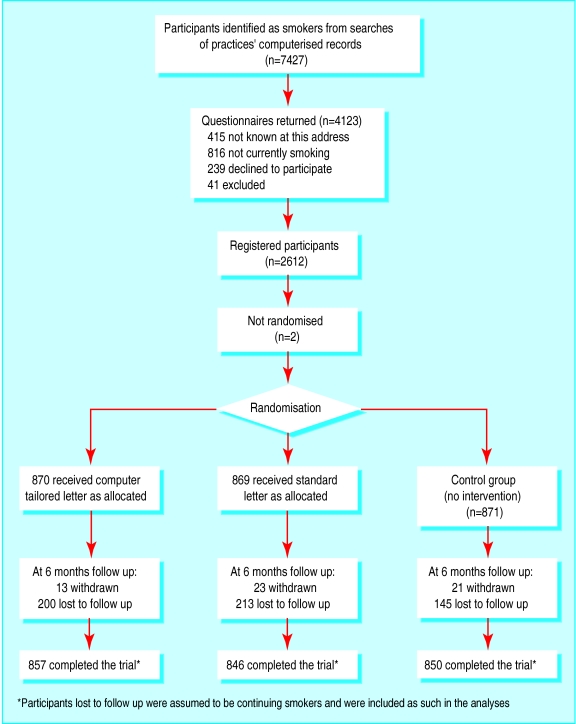
Participants: 2553 smokers aged 17 to 65.
Interventions: All participants received a questionnaire asking about their smoking. Participants subsequently received either a computer tailored or a non-tailored, standard letter on smoking cessation, or no letter.
Main outcome measures: Prevalence of validated abstinence at six months; change in intention to stop smoking in the next six months.
Results: The validated cessation rate at six months was 3.5% (30/857) (95% confidence interval 2.3% to 4.7%) for the tailored letter group, 4.4% (37/846) (3.0% to 5.8%) for the non-tailored letter group, and 2.6% (22/850) (1.5% to 3.7%) for the control (no letter) group. After adjustment for significant covariates, the cessation rate was 66% greater (-4% to 186%; P=0.07) in the non-tailored letter group than that in the no letter group. Among participants who smoked <20 cigarettes per day, the cessation rate in the non-tailored letter group was 87% greater (0% to 246%; P=0.05) than that in the no letter group. Among heavy smokers who did not quit, a 76% higher rate of positive shift in "stage of change" (intention to quit within a particular period of time) was seen compared with those who received no letter (11% to 180%; P=0.02). The increase in cost for each additional quitter in the non-tailored letter group compared with the no letter group was pound 89.
Conclusions: In a large general practice, a brief non-tailored letter effectively increased cessation rates among smokers. A tailored letter was not effective in increasing cessation rates but promoted shift in movement towards cessation ("stage of change") in heavy smokers. As a pragmatic tool to encourage cessation of smoking, a mass mailing of non-tailored letters from general practices is more cost effective than computer tailored letters or no letters.
Figures
References
-
- Reid JD, Killoran AJ, McNeill AD, Chambers JS. Choosing the most effective health promotion options for reducing a nation's smoking prevalence. Tob Control. 1992;1:185–197.
-
- Lennox AS, Taylor RJ. Smoking cessation activity within primary health care in Scotland: present constraints and their implications. Health Educ J. 1995;54:48–60.
-
- Strecher VJ, Kreuter M, Den Boer D-J, Kobrin S, Hospers HJ, Skinner CS. The effects of computer tailored smoking cessation messages in family practice settings. J Fam Pract. 1994;39:262–270. - PubMed
-
- Velicer WF, Prochaska JO, Bellis JM, DiClemente CC, Rossi JS, Fava JL, et al. An expert system intervention for smoking cessation. Addict Behav. 1993;18:269–290. - PubMed
Publication types
MeSH terms
Substances
LinkOut - more resources
Full Text Sources
Medical