. 2001 Jun;133(4):595-605.
doi: 10.1038/sj.bjp.0704088.

The vascular activity of some isoflavone metabolites: implications for a cardioprotective role

Affiliations

The vascular activity of some isoflavone metabolites: implications for a cardioprotective role

J P Chin-Dusting et al. Br J Pharmacol. 2001 Jun.

Abstract

Legume-derived isoflavones such as genistein, diadzein and equol have been associated with a reduction in risk of cardiovascular disease. In the current study, we explore the vascular activity of several isoflavone metabolites namely dihydrodaidzein, cis and trans-tetrahydrodaidzein and dehydroequol for potential cardioprotective properties. Rat isolated aortic rings were used. 17beta-oestradiol, equol, and all four of the metabolites studied significantly antagonized contractile responses to noradrenaline. The direct vasodilatory action of these compounds were examined and in contrast to 17beta-oestradiol, the vasodilatory effect of which was demonstrated to be endothelium independent, the dilatory action of all four compounds could be inhibited by endothelium denudation. Further, the dilatory action of both dihydrodaidzein and cis-tetrahydrodaidzein were inhibited by the nitric oxide synthase inhibitor, N(omega)-nitro-L-arginine (NOLA), by the soluble guanylate cyclase inhibitor, 1H-[1,2,4]oxadiazolo[4,3-a]quinoxalin-1-one (ODQ) and by 40 mM KCl. Dilatory responses to dehydroequol and trans-tetrahydrodaidzein, on the other hand, were inhibited by 40 mM KCL but not by NOLA nor ODQ. Finally, we examined the protective potential of these compounds in inhibiting endothelium damage by oxidized low density lipoprotein (ox-LDL). Trans-tetrahydrodaidzein was at least 10 fold more potent than 17beta-oestradiol in protecting against ox-LDL induced damage. We conclude that the isoflavone metabolites, dihydrodaidzein, cis- and trans-tetrahydrodaidzein and dehydroequol, may potentially represent a novel series of cardioprotective therapeutics.


Figures
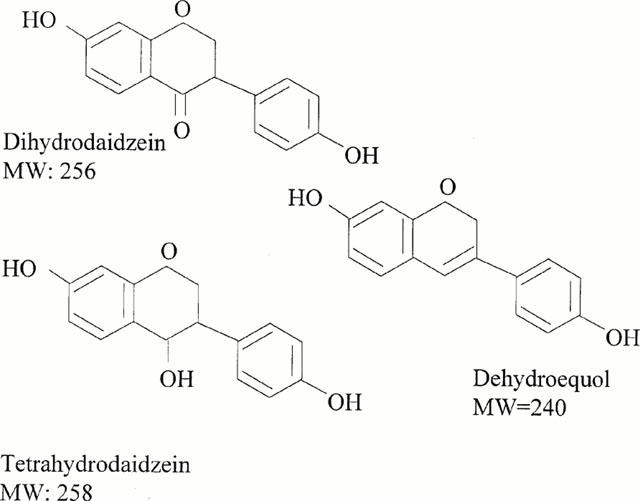
Figure 1
Figure 1
Shows the structure and molecular weights of the main isoflavone metabolites examined. The molecular weight (MW) of β-oestradiol is 272.
Figure 2
Figure 2
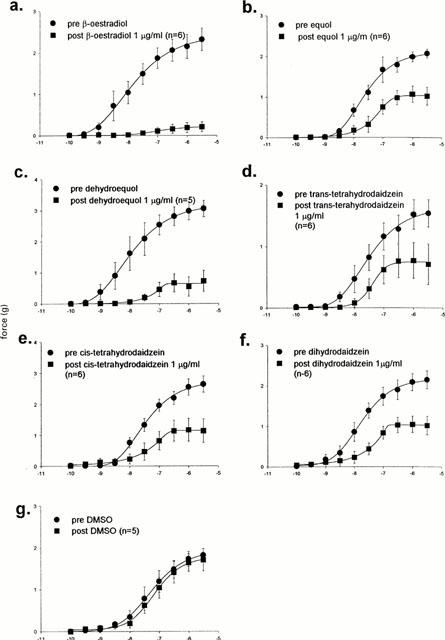
Effects of β-oestradiol, equol, dehydroequol, trans-tetrahydrodaidzein, cis-tetrahydrodaidzein, dihydrodaidzein (1 μg ml−1 30 min) and DMSO on full concentration-contractile responses to noradrenaline.
Figure 3
Figure 3
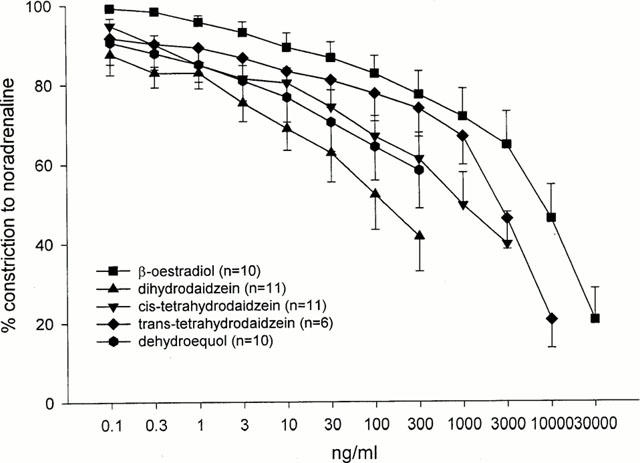
Concentration-dilatory responses to β-oestradiol, dihydrodaidzein, cis- and trans-tetrahydrodaidzein and dehydroequol were constructed on rat aortic rings pre-contracted with a sub-maximal concentration of noradrenaline. Dilatory responses to dihydrodaidzein, cis-tetrahydrodaidzein and dehydroequol were significantly greater than those to β-oestradiol. Analysis was by two-way ANOVA.
Figure 4
Figure 4
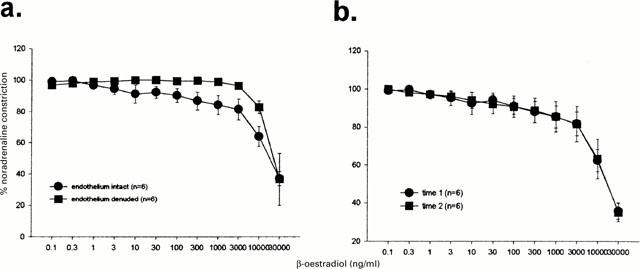
Dilatory responses to β-oestradiol were not significantly affected by endothelium denudation (a) nor by 30 min time-control (b).
Figure 5
Figure 5
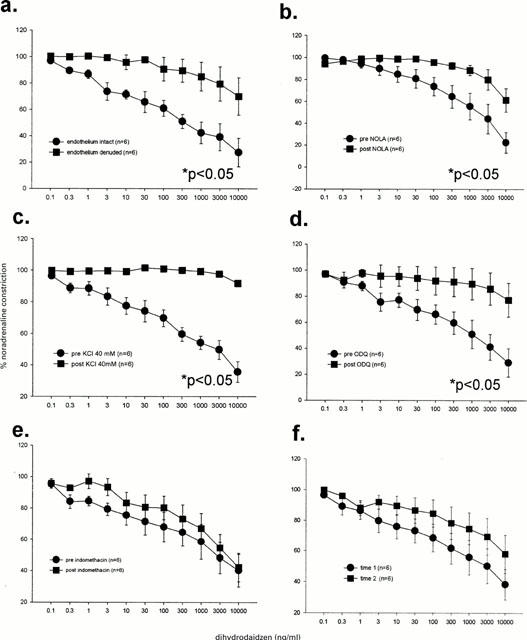
Dilatory responses to dihydrodaidzein were significantly inhibited by endothelium denudation (a), incubation with and Nω-nitro-L-arginine (b; NOLA), KCl (c) and 1H-[1,2,4]oxadiazolo[4,3-a]quinoxalin-1-one (d; ODQ) but not by indomethacin (e) nor time (f). Analysis was by two-way repeated measures ANOVA.
Figure 6
Figure 6
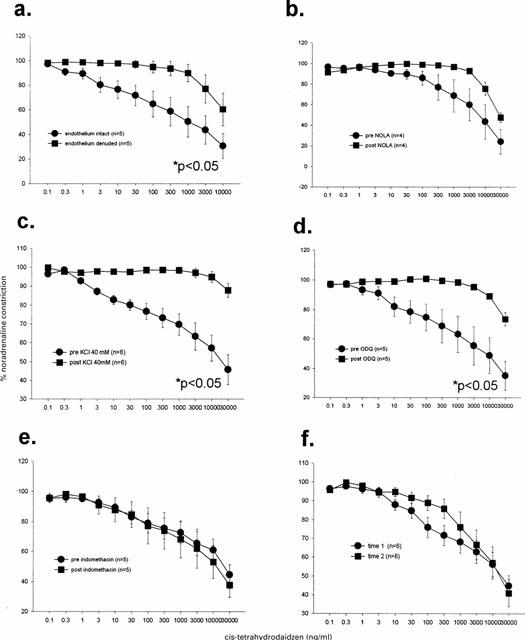
Dilatory responses to cis-tetrahydrodaidzein were significantly inhibited by endothelium denudation (a), KCl (c) and 1H-[1,2,4]oxadiazolo[4,3-a]quinoxalin-1-one (ODQ; d) but not by Nω-nitro-L-arginine (NOLA; b), indomethacin (e) nor time (f). Analysis was by two-way repeated measures ANOVA.
Figure 7
Figure 7
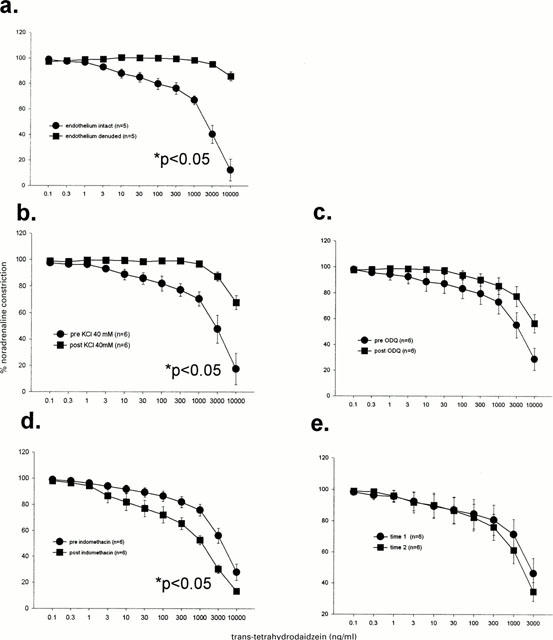
Dilatory responses to trans-tetrahydrodaidzein were significantly inhibited by endothelium denudation (a) and KCl (b) but not by 1H-[1,2,4]oxadiazolo[4,3-a]quinoxalin-1-one (ODQ; c) nor time (e). These responses were significantly augmented with indomethacin (d). Analysis was by two-way repeated measures ANOVA.
Figure 8
Figure 8
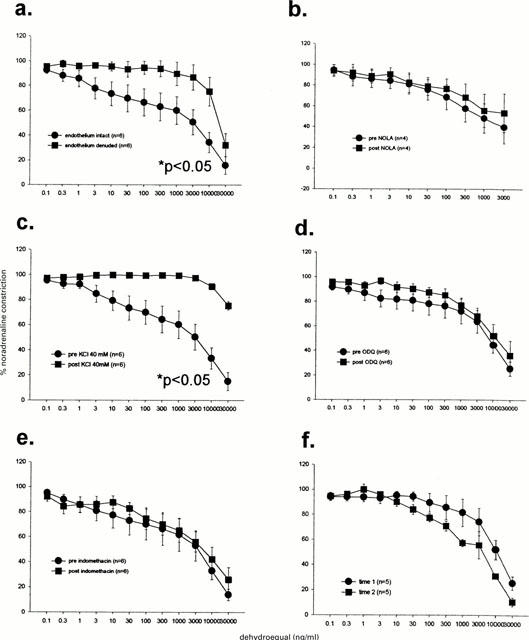
Dilatory responses to dehydroequol were significantly inhibited by endothelium denudation (a) and KCl (b) but not by Nω-nitro-L-arginine (NOLA; b), 1H-[1,2,4]oxadiazolo[4,3-a]quinoxalin-1-one (ODQ; c), indomethacin (e) nor time (e). Analysis was by two-way repeated measures ANOVA.
Figure 9
Figure 9
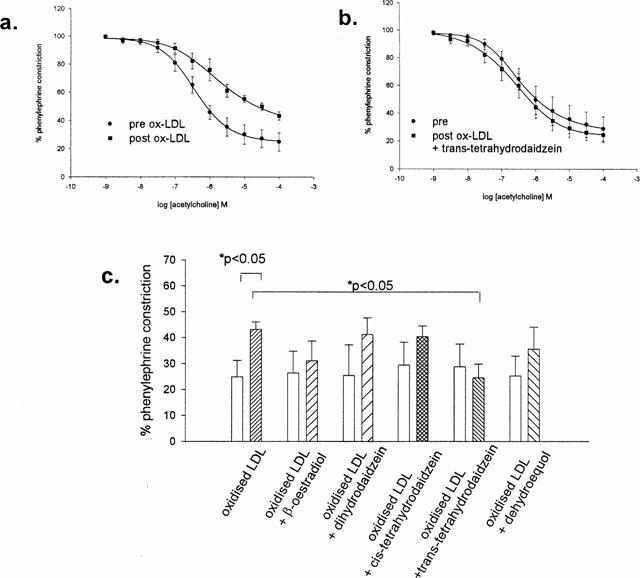
Dilatory responses to acetylcholine were significantly attenuated by incubation with ox-LDL (a). This inhibitory effect was no longer apparent when ox-LDL was co-incubated with trans-tetrahydrodaidzein. (b). Histograms (c) depict maximal responses to acetylcholine±oxidized LDL±metabolites. Analysis was by ANOVA.

References

    1. ANDERSON J., GARNER S. Phytoestrogens and bone. Baillieres Clin. Endocrinol. Metab. 1998;12:543–557. - PubMed
    1. CLARKSON T., ANTHONY M. Phytoestrogens and coronary heart disease. Baillieres Clin. Endocrinol. Metab. 1998;12:589–604. - PubMed
    1. FREAY A., CURTIS S., KORACH K., RUBANYI G. Mechanism of vascular smooth muscle relaxation by estrogen in depolarized rat and mouse aorta. Role of nuclear estrogen receptor and Ca2+ uptake. Circ. Res. 1997;81:242–248. - PubMed
    1. GIMENEZ I., LOU M., VARGAS F., ALVAREZ-GUERRA M., MAYORAL J., MARTINEZ R., GARAY R., ALDA J. Renal and vascular actions of equol in the rat. J. Hypertens. 1997;15:1303–1308. - PubMed
    1. JACOBS M., PLANE F., BRUCKDORFER K.R. Native and oxidized low-density lipoproteins have different inhibitory effects on endothelium-derived relaxing factor in the rabbit aorta. Br. J. Pharmacol. 1990;100:21–26. - PMC - PubMed

Publication types

MeSH terms

LinkOut - more resources