


doi: 10.1105/tpc.13.6.1427.
FPA, a gene involved in floral induction in Arabidopsis, encodes a protein containing RNA-recognition motifs
Affiliations
- PMID: 11402170
- PMCID: PMC135578
- DOI: 10.1105/tpc.13.6.1427
Item in Clipboard
FPA, a gene involved in floral induction in Arabidopsis, encodes a protein containing RNA-recognition motifs
Plant Cell.
2001 Jun.
Abstract
FPA is a gene that regulates flowering time in Arabidopsis via a pathway that is independent of daylength (the autonomous pathway). Mutations in FPA result in extremely delayed flowering. FPA was identified by means of positional cloning. The predicted FPA protein contains three RNA recognition motifs in the N-terminal region. FPA is expressed most strongly in developing tissues, similar to the expression of FCA and LUMINIDEPENDENS, two components of the autonomous pathway previously identified. Overexpression of FPA in Arabidopsis causes early flowering in noninductive short days and creates plants that exhibit a more day-neutral flowering behavior.
Figures
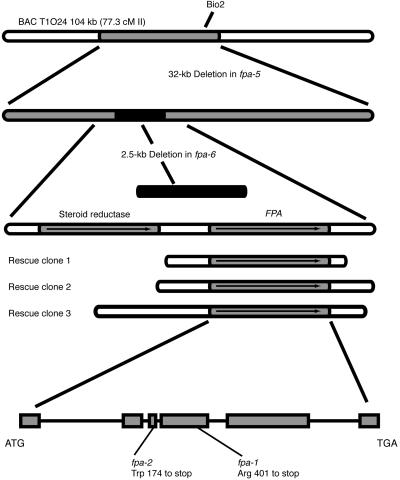
Cloning and Characterization of FPA. Summary of the isolation of FPA based on deletion alleles (top). The deletion found in fpa-5 approximately encompasses nucleotides 24,500 to 57,000 of bacterial artificial chromosome (BAC) T1O24. BAC T1O24 is located 77.3 cM (centimorgan) from the top of chromosome II. Schematic representations of genomic clones that rescued fpa-6 mutants are shown in the middle. The genomic structure of FPA is shown at bottom; boxes designate exons and lines designate introns. Point mutations in fpa-1 and fpa-2 are shown.
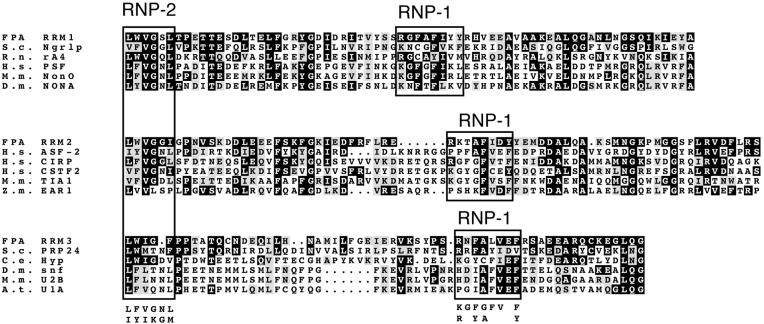
Amino Acid Sequence Alignment of FPA RRMs. Three RRMs of FPA are shown aligned to the most similar RRMs in the databases. Boxed regions show RNP-2 and RNP-1 subdomains of RRM regions. Consensus regions for RNP domains are defined by Burd and Dreyfuss (1994). Black boxes denote amino acid residues identical to those in FPA, and gray boxes denote similar amino acid residues. FPA RRM1 is shown aligned to Saccharomyces cerevisiae Negative Growth Regulatory Protein (S.c. Ngr1p), Rattus norvegicus C-terminal domain binding protein (R.n. rA4), Homo sapiens PTB-associated Splicing Factor (H.s. PSF), Mus musculus octamer binding protein (M.m. NonO), and Drosophila melanogaster No-on-transient A (D.m. NONA). FPA RRM2 is shown aligned to H. sapiens alternative splicing factor (H.s. ASF-2), H. sapiens cold inducible RNA binding protein (H.s. CIRP), H. sapiens cleavage stimulation factor (H.s. CSTF2), M. musculus RNA binding protein (M.m. TIA1), and Zea mays EAR1 protein (Z.m. EAR1). FPA RRM3 is shown aligned to S. cerevisiae U6 snRNP protein (S.c. PRP24), Caenorhabditis elegans hypothetical protein T07F10.3 (C.e. Hyp), D. melanogaster splicing protein snf (D.m. snf), M. musculus snRNP (M.m U2B), and Arabidopsis thaliana snRNP-specific protein (A.t. U1A).
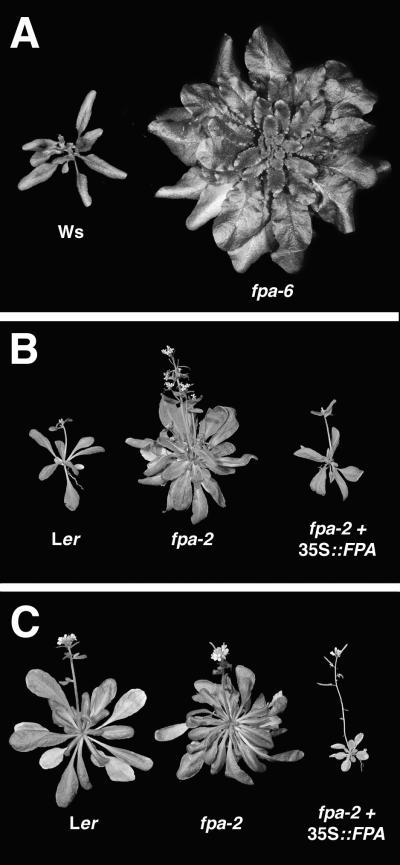
Flowering Phenotypes of Lines Used in this Study. (A) Ws and fpa-6 in Ws grown under long-day photoperiods. (B) Ler, fpa-2 in Ler, and fpa-2 + 35S::FPA in Ler grown under long-day photoperiods. (C) Ler, fpa-2 in Ler, and fpa-2 + 35S::FPA in Ler grown under short-day photoperiods.
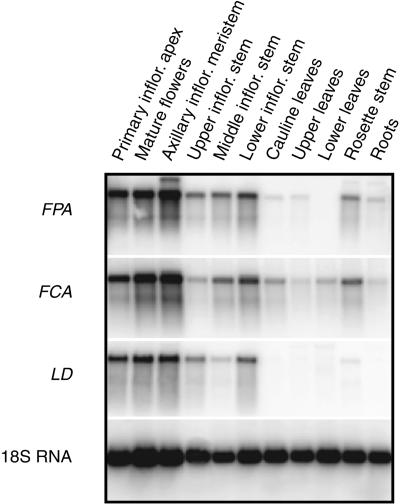
Reverse Transcription–PCR Analysis of FPA, FCA, and LD Expression Patterns. FPA, FCA, and LD expression patterns were determined by reverse transcription–PCR. Twenty-five cycles of PCR amplification were used for each sample except the control 18S RNA product, which was detected at 17 cycles. Tissue for these experiments was obtained from the Ws accession at 22 days after germination. The inflorescence height at the time of tissue harvest was between 16 and 19 cm. The primary inflorescence (inflor.) apex consisted of the uppermost 3 mm of the inflorescence and contained immature floral buds. Flowers were taken on the day of anthesis. Axillary inflorescence meristem tissue was isolated with 2 mm of stem on either side of the meristem. Upper, middle, and lower inflorescence stem are defined as internode stem sections of the primary inflorescence. The lower stem refers to the first internode from the rosette followed by middle stem and upper stem, respectively. Stem sections did not contain shoot meristems. Cauline leaves are the oldest two leaves of the inflorescence. Upper leaves are defined as the youngest two leaves of the rosette, whereas the lower leaves are the oldest two rosette leaves. Rosette stem was obtained by removing roots, leaves, and the inflorescence from the rosette. Root tissue was isolated from plants grown on sterile medium (see Methods).
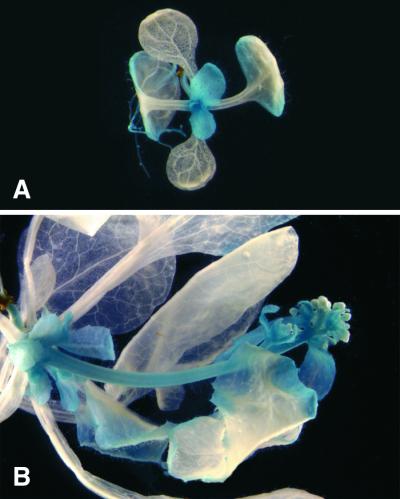
FPA::GUS Fusion Analysis of FPA Expression (A) FPA::GUS expression in Ws before flowering, 13 days after germination. (B) FPA::GUS expression in Ws during flowering (20-mm inflorescence), 19 days after germination.
References
-
- Aukerman, M.J., Lee, I., Weigel, D., and Amasino, R.M. (1999). The Arabidopsis flowering-time gene LUMINIDEPENDENS is expressed primarily in regions of cell proliferation and encodes a nuclear protein that regulates LEAFY expression. Plant J. 18, 195–203. - PubMed
-
- Burd, C.G., and Dreyfuss, G. (1994). Conserved structures and diversity of functions of RNA-binding proteins. Science 265, 615–621. - PubMed
-
- Burn, J.E., Smyth, D.R., Peacock, W.J., and Dennis, E.S. (1993). Genes conferring late flowering in Arabidopsis thaliana. Genetica 90, 147–155.
-
- Clarke, J.H., and Dean, C. (1994). Mapping FRI, a locus controlling flowering time and vernalization response in Arabidopsis thaliana. Mol. Gen. Genet. 242, 81–89. - PubMed
Publication types
MeSH terms
Substances
LinkOut - more resources
Full Text Sources
Other Literature Sources
Molecular Biology Databases
