. 2001 Jun;126(2):849-60.
doi: 10.1104/pp.126.2.849.

Jasmonate-dependent induction of indole glucosinolates in Arabidopsis by culture filtrates of the nonspecific pathogen Erwinia carotovora

Affiliations

Jasmonate-dependent induction of indole glucosinolates in Arabidopsis by culture filtrates of the nonspecific pathogen Erwinia carotovora

G Brader et al. Plant Physiol. 2001 Jun.

Abstract

Elicitors from the plant pathogen Erwinia carotovora trigger coordinate induction of the tryptophan (Trp) biosynthesis pathway and Trp oxidizing genes in Arabidopsis. To elucidate the biological role of such pathogen-induced activation we characterized the production of secondary defense metabolites such as camalexin and indole glucosinolates derived from precursors of this pathway. Elicitor induction was followed by a specific increase in 3-indolylmethylglucosinolate (IGS) content, but only a barely detectable accumulation of the indole-derived phytoalexin camalexin. The response is mediated by jasmonic acid as shown by lack of IGS induction in the jasmonate-insensitive mutant coi1-1. In accordance with this, methyl jasmonate was able to trigger IGS accumulation in Arabidopsis. In contrast, ethylene and salicylic acid seem to play a minor role in the response. They did not trigger alterations in IGS levels, and methyl jasmonate- or elicitor-induced IGS accumulation in NahG and ethylene-insensitive ein2-1 mutant plants was similar as in the wild type. The breakdown products of IGS and other glucosinolates were able to inhibit growth of E. carotovora. The results suggest that IGS is of importance in the defense against bacterial pathogens.


Figures
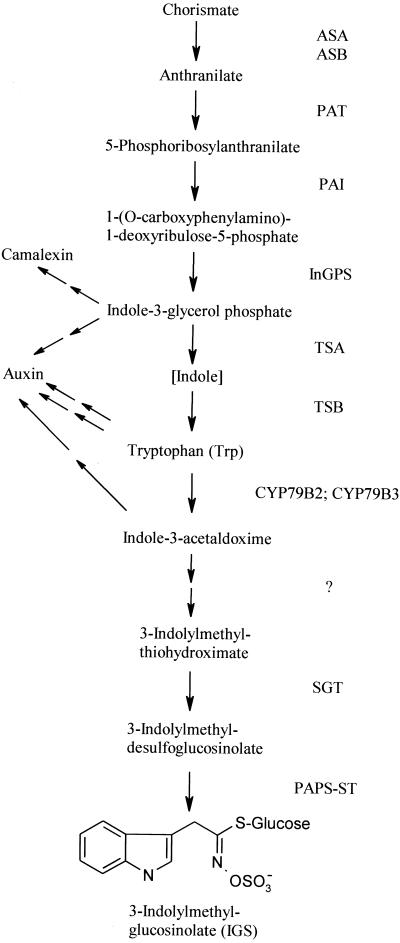
Figure 1
Figure 1
The biosynthetic pathway for Trp and IGS. Enzyme names are shown on the right. Postulated branch points leading to camalexin and auxin are marked with arrows. ASA, Anthranilate synthase α-subunit; ASB, anthranilate synthase β-subunit; PAT, phosphoribosylanthranilate transferase; PAI, phosphoribosyl-anthranilate isomerase; InGPS, indole-3-glycerolphosphate synthase; TSA, Trp synthase α-subunit; TSB, Trp synthase β-subunit; CYP79B2 and CYP79B3, cytochrome P-450 monooxygenases; ?, enzymes between CYP79B and SGT are unknown; SGT, UDPG-thiohydroximate glucosyltransferase; PAPS-ST, 3′-phosphoadenosine 5′-phosphosulfate:desulfogluco-sino- late sulfotransferase.
Figure 2
Figure 2
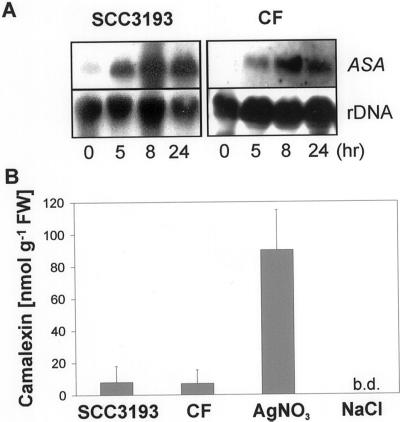
Induction of anthranilate synthase α (ASA) and camalexin by E. carotovora. Three-week-old axenic Arabidopsis Col-0 wild-type plants were treated on leaves with 2 μL of CF of E. carotovora subsp. carotovora SCC3193 or the bacteria itself (SCC3193; 2–3 × 10⁶ CFU). A, Material harvested after 0, 5, 8, and 24 h as indicated on the bottom of the figure. Gel RNA blots were hybridized with the probes indicated on the right. B, Camalexin accumulation 48 h after CF and bacterial treatment. As a positive control, camalexin levels 48 h after treatment with 2 μL of silver nitrate (AgNO3; 10 mm) are shown. Mock treatment was performed with 0.9% (w/v) NaCl. b.d., Amounts below detection limit. Values represent averages ± se of three measurements. FW, Fresh weight of tissue.
Figure 3
Figure 3
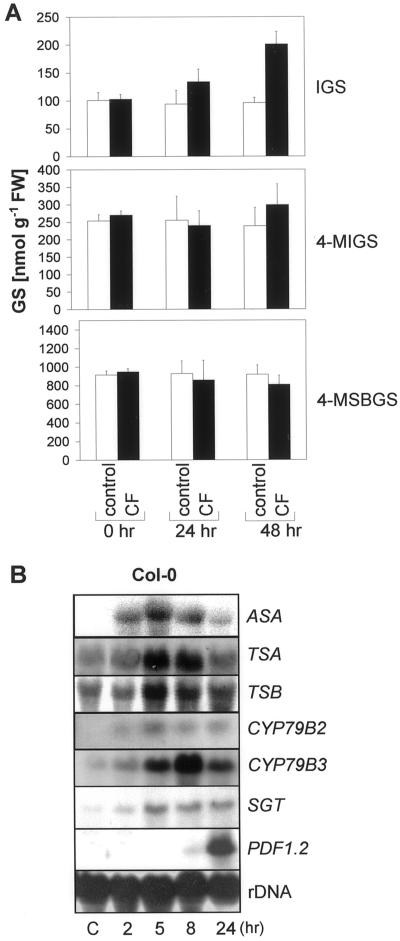
Induction of GSs and Trp/IGS pathway genes by CF of E. carotovora. Three-week-old axenic Col-0 wild-type plants were treated on leaves with 2 μL of CF of E. carotovora subsp. carotovora SCC3193 or mock treated with 0.9% (w/v) NaCl (control). A, The GSs IGS, 4-MIGS, and 4-methylsulphinylbutylglucosinolate (4-MSBGS) were quantified by HPLC. The accumulation of the GSs 0, 24, and 48 h after treatment is indicated. The data shown are the means ±se of five measurements. In each case the GS content was determined within five pooled plants. FW, Fresh weight of tissue. B, RNA gel blots were probed with the IGS synthesis-related genes ASA, TSA, TSB, CYP79B2, CYP79B3, and SGT as well as the defense related PDF1.2. at different time points after the addition of CF or 5 h after mock treatment (C). Membranes were reprobed with a ribosomal probe to ensure equal loading.
Figure 4
Figure 4
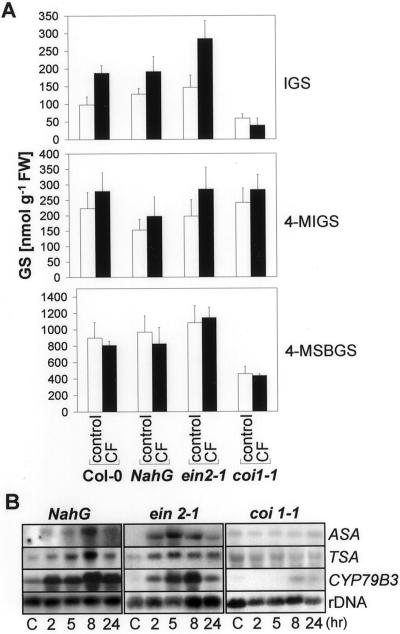
CF-Induction of GSs and Trp/IGS pathway genes in signal transduction mutants. Three-week-old NahG, ein2-1, and coi1-1 axenic plants were treated on leaves with 2 μL of CF or mock treated with 0.9% (w/v) NaCl (control). A, Forty-eight hours after treatment, leaves were harvested and the GSs IGS, 4-MIGS, and 4-MSBGS were quantified by HPLC. The data shown are the means ± se of four measurements. In each case the GS content was determined within five pooled plants. FW, Fresh weight of tissue. B, RNA gel blots were probed with ASA, TSA, and CYP79B3 at different time points after the addition of CF or 5 h after mock treatment (C). Membranes were reprobed with a ribosomal probe to ensure equal loading.
Figure 5
Figure 5
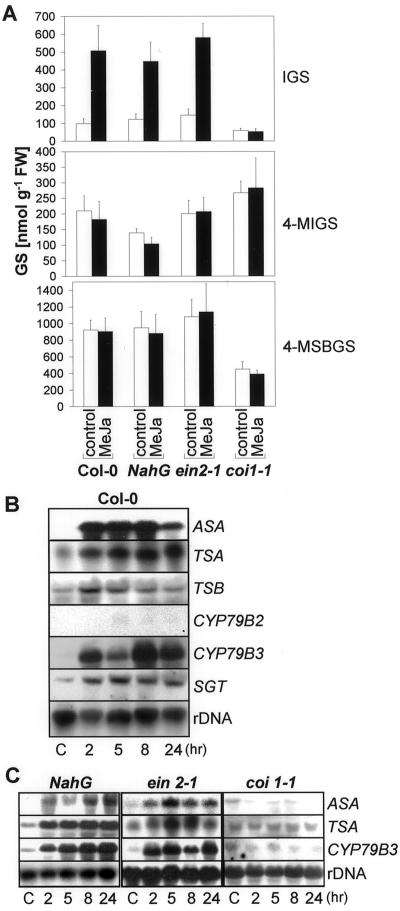
Induction of GSs and Trp/IGS pathway genes by MeJa. Three-week-old Col-0 wild-type as well as NahG, ein 2-1, and coi 1-1 plants were treated on leaves with 2 μL of MeJa (500 μm) or 0.1% (v/v) Tween 20 (control). A, Forty-eight h after treatment, leaves were harvested and the GSs IGS, 4-MIGS, and 4-MSBGS were quantified by HPLC. The data shown are the means ± se of four measurements. In each case the GS content was determined within five pooled plants. FW, Fresh weight of tissue. B, In experiments with Col-0 wild type, RNA gel blots were probed with ASA, TSA, TSB, CYP79B2, CYP79B3, and SGT at different time points after the addition of MeJa or 5 h after addition of 0.1% (v/v) Tween 20 as control (C). Membranes were reprobed with a ribosomal probe to ensure equal loading. C, RNA gel blots from NahG, ein2-1, and coi1-1 plants were probed with ASA, TSA, and CYP79B3 at different time points after the addition of MeJa or 5 h after mock treatment (C). Membranes were reprobed with a ribosomal probe to ensure equal loading.
Figure 6
Figure 6
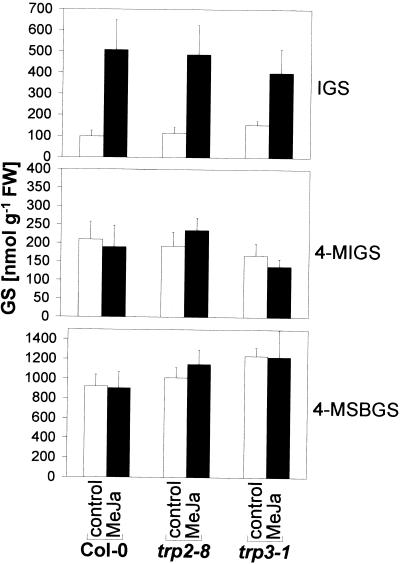
GS Induction by MeJa in Trp biosynthesis mutants. Three-week-old axenic trp2-8 and trp3-1 Trp mutant as well as Col-0 wild-type plants were treated on leaves with 2 μL MeJa (500 μm) or 0.1% (v/v) Tween 20 (control). Forty-eight h after treatment, leaves were harvested and the GSs IGS, 4-MIGS, and 4-MSBGS were quantified by HPLC. The data shown are the means ± se of three measurements. In each case the GS content was determined within five pooled plants.

References

    1. Agerbirk N, Bjergegaard C, Olsen CE, Sørensen H. Kinetic investigation of the transformations of indol-3-ylcarbinol into oligomeric indolyl compounds based on micellar elektrokinetic capillary chromatography. J Chromatography A. 1996;745:239–248.
    1. Agerbirk N, Olsen CE, Sørensen H. Initial and final products, nitriles, and ascorbigens produced in myrosinase-catalyzed hydrolysis of indole glucosinolates. J Agric Food Chem. 1998;46:1563–1571.
    1. Barczak AJ, Zhao J, Pruitt KD, Last RL. 5-Fluoroindole resistance identifies tryptophan synthase beta subunit mutants in Arabidopsis thaliana. Genetics. 1995;140:303–313. - PMC - PubMed
    1. Berger S, Bell E, Sadka A, Mullet JE. Arabidopsis thaliana Atvsp is homologous to soybean VspA and VspB, genes encoding vegetative storage protein acid phosphatases, and is regulated similarly by methyl jasmonate, wounding, sugars, light and phosphate. Plant Mol Biol. 1995;27:933–942. - PubMed
    1. Berlyn MB, Last RL, Fink GR. A gene encoding the tryptophan synthase beta subunit of Arabidopsis thaliana. Proc Natl Acad Sci USA. 1989;86:4604–4608. - PMC - PubMed

MeSH terms

LinkOut - more resources