. 2001 Jun 19;98(13):7605-10.
doi: 10.1073/pnas.131152998. Epub 2001 Jun 12.

Phenserine regulates translation of beta -amyloid precursor protein mRNA by a putative interleukin-1 responsive element, a target for drug development

Affiliations

Phenserine regulates translation of beta -amyloid precursor protein mRNA by a putative interleukin-1 responsive element, a target for drug development

K T Shaw et al. Proc Natl Acad Sci U S A. .

Abstract

The reduction in levels of the potentially toxic amyloid-beta peptide (Abeta) has emerged as one of the most important therapeutic goals in Alzheimer's disease. Key targets for this goal are factors that affect the expression and processing of the Abeta precursor protein (betaAPP). Earlier reports from our laboratory have shown that a novel cholinesterase inhibitor, phenserine, reduces betaAPP levels in vivo. Herein, we studied the mechanism of phenserine's actions to define the regulatory elements in betaAPP processing. Phenserine treatment resulted in decreased secretion of soluble betaAPP and Abeta into the conditioned media of human neuroblastoma cells without cellular toxicity. The regulation of betaAPP protein expression by phenserine was posttranscriptional as it suppressed betaAPP protein expression without altering betaAPP mRNA levels. However, phenserine's action was neither mediated through classical receptor signaling pathways, involving extracellular signal-regulated kinase or phosphatidylinositol 3-kinase activation, nor was it associated with the anticholinesterase activity of the drug. Furthermore, phenserine reduced expression of a chloramphenicol acetyltransferase reporter fused to the 5'-mRNA leader sequence of betaAPP without altering expression of a control chloramphenicol acetyltransferase reporter. These studies suggest that phenserine reduces Abeta levels by regulating betaAPP translation via the recently described iron regulatory element in the 5'-untranslated region of betaAPP mRNA, which has been shown previously to be up-regulated in the presence of interleukin-1. This study identifies an approach for the regulation of betaAPP expression that can result in a substantial reduction in the level of Abeta.


Figures
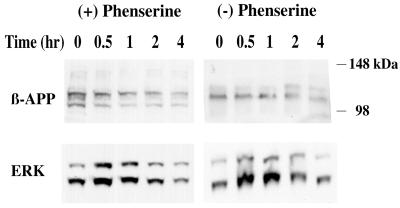
Figure 1
Figure 1
Phenserine treatment of SH-SH-5Y neuroblastoma cells decreased βAPP protein levels and affected ERK transcription factor levels. SH-SY-5Y cells were incubated with 5 μM (+)- or (−)-phenserine for 0, 0.5, 1, 2, and 4 h to determine the effect of the drug on βAPP protein levels. Western blots of cell lysates containing 15 μg of total protein per lane were analyzed. The blot was sectioned into two halves, and the top portion was probed with an N-terminal directed anti-βAPP antibody; the remaining portion was probed with an antibody directed to phosphorylated ERK. In accord with prior reports (19, 21, 39), two high molecular mass bands corresponded to alternate forms of βAPP (100–125 kDa) and ERK 1/2 (42–46 kDa).
Figure 2
Figure 2
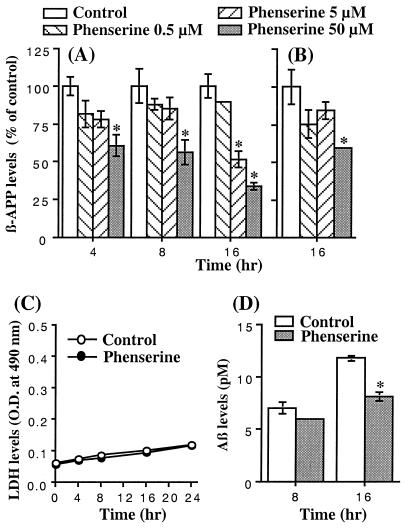
Phenserine treatment of SK-N-SH neuroblastoma cells decreased βAPP protein and total Aβ peptide levels without cellular dysfunction. SK-N-SH cells were incubated with (−)-phenserine for up to 16 h to determine the effect of the drug on βAPP protein (A and B), LDH (C), and total Aβ levels (D). (A and B) βAPP levels as a percent of controls after pretreatment with 0.5, 5, and 50 μM (−)-phenserine for 4, 8, and 16 h (*, significantly different from control, P < 0.05). Western blots of conditioned media (A) and cell lysates (B) were probed with an N-terminal directed anti-βAPP antibody. (C) LDH levels in media from cells treated with and without 50 μM (−)-phenserine for up to 16 h. There was no significant difference between treated and untreated levels up to 16 h (P > 0.05). (D) Concentration of total Aβ peptide in media from SK-N-SH cells incubated with 50 μM (−)-phenserine for up to 16 h. Levels fell from 6.95 to 5.95 pM (14%) at 8 h and from 11.75 to 8.1 pM (31%, P < 0.02) at 16 h in control and phenserine-treated cells, respectively.
Figure 3
Figure 3
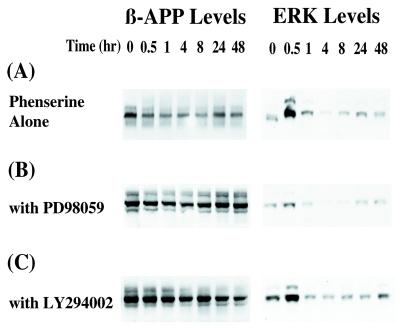
Phenserine treatment of U373 MG astrocytoma cells decreased βAPP protein levels, yet cotreatment with ERK and PI3-kinase inhibitors did not affect this process. U373 MG astrocytoma cells were treated with (−)-phenserine to determine their effect on βAPP protein levels. ERK inhibitor, PD98059, and PI3-kinase inhibitor, LY294002, were added and used to ascertain whether or not phenserine action on βAPP was directed via these signaling pathways. (A) Western blots of lysates (15 μg/lane) of U373 cells incubated with 50 μM (−)-phenserine for 0, 0.5, 1, 4, 8, 24, and 48 h were analyzed. The blot was divided into two sections. The blot was probed with anti-βAPP antibody (Left) or with anti-phosphorylated ERK antibody (Right). (B) U373 MG cells were pretreated with 25 nM PD98059 for 16 h before (−)-phenserine treatment. Lysates were analyzed by Western blots, described above. (C) U373 MG cells were pretreated with 200 μM LY294002 for 1.5 h before addition of (−)-phenserine. The cell lysate of each sample was analyzed as described above. βAPP protein levels were reduced by in excess of 25% (P < 0.05) with phenserine treatment in A, B, and C, as determined by densitometric quantification.
Figure 4
Figure 4
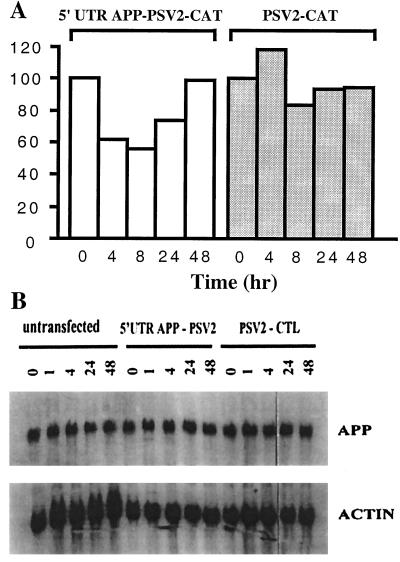
Phenserine regulation of βAPP protein levels in U373 MG astrocytoma cells is conferred through the action of the βAPP–mRNA 5′ UTR. U373 MG astrocytoma cells were transfected with 3 μg of pSV2 (APP) CAT plasmid or the parental vector pSV2 CAT. Each set of transfection plates was left unstimulated or treated with 50 μM of phenserine for the experimental times listed. (A) CAT activity was assessed from lysates of transfected cells treated with (−)-phenserine for 0, 4, and 8 h, and 50 μg from each sample was measured in duplicate for each assay. Quantitation of the fold stimulus of CAT gene activity conferred by the 5′ UTR βAPP–mRNA was measured. ELISA readings of CAT expression were measured at 405 nm. (B) Phenserine does not affect the steady-state levels of βAPP–mRNA levels. Ten micrograms of RNA isolated from untransfected and transfected cells treated with (−)-phenserine for 0, 1, 4, 24, and 48 h was analyzed by Northern blot. Phosphoimager analysis revealed steady-state expression of βAPP–mRNA in each sample. The filter was stripped and rehybridized with a labeled human actin probe to standardize the loading differences in individual samples.

References

    1. Selkoe D J. Science. 1997;275:630–631. - PubMed
    1. Roberson M, Harrell L. Brain Res Rev. 1997;25:50–69. - PubMed
    1. Checler F. J Neurochem. 1995;65:1431–1444. - PubMed
    1. Hussain I, Powell D, Howlett D, Tew D, Meek T, Chapman C, Gloger I, Murphy K, Southan C, Ryan D, et al. Mol Cell Neurosci. 1999;14:419–427. - PubMed
    1. Sinha S, Anderson J P, Barbour R, Basi G, Caccavello R, Davis D, Dovey H, Frigon N, Hong J, et al. Nature (London) 1999;402:537–540. - PubMed

Publication types

MeSH terms

LinkOut - more resources