


Relaxin for cervical ripening and induction of labour
- PMID: 11406079
- PMCID: PMC8693181
- DOI: 10.1002/14651858.CD003103
Relaxin for cervical ripening and induction of labour
Abstract
Background: Relaxin is a protein hormone composed of two amino acid chains. The role played by relaxin in human pregnancy and parturition is unclear. Its use and involvement as a cervical ripening agent has been debated since the 1950s. Because the main source of human relaxin is the corpus luteum of pregnancy much of the early work on induction of labour has focused on porcine or bovine preparations. With the advent of DNA recombinant technology human relaxin has become available for evaluation. Relaxin is thought to have a promoting effect on cervical ripening. Due to a possible inhibitory effect on human myometrial activity, relaxin may not be associated with the concomitant increase in the rate of uterine hyperstimulation seen with other induction agents. This is one of a series of reviews of methods of cervical ripening and labour induction using a standardised methodology.
Objectives: To determine the effects of relaxin (both purified porcine and recombinant human) for third trimester cervical ripening or induction of labour in comparison with other methods of induction.
Search strategy: The Cochrane Pregnancy and Childbirth Group trials register, the Cochrane Controlled trials register and bibliographies of relevant papers. Last searched: November 2000.
Selection criteria: (1) clinical trials comparing relaxin used for third trimester cervical ripening or labour induction with placebo/no treatment or other methods listed above it on a predefined list of labour induction methods; (2) random allocation to the treatment or control group; (3) adequate allocation concealment; (4) violations of allocated management not sufficient to materially affect conclusions; (5) clinically meaningful outcome measures reported; (6) data available for analysis according to the random allocation; (7) missing data insufficient to materially affect the conclusion.
Data collection and analysis: A strategy has been developed to deal with the large volume and complexity of trial data relating to labour induction. This involves a two-stage method of data extraction.
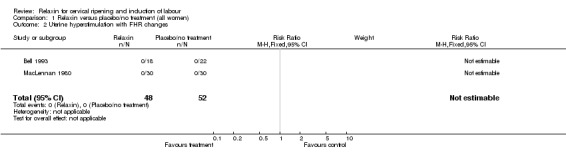
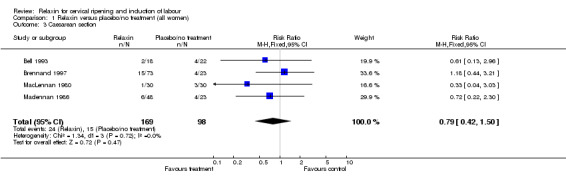
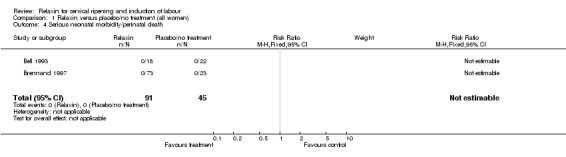
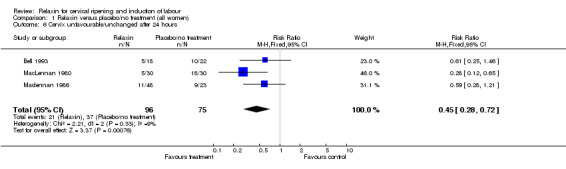
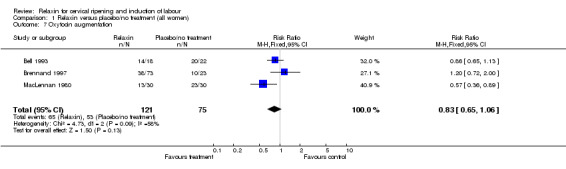
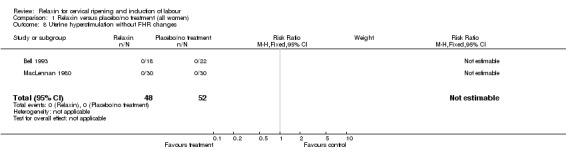
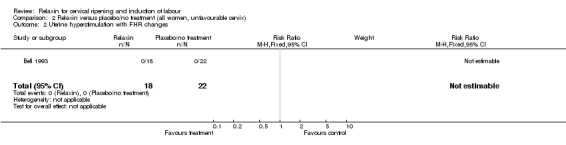
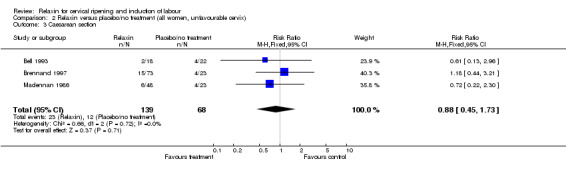
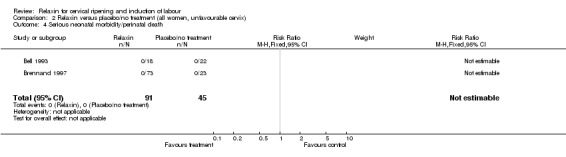
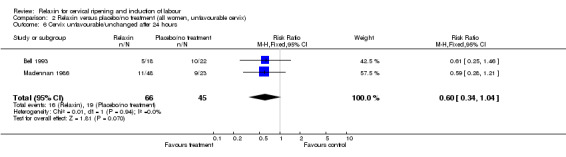
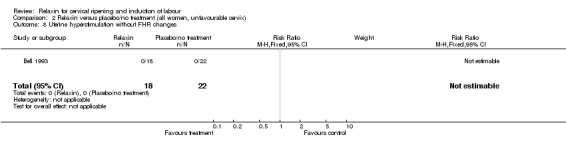
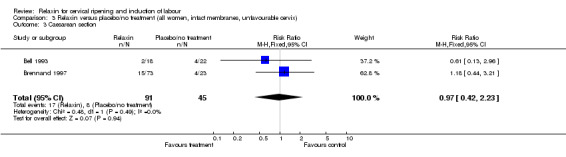
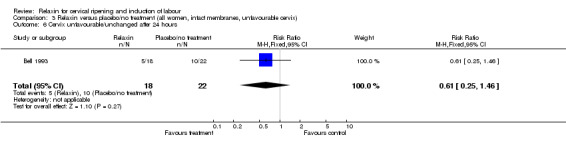
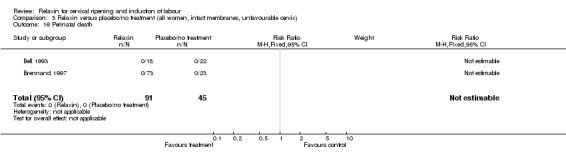
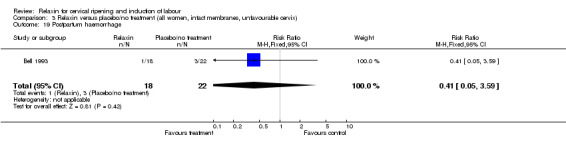
Main results: In total, nine studies were considered; five have been excluded and four included examining a total of 267 women. There were no reported cases of uterine hyperstimulation with fetal heart rate changes in any of the studies. The rate of caesarean section was not different in those women given relaxin compared with placebo (15.3% versus 14.2%; relative risk (RR) 0.79, 95% confidence interval (CI) 0.42,1.50). There was a reduction in the risk of the cervix remaining unfavourable or unchanged with induction with relaxin (21.9% versus 49.3%; RR 0.45, 95% CI 0.28,0.72). There were no reported cases of uterine hyperstimulation without FHR changes.
Reviewer's conclusions: The place of relaxin, either purified porcine or recombinant human, as an induction or cervical priming agent is unclear. Further trials are needed to estimate the true effect of relaxin within current clinical practice.
Conflict of interest statement
None known.
Figures


References
References to studies included in this review
Bell 1993 {published data only}
-
- Bell RJ, Permezel M, MacLennan A, Hughes C, Healy D, Brennecke S. A randomized, double‐blind, placebo controlled trial of the safety of vaginal recombinant human relaxin for cervical ripening. Obstetrics & Gynecology 1993;82:328‐33. - PubMed
Brennand 1997 {published data only}
-
- Brennand JE, Calder AA, Leitch CR, Greer IA, Chou MM, MacKenzie IZ. Recombinant human relaxin as a cervical ripening agent. British Journal of Obstetrics and Gynaecology 1997;104:775‐80. - PubMed
MacLennan 1980 {published data only}
-
- MacLennan AH, Green RC, Bryant‐Greenwood GD, Greenwood FC, Seamark RF. Ripening of the human cervix and induction of labor with purified porcine relaxin. Lancet 1980;1:220‐3. - PubMed
Maclennan 1986 {published data only}
-
- MacLennan AH, Green RC, Grant P, Nicolson R. Ripening of the human cervix and induction of labor with intracervical purified porcine relaxin. Obstetrics & Gynecology 1986;68:598‐601. - PubMed
References to studies excluded from this review
Chou 1991 {unpublished data only}
-
- Chou MM. Double‐blind randomized trial of human relaxin gel for cervical ripening and induction of labour. Personal communication 1991.
Decker 1958 {published data only}
-
- Decker WH, Thwaite W, Bordat S, Kayser R, Harami T, Campbell J. Some effects of relaxin in obstetrics. Obstetrics & Gynecology 1958;12:37‐46. - PubMed
Dill 1958 {published data only}
-
- Dill L, Chanatry J. Effect of relaxin on normal labour. JAMA 1958;167:1910‐2. - PubMed
Evans 1983 {published data only}
-
- Evans MI, Dougan MB, Moawad AH, Evans WJ, Bryant‐Greenwood GD, Greenwood FC. Ripening of the human cervix with porcine ovarian relaxin. American Journal of Obstetrics and Gynecology 1983;147:410‐4. - PubMed
Nesbitt 1961 {published data only}
-
- Nesbitt R, Cirigliano G. Use of relaxin during parturition. New York State Journal of Medicine 1961;61:90‐7. - PubMed
References to studies awaiting assessment
Critchley 1994 {published data only}
-
- Critchley HOD, Healy DL, Chard T. Is ovarian relaxin a stimulus to placental protein 14 secretion in pregnancy?. Journal of Endocrinology 1994;142(2):375‐8. - PubMed
Karpovich 2006 {published data only}
-
- Karpovich E. Recombinant human relaxin (rhRIx) in pregnant women scheduled for induction of labor (ongoing trial). ClinicalTrials.gov (http://clinicaltrials.gov/) (accessed 21 March 2006) 2006.
Weiss 2009 {published data only}
-
- Weiss G, Teichman S, Stewart D, Nader D, Wood S, Unemori E. A randomized, double‐blind, placebo‐controlled trial of relaxin for cervical ripening in post‐delivery date pregnancies. Annals of the New York Academy of Sciences 2009;1160:385‐6. - PubMed
Additional references
Clarke 2002
-
- Clarke M, Oxman AD, editors. Cochrane Reviewers’ Handbook 4.1.5 [Updated April 2002]. In: The Cochrane Library, Issue 3, 2002. Oxford: Update Software. Updated quarterly.
Curtis 1987
-
- Curtis P, Evans S, Resnick J. Uterine hyperstimulation. The need for standard terminology. Journal of Reproductive Medicine 1987;32:91‐5. - PubMed
Hofmeyr 2000
RevMan 2003 [Computer program]
-
- The Cochrane Collaboration. Review Manager (RevMan). Version 4.2 for Windows. Oxford, England: The Cochrane Collaboration, 2003.
Publication types
MeSH terms
Substances
LinkOut - more resources
Full Text Sources
Other Literature Sources
