. 2001 Jun;12(6):1801-10.
doi: 10.1091/mbc.12.6.1801.

Identification of a Saccharomyces cerevisiae gene that is required for G1 arrest in response to the lipid oxidation product linoleic acid hydroperoxide

Affiliations
Free PMC article

Identification of a Saccharomyces cerevisiae gene that is required for G1 arrest in response to the lipid oxidation product linoleic acid hydroperoxide

N Alic et al. Mol Biol Cell. 2001 Jun.
Free PMC article

Abstract

Reactive oxygen species cause damage to all of the major cellular constituents, including peroxidation of lipids. Previous studies have revealed that oxidative stress, including exposure to oxidation products, affects the progression of cells through the cell division cycle. This study examined the effect of linoleic acid hydroperoxide, a lipid peroxidation product, on the yeast cell cycle. Treatment with this peroxide led to accumulation of unbudded cells in asynchronous populations, together with a budding and replication delay in synchronous ones. This observed modulation of G1 progression could be distinguished from the lethal effects of the treatment and may have been due to a checkpoint mechanism, analogous to that known to be involved in effecting cell cycle arrest in response to DNA damage. By examining several mutants sensitive to linoleic acid hydroperoxide, the YNL099c open reading frame was found to be required for the arrest. This gene (designated OCA1) encodes a putative protein tyrosine phosphatase of previously unknown function. Cells lacking OCA1 did not accumulate in G1 on treatment with linoleic acid hydroperoxide, nor did they show a budding, replication, or Start delay in synchronous cultures. Although not essential for adaptation or immediate cellular survival, OCA1 was required for growth in the presence of linoleic acid hydroperoxide, thus indicating that it may function in linking growth, stress responses, and the cell cycle. Identification of OCA1 establishes cell cycle arrest as an actively regulated response to oxidative stress and will enable further elucidation of oxidative stress-responsive signaling pathways in yeast.


Figures
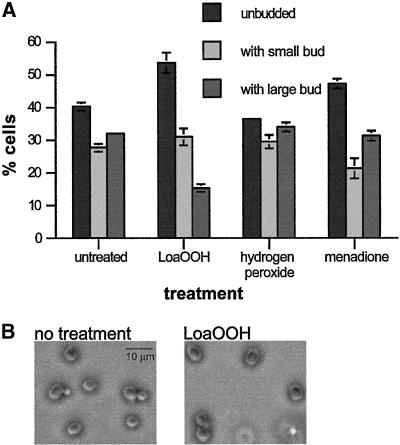
Figure 1
Figure 1
Treatment with LoaOOH leads to accumulation of unbudded cells. Wild-type cultures were grown to exponential phase in SDC medium, and aliquots were left untreated or treated with LoaOOH (0.04 mM), H2O2 (2 mM), or menadione (6 mM) for 2 h. Cells were fixed and scored for the presence and size of a bud. (A) Averages of 3 experiments are shown; error bars (± SD) are included if larger than 1%. (B) Photomicrographs of representative LoaOOH-treated or control cells.
Figure 2
Figure 2
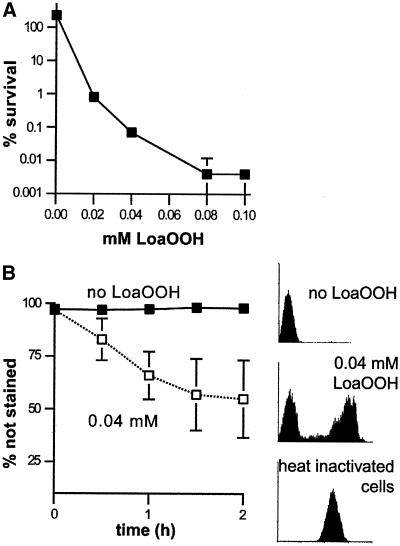
Viability and vitality after treatment with LoaOOH. Wild-type cultures were grown to exponential phase, and aliquots were treated with the indicated concentrations of LoaOOH or left untreated. (A) Survival after a 2-h incubation is expressed as the colony-forming ability relative to that before treatment. Data are the averages ± SD of triplicate measurements from a representative 1 of 3 experiments. (B) Cell vitality was monitored during the 2-h incubation by staining with oxonol, as described in MATERIALS AND METHODS. Averages ± SD from 2 independent experiments are shown. Representative FACS analysis profiles of the oxonol-stained cells are included. Heat-inactivated cells illustrate the usual staining of dead cells. Note the change in axes from panels A to B. Some error bars are masked by the symbols.
Figure 3
Figure 3
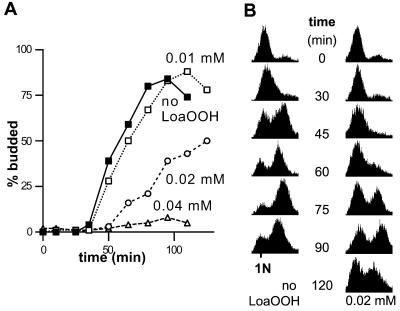
Treatment with LoaOOH leads to budding and replication delay. Wild-type cells were arrested with α-factor, and the culture was divided into aliquots, washed, resuspended in PBS, and treated with the indicated concentrations of LoaOOH for 30 min. Cells were then washed with PBS and resuspended in fresh SDC medium (time zero). Within the first 30 min, cells were plated on SDC medium for colony counts and total cell numbers were determined to give estimate of viability. (A) Progression through the cell division cycle was monitored by determining the proportion of budded cells. SDs were calculated for each sample as given in MATERIALS AND METHODS and were <3%. (B) Progression through the cell division cycle was monitored by determining the cellular DNA content as described in MATERIALS AND METHODS. FACS profiles show fluorescence on the X axis and event numbers on the Y axis. In both panels A and B, a representative of 2 independent experiments is shown.
Figure 4
Figure 4
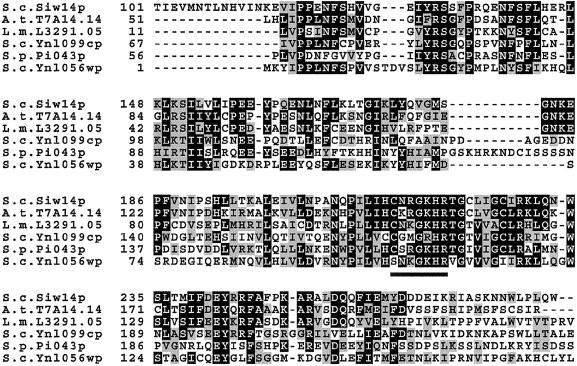
Multiple sequence alignment of Ynl099cp and several of its homologues. Homology search was performed with the use of BLAST, and the sequences were aligned with CLUSTALW. Only a portion of the alignment is shown. Ynl099cp and its 2 homologues from S. cerevisiae (S.c.) Siw14p and Ynl056wp are included together with the closest homologues from Arabdidopsis thaliana (A.t., gene product of T7A14.14), Leishmania major (L.m., hypothetical protein L3291.05), and Schizosaccharomyces pombe (S.p., Pi043p). The CX5R motif is underlined. Consensus identity is indicated by black boxes, while consensus similarity is indicated with gray boxes. GeneBank numbers for the sequences are (top to bottom): CAA95895, AAC97999, CAB42360, CAA95975, CAB51762, and CAA95929.
Figure 5
Figure 5
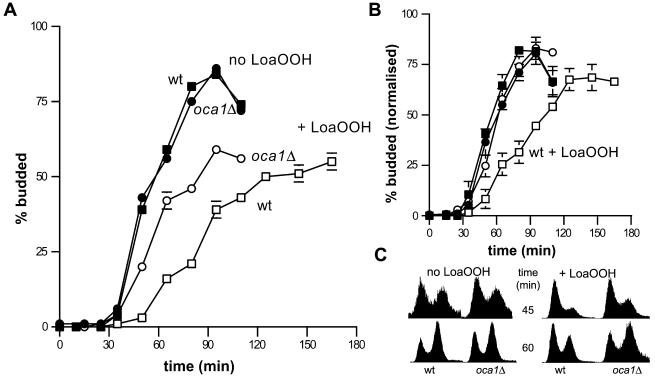
Absence of a budding and replication delay in the oca1Δ strain. Wild-type and oca1Δ cells were treated with 0.02 mM LoaOOH as described in Figure 3A, and the timing of budding was determined. (A) Data from a representative of 2 independent experiments are presented. (B) The percentages of budded cells were normalized to the viabilities in the corresponding populations. Averages ± SE of 2 independent experiments are shown. In both panels A and B the error bars are shown if larger than 2.5%. (C) In a separate experiment, cells were treated as described for A, samples were taken at 45 and 60 min after resuspension in fresh medium and the DNA content of cells determined as described in MATERIALS AND METHODS. The data are presented as in Figure 3B, with LoaOOH treated populations shown on the right.
Figure 6
Figure 6
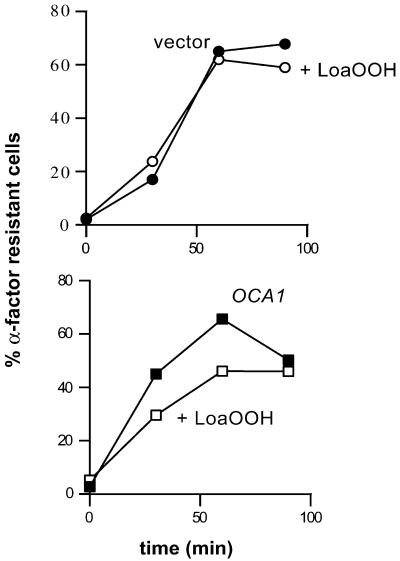
Dependence of Start delay on OCA1. A single-copy plasmid carrying OCA1 or the vector alone as a control were separately introduced into the oca1Δ strain. Both resulting transformants were synchronized with α-factor, treated with 0.02 mM LoaOOH (open symbols), or left untreated (closed symbols), and released as described in Figure 3A, except that SD-ura replaced SDC medium. The proportions of α-factor resistant cells were determined as described in MATERIALS AND METHODS. SDs for all samples were <4%. A representative of 2 independent experiments is shown.
Figure 7
Figure 7
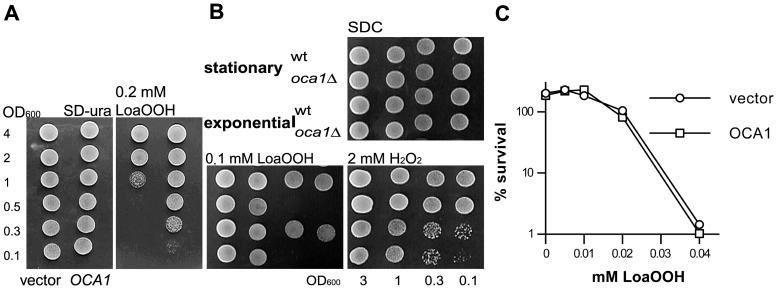
Absence of Oca1p results in LoaOOH sensitivity, irrespective of culture growth phase. (A) The oca1Δ strain carrying either the OCA1 clone (right colums) or the vector control (left columns) was grown in SD-ura medium to stationary phase. Cells were washed, diluted to the indicated OD600, and spotted on plates with or without LoaOOH (right and left panels respectively). Plates were photographed after 2-d growth. (B) Plate tests of sensitivity to LoaOOH and H2O2 were performed on wild-type (C11#8) and oca1Δ (FY10459A) strains grown to exponential (OD600 = 0.4) or stationary growth phase (OD600 ≈ 7), as described for A, except that SD-ura medium was replaced with SDC. In both A and B a representative of 2 experiments is shown. (C) Cell survival of the 2 transformants after 2-h incubation with different concentrations of LoaOOH was determined, as described in the legend to Figure 2A.
Figure 8
Figure 8
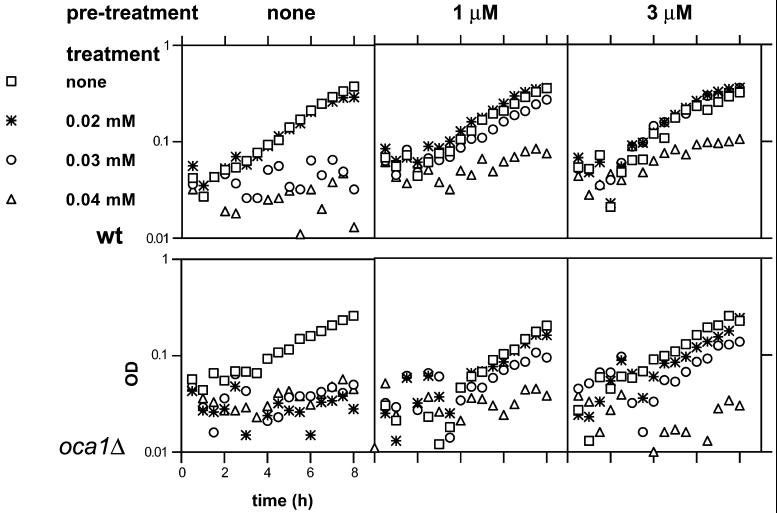
Growth of wild-type and oca1Δ strains in the presence of LoaOOH and adaptation to the hydroperoxide. Wild-type (upper panels) and the oca1Δ (lower panels) strains were grown to early exponential phase and aliquoted into wells of a microtiter plate. Cells were then pretreated with the indicated concentrations of LoaOOH for 1 h. LoaOOH was then added to the indicated treatment concentrations at time zero, and growth was monitored as described in MATERIALS AND METHODS. Data from a representative of 4 experiments are shown.

References

    1. Barrett WC, DeGnore JP, Keng YF, Zhang ZY, Yim MB, Chock PB. Roles of superoxide radical anion in signal transduction mediated by reversible regulation of protein-tyrosine phosphatase 1B. J Biol Chem. 1999;274:34543–34546. - PubMed
    1. Binley KM, Radcliffe PA, Trevethick J, Duffy KA, Sudbery PE. The yeast PRS3 gene is required for cell integrity, cell cycle arrest upon nutrient deprivation, ion homeostasis, and the proper organization of the actin cytoskeleton. Yeast. 1999;15:1459–1469. - PubMed
    1. Breeden LL. Alpha-factor synchronization of budding yeast. Methods Enzymol. 1997;283:332–342. - PubMed
    1. Carballo M, Conde M, El Bekay R, Martin-Nieto J, Camacho MJ, Monteseirin J, Conde J, Bedoya FJ, Sobrino F. Oxidative stress triggers STAT3 tyrosine phosphorylation and nuclear translocation in human lymphocytes. J Biol Chem. 1999;274:17580–17586. - PubMed
    1. Collinson LP, Dawes IW. Inducibility of the response of yeast cells to peroxide stress. J Gen Microbiol. 1992;138:329–335. - PubMed

Publication types