


Review
doi: 10.1172/JCI13375.
Unorthodox routes to prostanoid formation: new twists in cyclooxygenase-initiated pathways
Affiliations
- PMID: 11413151
- PMCID: PMC200204
- DOI: 10.1172/JCI13375
Item in Clipboard
Review
Unorthodox routes to prostanoid formation: new twists in cyclooxygenase-initiated pathways
J Clin Invest.
2001 Jun.
No abstract available
Figures
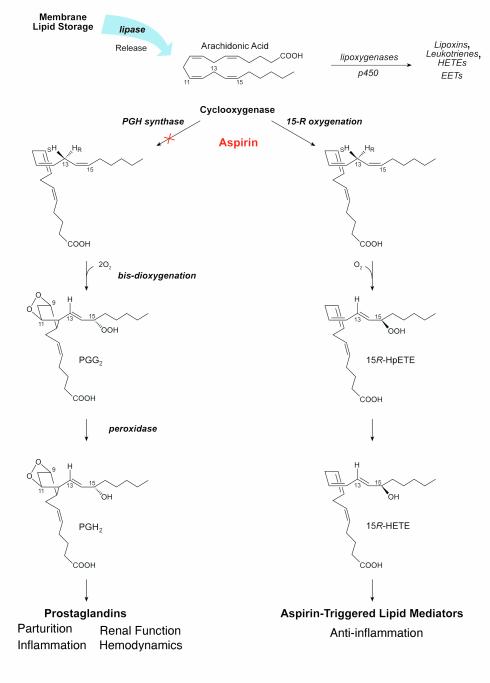
Cyclooxygenase reactions and products: prostaglandins and the impact of aspirin. Conversion of arachidonic acid to bioactive products involves stereoselective insertion of oxygen governed by COX (see text for details). Aspirin blocks formation of PGs from COX-1 and -2. In addition, with COX-2, aspirin triggers the formation of bioactive aspirin-triggered lipid mediators.
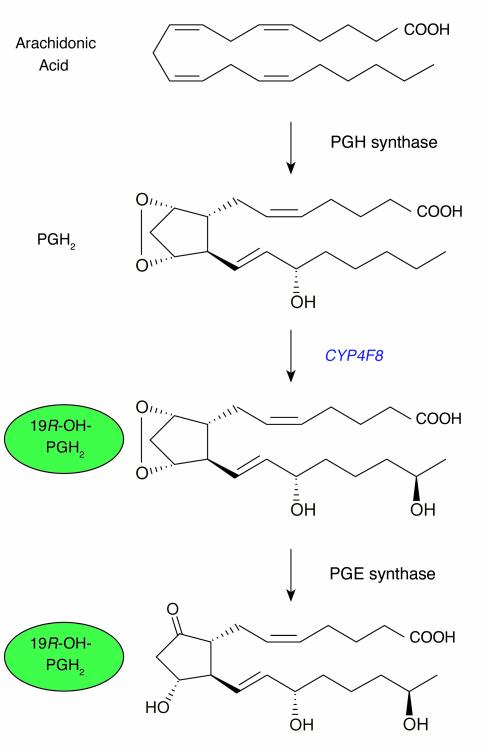
Biosynthesis of 19R-hydroxy-PGE from PGH2 by CYP4F8 and PGE synthases. 19R-hydroxy-PGE is a major eicosanoid in humans. This novel biosynthesis route indicates that the 19 position R alcohol is in place before the PGE2 ring is made (see text).
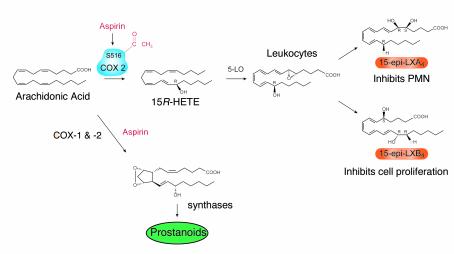
Aspirin-triggered lipid mediators: biosynthesis of 15-epi-LXs. Irreversible acetylation of COX-2 by aspirin changes the enzyme’s product from PGs intermediate to precursors of ATLMs. The acetylated COX-2 remains catalytically active (see text).
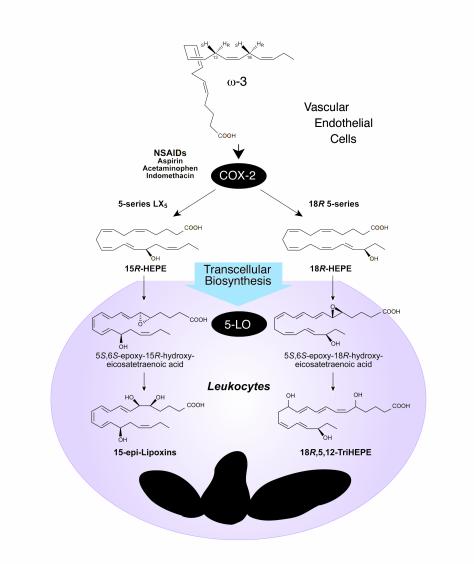
Functional arrays of lipid signals generated via transcellular processing ω-3 PUFA: endogenous inhibitors of microinflammation. At sites where COX-2 is expressed and treated with NSAIDs, although PG formation is blocked, systemic ω-3 PUFA can be converted via a COX-2-NSAID–dependent LO-type mechanism (stereospecific hydrogen abstraction at C16 or C13 in C20:5 to give R insertions of molecular O2) to yield 15R-H(p)EPE or 18R-H(p)EPE. These compounds are reduced to alcohols and converted to epoxide intermediates. Elucidation of the complete stereochemistry of the trihydroxy-compounds is in progress, and they are depicted in their likely configuration. The products interact with cells in the local microenvironment, inhibiting PMN recruitment. See text and suggested reading list (http://www.jci.org/cgi/content/full/107/12/1481/DC1) for details.
References
-
- Bylund J, Hidestrand M, Ingelman-Sundberg M, Oliw EH. Identification of CYP4F8 in human seminal vesicles as a prominent 19- hydroxylase of prostaglandin endoperoxides. J Biol Chem. 2000;275:21844–21849. - PubMed
-
- Bergström, S. 1982. The prostaglandins: from the laboratory to the clinic. In Les prix nobel: Nobel prizes, presentations, biographies and lectures. Edited by The Nobel Foundation. Almqvist & Wiksell. Stockholm, Sweden. 129–148.
Publication types
MeSH terms
Substances
Grants and funding
LinkOut - more resources
Full Text Sources
Other Literature Sources
Research Materials
