


Comment
doi: 10.1084/jem.193.12.f47.
On the role of the innate immunity in autoimmune disease
Affiliations
- PMID: 11413199
- PMCID: PMC2193298
- DOI: 10.1084/jem.193.12.f47
Item in Clipboard
Comment
On the role of the innate immunity in autoimmune disease
J Exp Med.
.
No abstract available
Figures
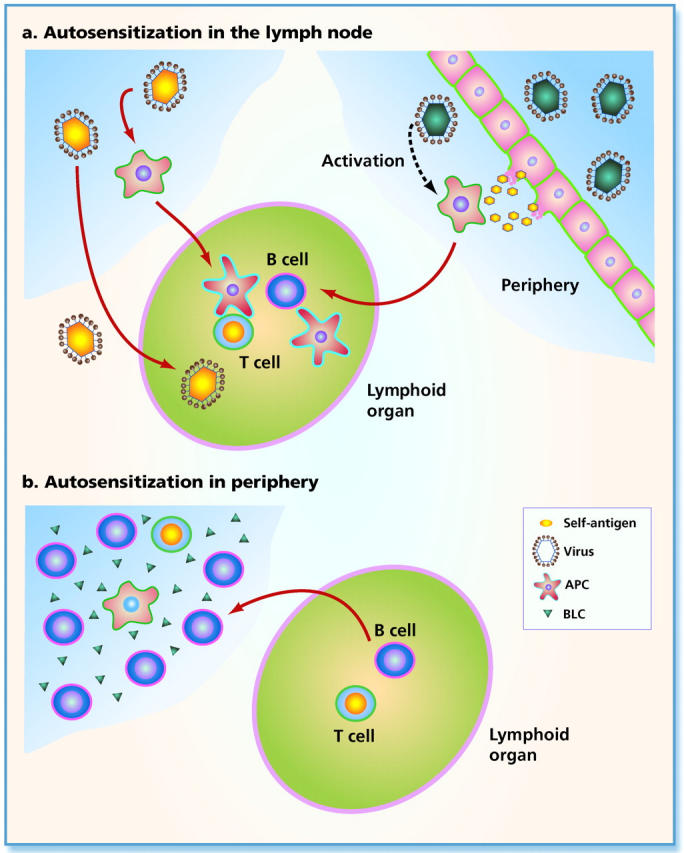
Models for autosensitization of lymphocytes. (a) Self-antigens are transported to lymphoid organs where activation of self-specific lymphocytes occurs. On the left side is indicated that pathogens carrying B or T cell epitopes shared with the host may directly reach lymphoid organs for induction of an immune response. Alternatively, pathogens may infect DCs or are processed by them. Activated DCs subsequently migrate to lymphoid organs and induce autoimmunity. On the right side is illustrated that pathogens may induce cell lysis, either directly or by activation of cytotoxic T cells. Self-antigens (shown in yellow) are released during this process and are taken up and processed by local DCs. In addition, the DCs are stimulated by pathogen-associated patterns triggering their migration to lymphoid organs where autosensitization occurs. (b) Lymphocytes are recruited to the periphery, where activation of self-specific lymphocytes occurs. Chemokines, such as BLC (triangles), are secreted by DCs which attracts B cells from lymphoid organs and probably the peritoneum. B1 cells may be attracted preferentially under these conditions. These B cells together with additionally recruited T cells and the BLC-producing DCs generate an environment ideal for activation of lymphocytes and autosensitization may occur locally.
Comment on
-
Aberrant high expression of B lymphocyte chemokine (BLC/CXCL13) by C11b+CD11c+ dendritic cells in murine lupus and preferential chemotaxis of B1 cells towards BLC.J Exp Med. 2001 Jun 18;193(12):1393-402. doi: 10.1084/jem.193.12.1393. J Exp Med. 2001. PMID: 11413194 Free PMC article.
References
-
- Medzhitov R., Janeway C.A., Jr. Innate immunitythe virtues of a nonclonal system of recognition. Cell. 1997;91:295–298. - PubMed
-
- Janeway C. Approaching the Asymptote? Evolution and Revolution in Immunology 1989. Cold Spring Harbor Laboratory Press; Cold Spring Harbor, New York: pp. 13 - PubMed
-
- Zinkernagel R.M. Immunology taught by viruses. Science. 1996;271:173–178. - PubMed
-
- Matzinger P. Tolerance, danger, and the extended family. Annu. Rev. Immunol. 1994;12:991–1045. - PubMed
-
- Oldstone M. Molecular mimicry and autoimmune disease. Cell. 1987;50:819–820. - PubMed
Publication types
MeSH terms
Substances
LinkOut - more resources
Full Text Sources
Other Literature Sources
Medical
