


Review
doi: 10.1128/AEM.67.7.2883-2894.2001.
Antifungal proteins
Affiliations
- PMID: 11425698
- PMCID: PMC92957
- DOI: 10.1128/AEM.67.7.2883-2894.2001
Item in Clipboard
Review
Antifungal proteins
Appl Environ Microbiol.
2001 Jul.
No abstract available
Figures
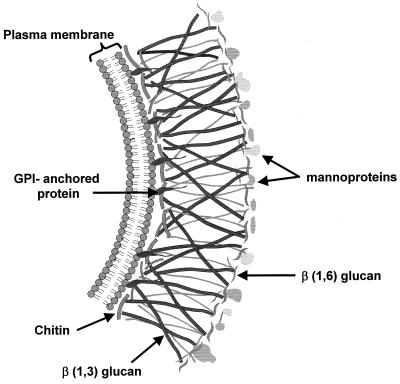
Schematic of fungal cell wall. GPI,
glycophosphatidylinositol.
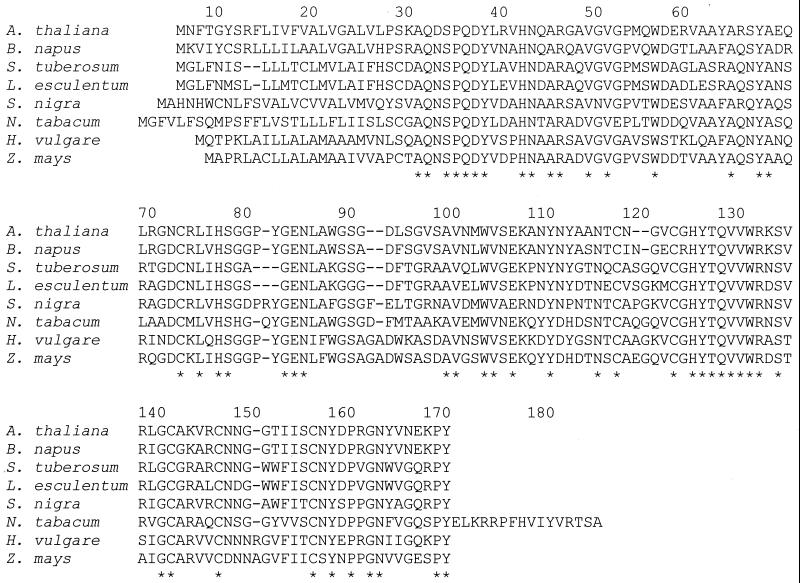
Amino acid sequence alignment of representative PR-1
proteins from Arabidopsis thaliana (accession no. P33154),
Brassica napus (rape, accession no. T08154), Solanum
tuberosum (potato, accession no. CAB58263), Lycopersicon
esculentum (tomato, accession no. CAA04881), Sambucus
nigra (elder, accession no. Q41359), Nicotiana tabacum
(tobacco, accession no. S10205), Hordeum vulgare (barley,
accession no. Q05968), and Zea mays (maize, accession no.
T02054). Alignments were performed with the ClustalW program
(http://clustalw.genome.ad.jp/ ); ∗ indicates amino acid identity.
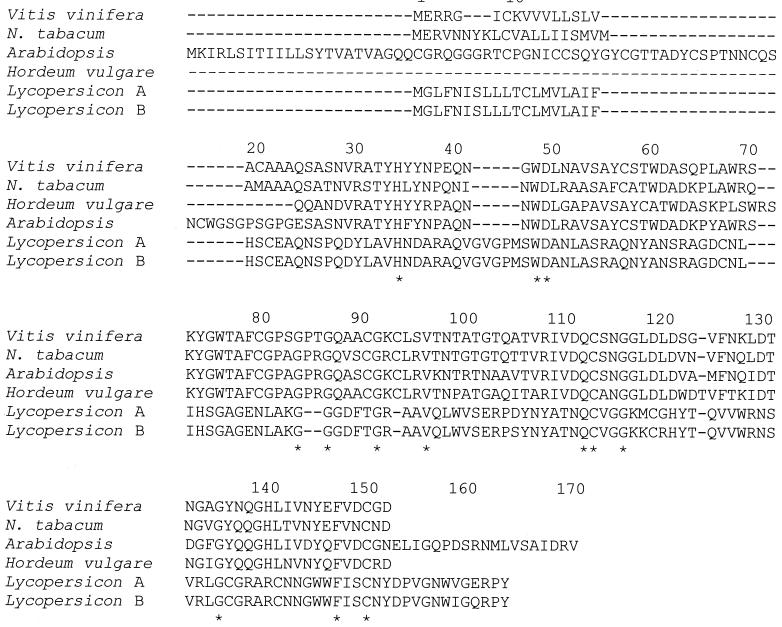
Amino acid sequence alignment of selected PR-4 proteins
from Vitis vinifera (accession no. AAC33732),
Nicotiana tabacum (common tobacco, accession no. S23799),
Arabidopsis thaliana (accession no. P43082), Hordeum
vulgare (barley-barwin, accession no. A43474), and
Lycopersicon esculentum (tomato, accession no. P04284 and
Q04108). Alignments were performed with the ClustalW program; ∗
indicates amino acid identity.
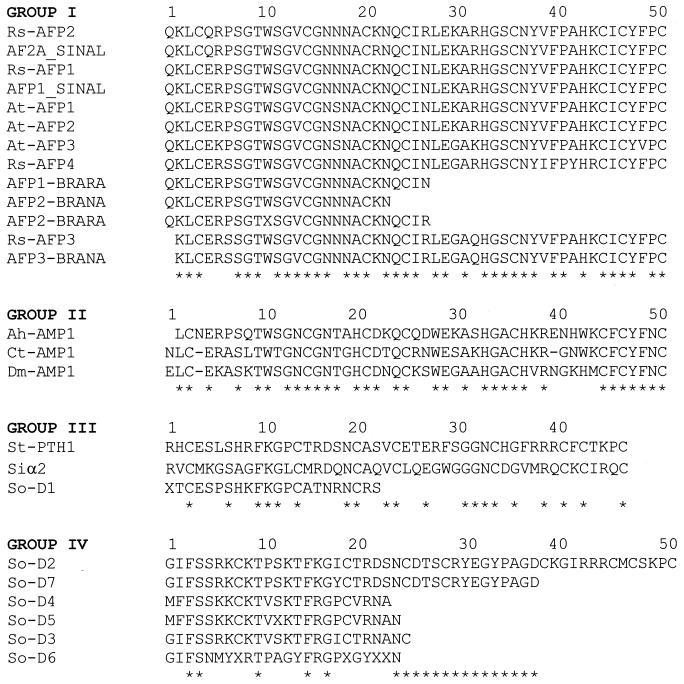
Amino acid sequence alignment of selected group I to IV
defensins. Rs-AFP 1 to 4 are from Raphanus sativas (radish,
accession no. P30225, P30230, 024332, and 024331), At-AFP1 to 3 are
from Arabidopsis thaliana (thale cress, accession no.
P30224, 080995, and 080994), AFP2-BRANA (rape, accession no. P30226)
and AFP3-BRANA (rape, accession no. Q39313) are from Brassica
napus, AFP1-BRARA (accession no. P30227) and AFP2-BRARA (accession
no. P30228) are from B. rapa, AFP1_SINAL (white mustard,
accession no. P30231) and AF2A_SINAL (white mustard, accession no.
P30232) are from Sinapis alba, Ct-AMP1 (accession no.
S66219) is from Clitoria ternate, Ah-AMP1 (common horse
chestnut, accession no. S66218) is from Aesculus
hippocastanum, Dm-AMP1 (bedding dahlia seeds, accession no.
AAB34972) is from Dahlia merckii, St-PTH1 (potato tubers,
accession no. AAB 31351) is from Solanum tuberosum, Siα2
(sorghum, accession no. P21924) is from Sorghum bicolor, and
So-D1- to -7 (spinach) are from Spinacia oleracea.
Alignments were done with the ClustalW program;∗ indicates amino acid
identity.
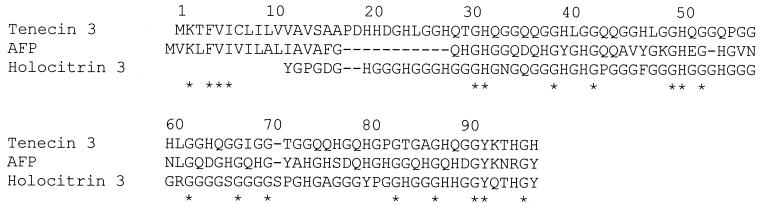
Amino acid sequence alignment of selected
glycine/histidine-rich proteins. Tenecin 3 (yellow mealworm, accession
no. AAA97579.1) is from Tenebrio molitor, AFP (flesh fly,
accession no. BAA02954.1) is from Sarcophaga peregrina, and
holotricin 3 (accession no. BAA02889) is from Holotrichia
diomphalia. Alignments were done with the ClustalW program, ∗
indicates amino acid identity.
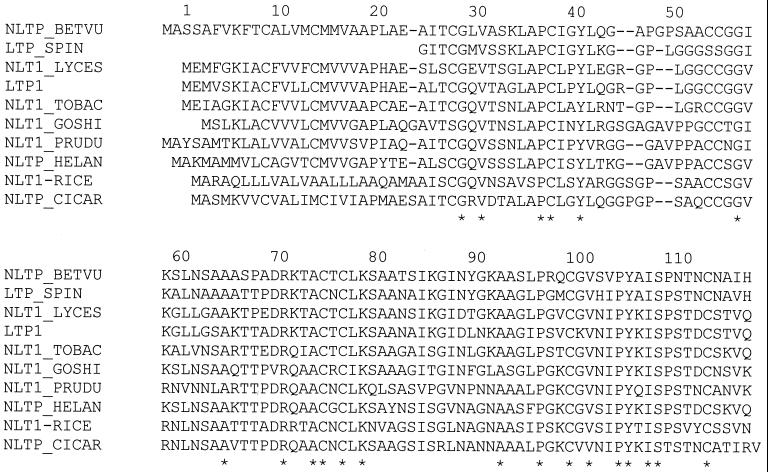
Amino acid sequence alignment of selected LTPs.
NLTP_BETVU (beet, accession no. Q43748) is from Beta
vulgaris, LTP_SPIN (common spinach, accession no. S00060) is from
Spinacia oleracea, NLT1_LYCES (tomato, accession no. P93224)
is from Lycopersicon esculentum, LTP1 (tomato, accession no.
AAB07486) is from L. pennellii, NLT1_TOBAC (common tobacco,
accession Q42952) is from Nicotiana tabacum, NLT1_GOSHI
(upland cotton, accession no. 42762) is from Gossypium
hirsutum, NLT1_PRUDU (almond, accession no. Q43017) is from
Prunus dulcis, NLTP_HELAN (common sunflower, accession no.
Q39950) is from Helianthus annuus, NLT1-RICE (rice,
accession no. T02038) is from Oryza sativa, and NLTP_CICAR
(chickpea, accession no. 023758) is from Cicer arietinum.
Alignments were done with the ClustalW program; ∗ indicates
amino acid identity.
References
-
- Agrawal G K, Jwa N S, Rakwal R. A novel rice (Oryza sativa L.) acidic PR1 gene highly responsive to cut, phytohormones, and protein phosphatase inhibitors. Biochem Biophys Res Commun. 2000;274:157–165. - PubMed
-
- Ahmed A, Sesti F, Ilan N, Shih T M, Sturley S L, Goldstein S A. A molecular target for viral killer toxin: TOK1 potassium channels. Cell. 1999;99:283–291. - PubMed
-
- Ainsworth G, editor. The fungi, an advance treatise. New York, N.Y: Academic Press; 1973.
-
- Almeida M S, Cabral K M, Zingali R B, Kurtenbach E. Characterization of two novel defense peptides from pea (Pisum sativum) seeds. Arch Biochem Biophys. 2000;378:278–286. - PubMed
-
- Alves A L, De Samblanx G W, Terras R R, Cammue B P, Broekaert W F. Expression of functional Raphanus sativusantifungal protein in yeast. FEBS Lett. 1994;348:228–232. - PubMed
Publication types
MeSH terms
Substances
LinkOut - more resources
Full Text Sources
Other Literature Sources
Medical
