. 2001 Jul;67(7):3269-74.
doi: 10.1128/AEM.67.7.3269-3274.2001.

Toxic-metabolite-producing bacteria and fungus in an indoor environment

Affiliations

Toxic-metabolite-producing bacteria and fungus in an indoor environment

J Peltola et al. Appl Environ Microbiol. 2001 Jul.

Abstract

Toxic-metabolite-emitting microbes were isolated from the indoor environment of a building where the occupant was suffering serious building-related ill-health symptoms. Toxic substances soluble in methanol and inhibitory to spermatozoa at <10 microg (dry weight) ml(-1) were found from six bacterial isolates and one fungus. The substances from isolates of Bacillus simplex and from isolates belonging to the actinobacterial genera Streptomyces and Nocardiopsis were mitochondriotoxic. These substances dissipated the mitochondrial membrane potential (Deltapsi) of boar spermatozoa. The substances from the Streptomyces isolates also swelled the mitochondria. The substances from isolates of Trichoderma harzianum Rifai and Bacillus pumilus damaged the cell membrane barrier function of sperm cells.


Figures
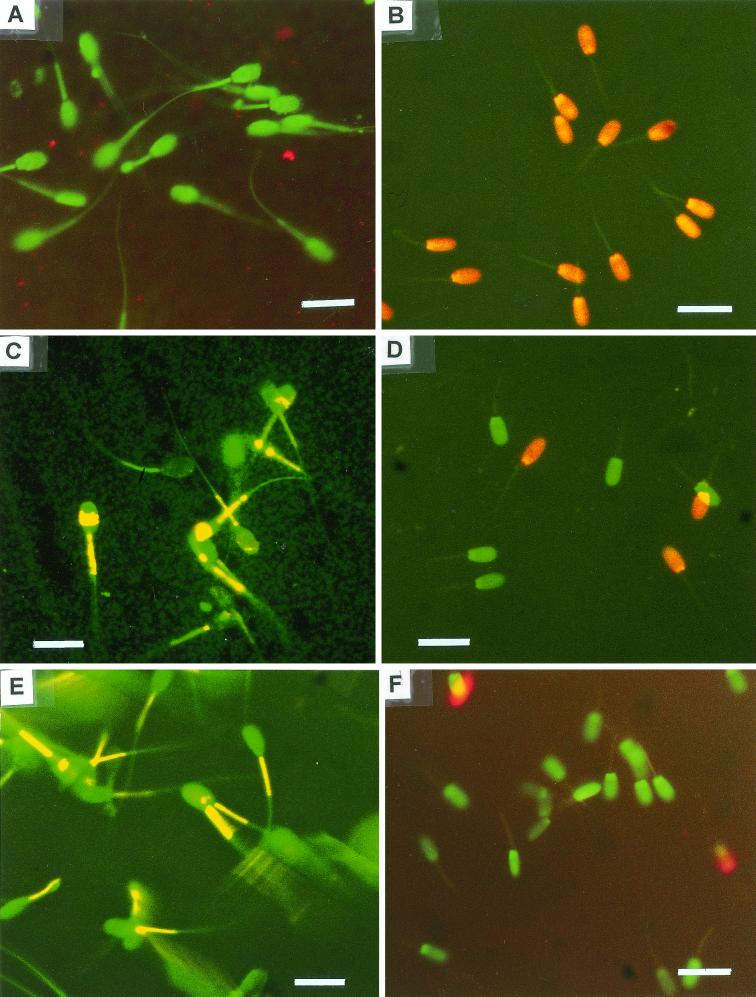
FIG. 1
FIG. 1
Epifluorescence micrographs of boar spermatozoa stained with the dye JC-1 to visualize the mitochondrial Δψ (A, C, and E) and with a live/dead staining with SYBR-14 and propidium iodide (B, D, and F) to demonstrate effects on the cell membrane. Boar spermatozoa were exposed to 9.6 μg of methanol-soluble metabolites from Trichoderma harzianum ES39 ml−1 for 3 days (A and B) or to 9.0 μg of methanol-soluble metabolites from Streptomyces sp. strain ES16 ml−1 for 3 days (C and D) or to the reagents only (E and F). Excitation light, 390 to 490 nm. Bars, 10 μm.
FIG. 2
FIG. 2
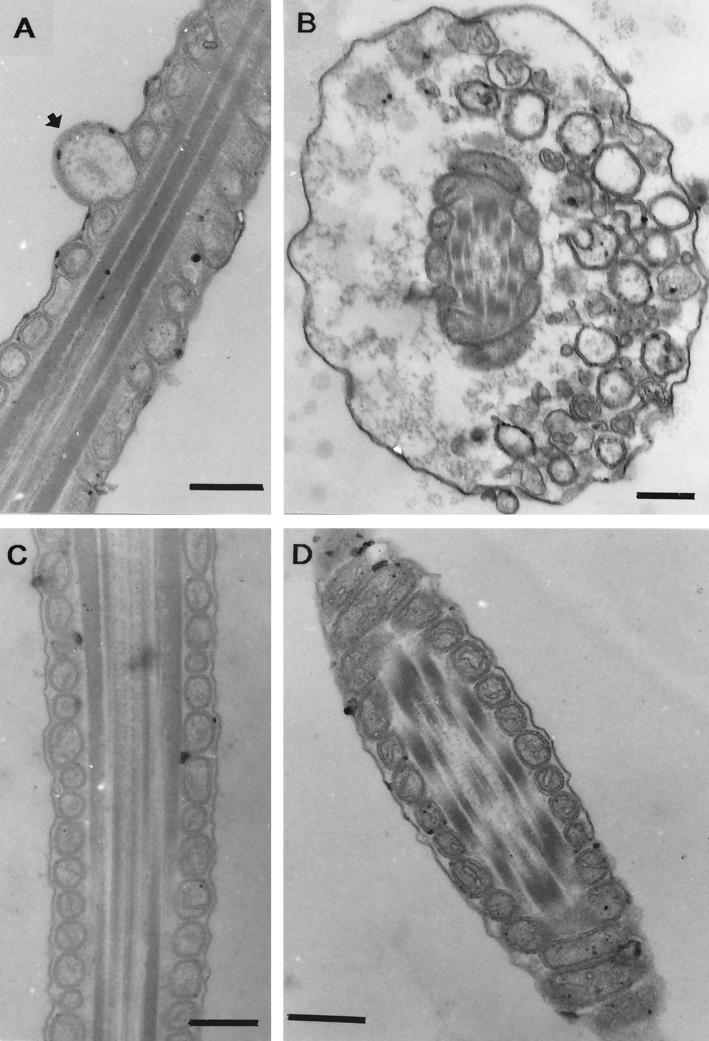
TEM of thin sections of middle piece of boar spermatozoa exposed to methanol-soluble metabolites from toxic bacterial isolates of indoor-environment origin. Boar spermatozoa were exposed to 9.0 μg of methanol-soluble substances of Streptomyces sp. strain ES16 ml−1 for 3 days (A) or to 40.0 μg of B. simplex ES21 ml−1 for 3 days (B). Longitudinal (C) and transverse (D) thin sections of spermatozoon exposed to reagents only. A swollen mitochondrion (arrow) is visible in panel A. Swelling of the midpiece of the spermatozoan tail is visible in panel B. Thin sections of panels C and D show unaffected cell membranes and normal-sized mitochondria. Bars, 0.2 μm.

References

    1. Andersson M A, Laukkanen M, Nurmiaho-Lassila E-L, Rainey F A, Niemelä S, Salkinoja-Salonen M S. Bacillus thermosphaericus sp. nov.: a new thermophilic ureolytic Bacillus isolated from air. Syst Appl Microbiol. 1995;18:203–220.
    1. Andersson M A, Nikulin M, Köljalg U, Andersson M C, Rainey F A, Reijula K, Hintikka E-L, Salkinoja-Salonen M S. Bacteria, molds, and toxins in water-damaged building materials. Appl Environ Microbiol. 1997;63:387–393. - PMC - PubMed
    1. Andersson M A, Mikkola R, Helin J, Andersson M C, Salkinoja-Salonen M S. A novel sensitive bioassay for the detection of Bacillus cereus emetic toxin and related depsipeptide ionophores. Appl Environ Microbiol. 1998a;64:1338–1343. - PMC - PubMed
    1. Andersson M A, Mikkola R, Kroppenstedt R, Rainey F A, Peltola J, Helin J, Sivonen K, Salkinoja-Salonen M S. Mitochondrial toxin produced by Streptomyces griseus strains isolated from indoor environment is valinomycin. Appl Environ Microbiol. 1998b;64:4767–4773. - PMC - PubMed
    1. Andersson M A, Weiss N, Rainey F A, Salkinoja-Salonen M S. Dust-borne bacteria in animal sheds, schools and children's day care centers. J Appl Microbiol. 1999;86:622–634. - PubMed

Publication types

MeSH terms

LinkOut - more resources