. 2001 Jul;39(7):2610-7.
doi: 10.1128/JCM.39.7.2610-2617.2001.

Detection of rifampin-resistant Mycobacterium tuberculosis in sputa by nested PCR-linked single-strand conformation polymorphism and DNA sequencing

Affiliations

Detection of rifampin-resistant Mycobacterium tuberculosis in sputa by nested PCR-linked single-strand conformation polymorphism and DNA sequencing

B J Kim et al. J Clin Microbiol. 2001 Jul.

Abstract

Either PCR-mediated single strand conformation polymorphism (SSCP) analysis or DNA sequencing of rpoB DNA (157 bp) can be used as a rapid screening method for the detection of mutations related to the rifampin resistance of Mycobacterium tuberculosis. However, due to the nonspecific amplification of rpoB DNA from nontuberculous mycobacteria these methods cannot be directly applied to clinical specimens such as sputa. We developed a nested PCR method that can specifically amplify the rpoB DNA of M. tuberculosis on the basis of rpoB DNA sequences of 44 mycobacteria. Nested PCR-linked SSCP analysis and the DNA sequencing method were applied directly in order to detect M. tuberculosis and determine its rifampin susceptibility in 56 sputa. The results obtained by nested PCR-SSCP and DNA sequencing were concordant with those of conventional drug susceptibility testing and DNA sequencing performed with culture isolates.


Figures
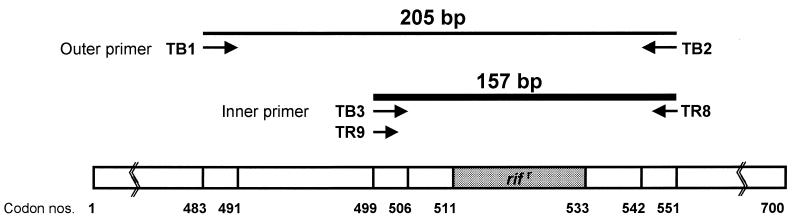
FIG. 1
FIG. 1
Primers used for PCR and nested PCR. Conventional PCR was performed with the TR9-TR8 primer set as previously described. The first-round PCR was performed with the TB1-TB2 primer set amplifying 205-bp rpoB DNA. The second-round PCR was performed with the TB3-TR8 primer set to amplify 157-bp DNA from the first-round PCR product. Numbers indicate rpoB codons of E. coli.
FIG. 2
FIG. 2
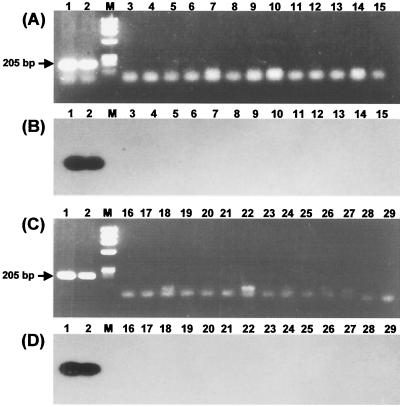
Specific amplification of M. tuberculosis rpoB DNA by first-round PCR (TB1-TB2 primer set). The Southern blot shows that the PCR product (205 bp) was amplified from only M. tuberculosis by the first-round PCR. (A and B) Lanes: 1, M. tuberculosis H37Rv; 2, clinical isolate of M. tuberculosis; M, φX174/RF DNA/HaeIII digest; 3, M. avium; 4, M. fortuitum; 5, M. gastri; 6, M. gordonae; 7, M. intracellulare; 8, M. kansasii; 9; M. malmoense; 10, M. nonchromogenicum; 11, M. phlei; 12, M. scrofulaceum; 13, M. simiae; 14, M. smegmatis; 15, M. terrae. (C and D) Lanes 16, M. triviale; 17, M. vaccae; 18, M. chelonae; 19, M. szulgai; 20, M. ulcerans; 21, Rhodococcus equi; 22, Rhodococcus erythropolis; 23, Rhodococcus rhodochrous; 24, Nocardia otitidiscaviarum; 25, Nocardia nova; 26, Corynebacterium glutamicum; 27, Corynebacterium diphtheriae; 28, Neisseria meningitidis; 29, Haemophilus influenzae.
FIG. 3
FIG. 3
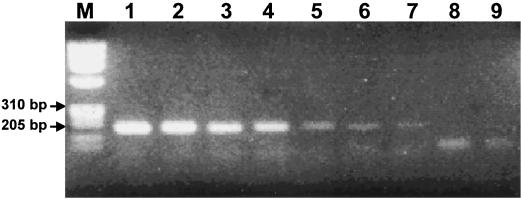
Amplification of rpoB DNA by nested PCR using serially diluted M. tuberculosis DNA as templates. Amplified products are observed only in the lanes that used more than 10 fg of template DNA. Lanes: M, φX174/RF DNA/HaeIII digest; 1, 10 ng; 2, 1 ng; 3, 100 pg; 4, 10 pg; 5, 1 pg; 6, 100 fg; 7, 10 fg; 8, 1 fg; 9, negative control without DNA.
FIG. 4
FIG. 4
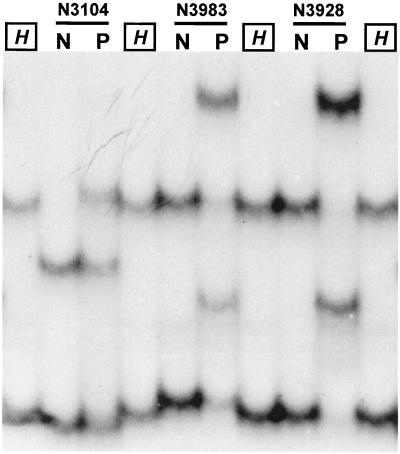
Comparison of PCR-SSCP and nested PCR-SSCP performed with three sputum specimens, N3104 (His526 [CAC]→Arg [CGC]), N3928 (wild type), and N3983 (Ser531 [TTG]→Leu [TCG]). Patterns of conventional PCR-SSCP using the TR9-TR8 primer set showed more than two bands (lanes P). They were unusual in PCR-SSCP analysis performed with culture. However, nested PCR-SSCP showed only two bands by which the rifampin resistance of M. tuberculosis could be determined as other reports (lanes N). H, M. tuberculosis H37Rv.
FIG. 5
FIG. 5
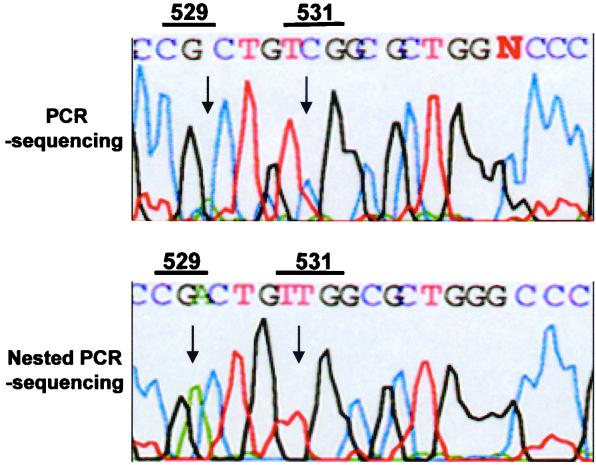
Electropherograms of automatic DNA sequencing after the amplification of rpoB DNA by PCR and nested PCR which were directly performed with the DNA from sputum sample N3983. The PCR DNA sequencing (upper panel) showed ambiguous results due to nonspecific amplification of rpoB DNA. However, nested PCR DNA sequencing (lower panel) revealed a signature nucleotide at codon 529 (CGA) and a mutation at codon 531 (TTG) in the rpoB DNA of M. tuberculosis. N3983 was confirmed by susceptibility testing and sequence analysis of culture isolate as a rifampin-resistant strain harboring a mutation at Ser531 (TCG→TTG).
FIG. 6
FIG. 6
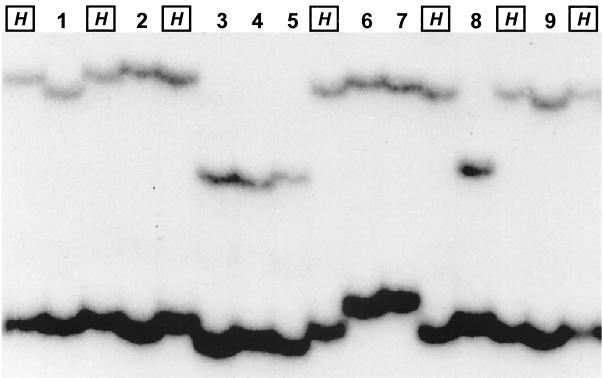
Nested PCR-SSCP patterns of rifampin-resistant strains (lanes 1 to 9) identified in this study. Lanes: H, M. tuberculosis H37Rv; 1, N3523 (Gln513→Pro); 2, N2893 (Asp516→Val); 3, N2910 (His526→Tyr); 4, N3501 (His526→Asp); 5, N2902 (His526→Arg); 6, N2895 (Ser531→Leu); 7, N3522 (Ser531→Met); 8, N2877 (Leu533→Pro); 9, N3471 (Met515, Asp516, Gla517, Asn518→Ile, Ala, Asn, Tyr).

References

    1. Barnes P, Bloch A B, Davidson P T, Snider D E., Jr Tuberculosis in patients with immunodeficiency virus infection. N Engl J Med. 1991;324:1644–1650. - PubMed
    1. Boom R, Sol C J A, Salimans M M M, Jansen C L, Wertheim-van Dillen P M E, Van Der Noordaa J. Rapid and simple method for purification of nucleic acids. J Clin Microbiol. 1990;28:495–503. - PMC - PubMed
    1. British Thoracic Association. A controlled trial of six months chemotherapy in pulmonary tuberculosis. Am Rev Respir Dis. 1982;126:460–462. - PubMed
    1. De Beenhouwer H, Lhiang Z, Jannes G, Mijs W, Machtelinckx L, Rossau R, Traore H, Portalels F. Rapid detection of rifampin resistance in sputum and biopsy specimens from tuberculosis patients by PCR and line probe assay. Tuber Lung Dis. 1995;76:425–430. - PubMed
    1. Des Prez R M, Heim C R. Mycobacterium tuberculosis. In: Mandell G L, Douglas R G, Bennett J E, editors. Principles and practice of infectious diseases. 2nd ed. New York, N.Y: Churchill Livingstone; 1990. pp. 1877–1906.

Publication types

MeSH terms

LinkOut - more resources