. 2001 Jul 3;98(14):7801-5.
doi: 10.1073/pnas.141036198. Epub 2001 Jun 26.

A TRP homolog in Saccharomyces cerevisiae forms an intracellular Ca(2+)-permeable channel in the yeast vacuolar membrane

Affiliations

A TRP homolog in Saccharomyces cerevisiae forms an intracellular Ca(2+)-permeable channel in the yeast vacuolar membrane

C P Palmer et al. Proc Natl Acad Sci U S A. .

Abstract

The molecular identification of ion channels in internal membranes has made scant progress compared with the study of plasma membrane ion channels. We investigated a prominent voltage-dependent, cation-selective, and calcium-activated vacuolar ion conductance of 320 pS (yeast vacuolar conductance, YVC1) in Saccharomyces cerevisiae. Here we report on a gene, the deduced product of which possesses significant homology to the ion channel of the transient receptor potential (TRP) family. By using a combination of gene deletion and re-expression with direct patch clamping of the yeast vacuolar membrane, we show that this yeast TRP-like gene is necessary for the YVC1 conductance. In physiological conditions, tens of micromolar cytoplasmic Ca(2+) activates the YVC1 current carried by cations including Ca(2+) across the vacuolar membrane. Immunodetection of a tagged YVC1 gene product indicates that YVC1 is primarily localized in the vacuole and not other intracellular membranes. Thus we have identified the YVC1 vacuolar/lysosomal cation-channel gene. This report has implications for the function of TRP channels in other organisms and the possible molecular identification of vacuolar/lysosomal ion channels in other eukaryotes.


Figures
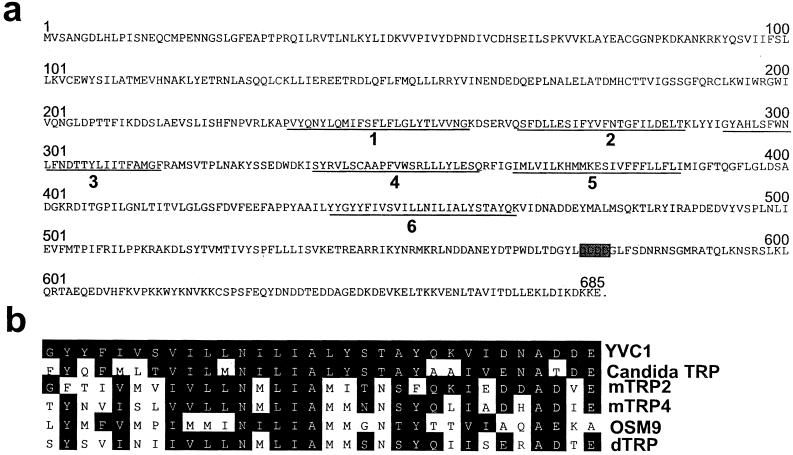
Figure 1
Figure 1
Deduced amino acid sequence of the protein encoded by the YVC1 gene and amino acid alignment with related sequences. (a) Deduced amino acid sequence of the YVC1 gene; predicted TM domains 1–6 are underlined. The C terminus contains a putative calcium binding bowl (18) (DDDD motif residues 572–575). (b) Alignment between the predicted sixth TM region of YVC1 and the predicted sixth TM regions of other TRPs: Candida TRP, a homolog in C. albicans; mTRP2 and mTRP4, mouse homologs (19, 20); OSM9, a homolog in Caenorhabditis elegans (21); dTRP, the Drosophila TRP (22).
Figure 2
Figure 2
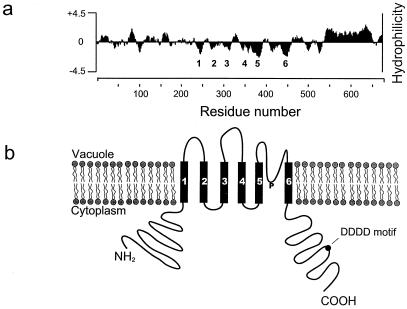
Predicted structure of the protein encoded by the YVC1 gene. (a) Hydrophilicity plot of the predicted protein encoded by YVC1. Six potential TM domains are marked (–6). (b) Model structure for the protein encoded by the YVC1 gene; six TM domains (–6) and a putative pore region (P) are labeled. A putative calcium binding bowl in the C terminus of the protein is also marked (18).
Figure 3
Figure 3
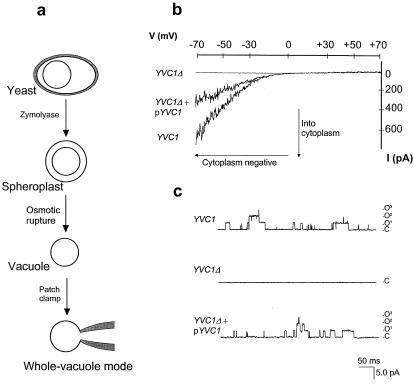
Absence and restoration of the yeast vacuolar conductance are correlated with the deletion and expression of the YVC1 gene. (a) Diagrammatic representation of the method of vacuole preparation and patch-clamping. (b) Whole-vacuole macroscopic currents upon applying a voltage ramp from +70 to −70 mV (bath voltage, cytoplasmic side) from each of the three yeast strains as marked. (c) Sample traces from whole vacuoles held at +10 mV. The low open probability at this voltage allows a clear resolution of the unitary conductances as marked from closed (C), to open (O1, O2, O3). Bath solution: 150 mM KCl/100 μM CaCl2; pipet solution: 180 mM KCl/10 μM CaCl2; both also had 5 mM MgCl2, 5 mM Hepes, and 2 mM DTT (pH 7.2).
Figure 4
Figure 4
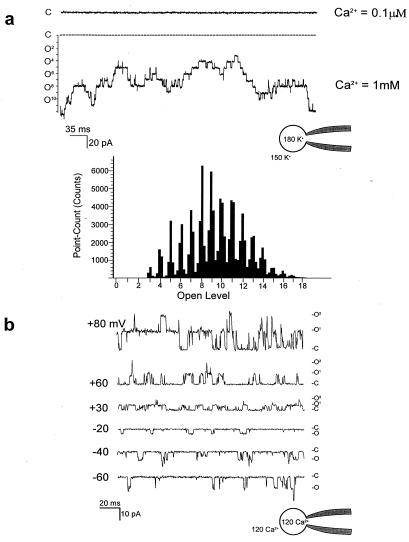
Ca2+-related properties of the wild-type YVC1 current. (a) Whole-vacuole recording at −30 mV (cytoplasm negative) showing the absence or presence of transmembrane current (traces) at 0.1 μM or 1 mM Ca2+, adjusted with EGTA, in the bath (cytoplasmic side). Bath: 150 mM KCl; pipet: 180 mM KCl; both also had 5 mM MgCl2 and 5 mM Hepes, pH 7.2. Amplitude distribution histogram displays data from a 20-s recording, ≈0.5 s of which are shown in the second trace. The whole vacuolar YVC1 mean open probability is 10. (b) YVC1 current can be carried solely by Ca2+. Whole-vacuole macroscopic currents with symmetric Ca2+ as the only permeant ion. Polarizations or depolarizations were applied to the patch as indicated. Channel openings are marked O1 and O2. Symmetric solution: 120 mM CaCl2/2 mM DTT/5 mM Hepes (pH 7.2).
Figure 5
Figure 5
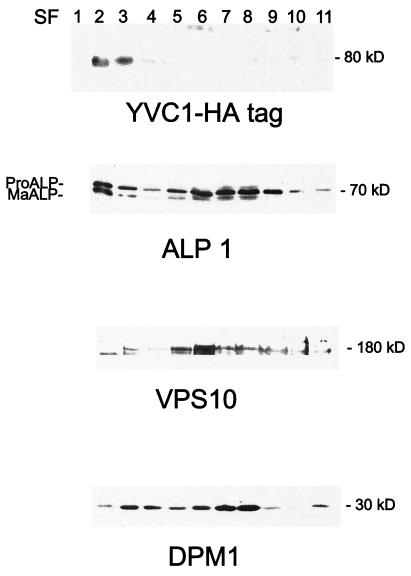
Localization of the YVC1 gene product. Western blot and immunodetection of HA-tagged YVC1, ALP1 (vacuole marker), VPS10 (Golgi marker), and DPM1 (ER marker) from subcellular fractionations (SF 1–11) of an HA-tagged YVC1 yeast strain. Both unprocessed ALP (ProALP) and mature ALP (MaALP) are detected, but only MaALP is located in the vacuole. Molecular masses of the bands are given in kilodaltons.

References

    1. Palmer C, Batiza A, Zhou X-L, Loukin S, Saimi Y, Kung C. In: Cell Signalling in Prokaryotes and Lower Metazoa. Fairweather I, editor. The Netherlands: Kluwer Dordrecht; 2001. , in press.
    1. Saimi Y, Martinac B, Delcour A H, Minorsky P V, Gustin M C, Culbertson M R, Adler J, Kung C. Methods Enzymol. 1992;207:681–691. - PubMed
    1. Paulsen I T, Sliwinski M K, Nelissen B, Goffeau A, Saier M H. FEBS Lett. 1998;430:116–125. - PubMed
    1. Ketchum K A, Joiner W J, Sellers A J, Kaczmarek L K, Goldstein S A. Nature (London) 1995;376:690–695. - PubMed
    1. Paidhungat M, Garrett S. Mol Cell Biol. 1997;17:6339–6347. - PMC - PubMed

Publication types