. 2001 Jul 3;98(14):7730-5.
doi: 10.1073/pnas.141039198. Epub 2001 Jun 26.

Intramolecular secondary structure rearrangement by the kissing interaction of the Neurospora VS ribozyme

Affiliations

Intramolecular secondary structure rearrangement by the kissing interaction of the Neurospora VS ribozyme

A A Andersen et al. Proc Natl Acad Sci U S A. .

Abstract

Kissing interactions in RNA are formed when bases between two hairpin loops pair. Intra- and intermolecular kissing interactions are important in forming the tertiary or quaternary structure of many RNAs. Self-cleavage of the wild-type Varkud satellite (VS) ribozyme requires a kissing interaction between the hairpin loops of stem-loops I and V. In addition, self-cleavage requires a rearrangement of several base pairs at the base of stem I. We show that the kissing interaction is necessary for the secondary structure rearrangement of wild-type stem-loop I. Surprisingly, isolated stem-loop V in the absence of the rest of the ribozyme is sufficient to rearrange the secondary structure of isolated stem-loop I. In contrast to kissing interactions in other RNAs that are either confined to the loops or culminate in an extended intermolecular duplex, the VS kissing interaction causes changes in intramolecular base pairs within the target stem-loop.


Figures
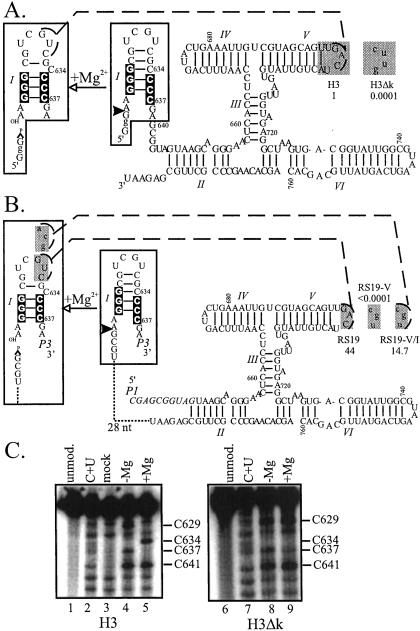
Figure 1
Figure 1
Secondary structure schematics of VS RNA constructs: H3 (21) and H3Δk (A) and RS19 (ref. ; B). VS positions are numbered as in ref. , and helices are numbered as in ref. . P1 and P3, in italics, are primer-binding sites attached where indicated (22). A functionally important kissing interaction is indicated by a dashed line (6). The unfilled boxed region indicates the secondary structure rearrangement and site-specific cleavage that occur in the presence of magnesium. Nucleotides in the lower part of stem-loop I involved in the conformational change are indicated by black boxes (22). The sequences in the gray boxes in H3 or RS19 were substituted by those in the corresponding gray boxes to construct the individual mutants. Numbers below each mutant name represent the observed cis-cleavage rate constant (per minute) of each mutant RNA. Non-VS sequences are indicated by lowercase letters or a dotted line. The cleavage site is indicated by a filled arrowhead. (C) DMS modification of 3′ end-labeled H3 D and H3Δk D RNAs (the region of the RNAs from nt 618 to nt 647 is shown). Modifications were performed on RNA in the presence (+) or absence (−) of 50 mM MgCl2, as indicated. The input material (unmod.), a chemical sequencing C + U ladder, and a control sample not exposed to DMS (mock) are included.
Figure 2
Figure 2
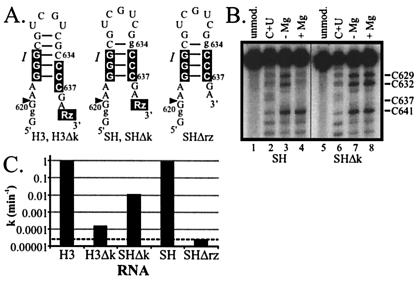
One functional role of the kissing interaction is to rearrange stem-loop I. (A) Secondary structures of the stem-loop I region of H3, H3Δk, SH, SHΔk, and SHΔrz. Helices II to VI are indicated by a filled rectangle marked Rz. Non-VS sequences, the cleavage site, and nucleotides in the lower part of stem-loop I involved in the conformational change are indicated as in Fig. 1A. (B) DMS modification of 3′ end-labeled SH D and SHΔk D RNAs (the region of the RNA from nt 618 to nt 647 is shown). Modifications were performed as described in Fig. 1C. (C) A mutant constitutively shifted stem-loop I partially suppresses the self-cleavage defect of a disrupted kissing interaction mutant. The first order rate constants are shown on the y axis (averaged from at least two experiments), and the VS RNA mutant on the x axis. The dotted line indicates the rate of background cleavage. See Materials and Methods for details.
Figure 3
Figure 3
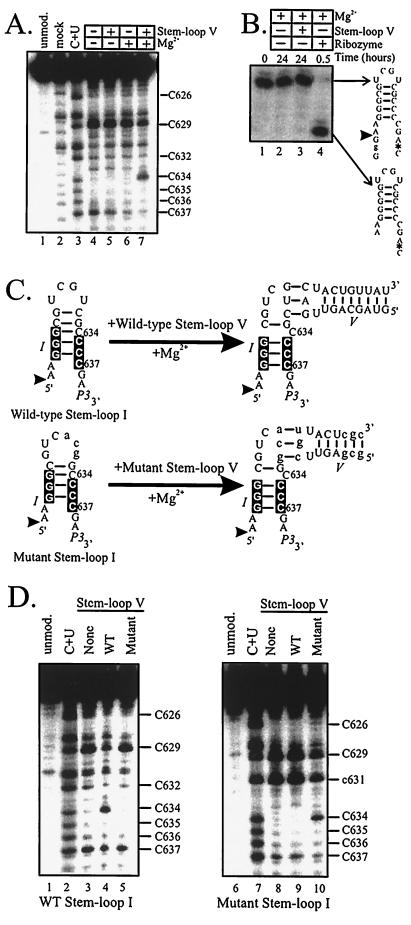
Stem-loop V is sufficient to rearrange the secondary structure of stem-loop I. (A) DMS modification of 3′ end-labeled wild-type stem-loop I. Modifications were performed on stem-loop I in the presence (+) or absence (−) of 50 mM MgCl2 or 10 μM wild-type stem-loop V, as indicated. unmod., mock, and C + U are as in Fig. 1C. (B) Wild-type stem-loop V is not sufficient to cleave wild-type stem-loop I in trans. 3′ end-labeled trans cleavage substrate (nt 618–nt 639) was incubated at 30°C in 50 mM MgCl2, and in the presence (+) of 20 μM wild-type stem-loop V or 700 nM ribozyme, as indicated. Schematics of the secondary structures of the trans cleavage substrate and the 3′ cleavage product are shown. The cleavage site is marked by an arrowhead, and the 3′ end-label by an asterisk. (C) Shown are schematics of the wild-type and mutant kissing complexes. P3 is a primer-binding site (22). Nucleotides in the lower part of stem-loop I involved in the conformational change are indicated by black boxes (22). The cleavage site is indicated by an arrowhead. (D) Rearrangement of stem-loop I by stem-loop V requires native interactions, including the kissing interaction. DMS modification of 3′ end-labeled wild-type (lanes 1–5) or mutant (lanes 6–10) stem-loop I in 100 mM MgCl2, and in the presence (+) or absence (−) of 10 μM (lane 4) or 100 μM (lanes 5, 9, and 10) wild-type or mutant stem-loop V, as indicated. unmod. and C + U are as in Fig. 1C.

References

    1. Nowakowski J, Tinoco I., Jr Semin Virol. 1997;8:153–165.
    1. Kim C H, Tinoco I., Jr Proc Natl Acad Sci USA. 2000;97:9396–9401. . (First Published August 8, 2000; 10.1073/pnas.170283697) - PMC - PubMed
    1. Kim S H, Suddath F L, Quigley G J, McPherson A, Sussman J L, Wang A H, Seeman N C, Rich A. Science. 1974;185:435–440. - PubMed
    1. Ladner J E, Jack A, Robertus J D, Brown R S, Rhodes D, Clark B F, Klug A. Proc Natl Acad Sci USA. 1975;72:4414–4418. - PMC - PubMed
    1. Lehnert V, Jaeger L, Michel F, Westhof E. Chem Biol. 1996;3:993–1009. - PubMed

MeSH terms

LinkOut - more resources