. 2001 Jul 3;98(14):7835-40.
doi: 10.1073/pnas.141222098. Epub 2001 Jun 26.

The complete genome of the crenarchaeon Sulfolobus solfataricus P2

Affiliations

The complete genome of the crenarchaeon Sulfolobus solfataricus P2

Q She et al. Proc Natl Acad Sci U S A. .

Abstract

The genome of the crenarchaeon Sulfolobus solfataricus P2 contains 2,992,245 bp on a single chromosome and encodes 2,977 proteins and many RNAs. One-third of the encoded proteins have no detectable homologs in other sequenced genomes. Moreover, 40% appear to be archaeal-specific, and only 12% and 2.3% are shared exclusively with bacteria and eukarya, respectively. The genome shows a high level of plasticity with 200 diverse insertion sequence elements, many putative nonautonomous mobile elements, and evidence of integrase-mediated insertion events. There are also long clusters of regularly spaced tandem repeats. Different transfer systems are used for the uptake of inorganic and organic solutes, and a wealth of intracellular and extracellular proteases, sugar, and sulfur metabolizing enzymes are encoded, as well as enzymes of the central metabolic pathways and motility proteins. The major metabolic electron carrier is not NADH as in bacteria and eukarya but probably ferredoxin. The essential components required for DNA replication, DNA repair and recombination, the cell cycle, transcriptional initiation and translation, but not DNA folding, show a strong eukaryal character with many archaeal-specific features. The results illustrate major differences between crenarchaea and euryarchaea, especially for their DNA replication mechanism and cell cycle processes and their translational apparatus.


Figures
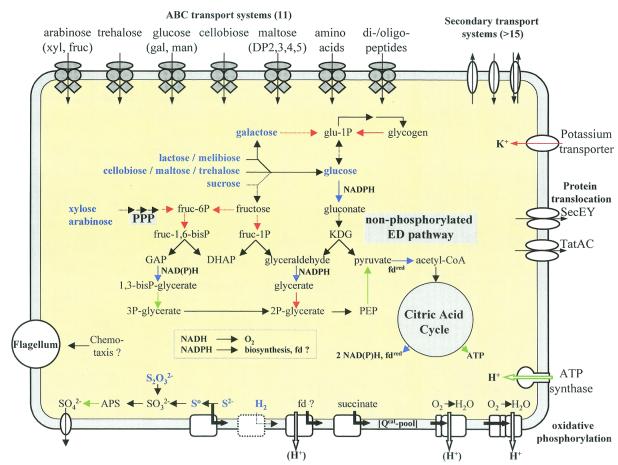
Figure 1
Figure 1
Overview of metabolism and transport in S. solfataricus. Pathways for energy production and carbohydrate catabolism are shown, and extracellular enzymes that hydrolyze polymers (proteases, glycosyl hydrolases) are not shown. Arrows denote the following reactions: chemical conversion (black), energy consuming (red), energy yielding (green), redox (blue), respiratory electron transfer (solid black), proton export (black, open), and import (green, open). Conversions that were anticipated but for which no gene was detected are shown as broken arrows. Eleven operons encoding ABC transport systems are present, and those with established substrate specificity are depicted (xyl, xylose; fruc, fructose; glu, glucose; gal, galactose; man, mannose. DP, degree of polymerization) (17). At least 15 secondary transporters (permeases) are present (symport and antiport). Carbohydrates that are imported and/or support growth of S. solfataricus are in blue. All but one of the genes encoding enzymes of the nonphosphorylated Entner–Doudoroff (ED) pathway was identified (KDG, 2-keto-3-deoxygluconate; GAP, glyceraldehyde-3P; DHAP, dihydroxyacetone-P; PEP, phosphoenolpyruvate). Only two genes involved in the pentose phosphate pathway (PPP) were identified (see text). All citric acid cycle enzymes are encoded. Several components of the aerobic respiratory network are identified that are involved in (i) reduction of the caldariella-quinone (Qcal) pool: a putative ferredoxin dehydrogenase (see text), succinate dehydrogenase, and (ii) oxidation of the Qcal pool: SoxABCD and SoxM terminal oxidases; an ATP synthase converts the proton gradient into ATP; alternative electron donors (in blue) are hydrogen (H2) and sulfide (S2−), reducing the Qcal pool via hydrogenase and sulfide reductase, respectively. Elemental sulfur and thiosulphate are completely converted to sulfate (APS, adenylylsulfate); some flagellar components are present (see text). Both Sec/signal recognition particle-type and Tat-type protein translocation systems are present.
Figure 2
Figure 2
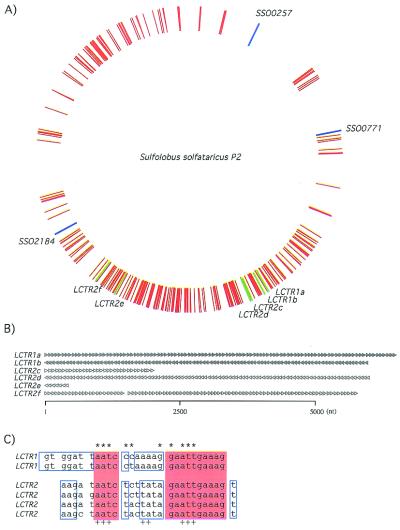
(A) IS elements, predicted replication origins, and clusters of regular tandem repeats mapped on the Sulfolobus genome. Genes encoding three CDC6 homologs (Sso0257, Sso0771, and Sso2184) (blue lines); six loci of clustered tandem repeats (LCTRa–f) (green lines); IS elements (red lines) (see Table 1). (B) Loci of tandem repeat clusters and their orientation, indicated by arrowheads. Clustered tandem repeats of sequence family 1 (LCTRa and b) and 2 (LCTRc–f) are indicated by solid and hollow arrows, respectively. (C) Sequence characteristics of the repeat units. Those in loci LCTR1 and LCTR2 share two blocks of identical sequence (solid red boxes). Within each sequence family, there is a low level of sequence variability, whereas some regions are invariant (boxed in blue). (*) and (+) denote the positions involved in imperfect palindromic base pairing for tandem repeats of sequence families 1 and 2, respectively.

References

    1. Zillig W, Stetter K O, Wunderl S, Schulz W, Priess H, Scholz I. Arch Microbiol. 1980;125:259–269.
    1. Pfeifer F, Palm P, Schleifer K-H, editors. Molecular Biology of Archaea. Stuttgart: Gustav Fischer; 1994. pp. 1–267.
    1. Zillig W, Arnold H P, Holz I, Prangishvili D, Schweier A, Stedman K, She Q, Phan H, Garrett R A, Kristjansson J K. Extremophiles. 1998;2:131–140. - PubMed
    1. Sowers K R, Schreier H J. Trends Microbiol. 1999;7:212–219. - PubMed
    1. Sensen C W, Charlebois R L, Chow C, Clausen I G, Curtis B, Doolittle W F, Duguet M, Erauso G, Gaasterland T, Garrett R A, et al. Extremophiles. 1998;2:305–312. - PubMed

Publication types

Substances

Associated data

LinkOut - more resources