. 2001 Jul 3;98(14):7858-62.
doi: 10.1073/pnas.151242798. Epub 2001 Jun 26.

Induction of primordial germ cells from murine epiblasts by synergistic action of BMP4 and BMP8B signaling pathways

Affiliations

Induction of primordial germ cells from murine epiblasts by synergistic action of BMP4 and BMP8B signaling pathways

Y Ying et al. Proc Natl Acad Sci U S A. .

Abstract

Extraembryonic ectoderm-derived factors instruct the pluripotent epiblast cells to develop toward a restricted primordial germ cell (PGC) fate during murine gastrulation. Genes encoding Bmp4 of the Dpp class and Bmp8b of the 60A class are expressed in the extraembryonic ectoderm and targeted mutation of either results in severe defects in PGC formation. It has been shown that heterodimers of DPP and 60A classes of bone morphogenetic proteins (BMPs) are more potent than each homodimers in bone and mesoderm induction in vitro, suggesting that BMP4 and BMP8B may form heterodimers to induce PGCs. To investigate how BMP4 and BMP8B interact and signal for PGC induction, we cocultured epiblasts of embryonic day 6.0--6.25 embryos with BMP4 and BMP8B proteins produced by COS cells. Our data show that BMP4 or BMP8B homodimers alone cannot induce PGCs whereas they can in combination, providing evidence that two BMP pathways are simultaneously required for the generation of a given cell type in mammals and also providing a prototype method for PGC induction in vitro. Furthermore, the PGC defects of Bmp8b mutants can be rescued by BMP8B homodimers whereas BMP4 homodimers cannot mitigate the PGC defects of Bmp4 null mutants, suggesting that BMP4 proteins are also required for epiblast cells to gain germ-line competency before the synergistic action of BMP4 and BMP8B.


Figures
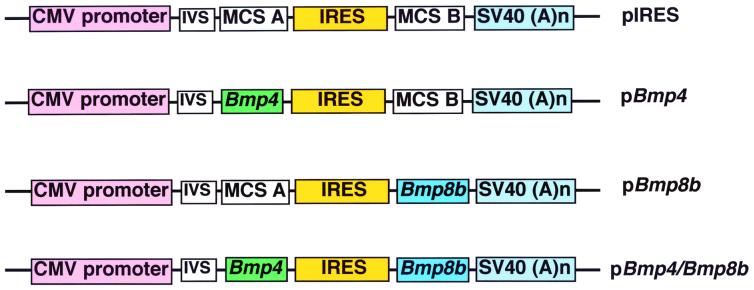
Figure 1
Figure 1
Schematic representation of expression vectors (only the relevant elements are shown). pIRES, the parental vector obtained from CLONTECH (#6028–1), which contains the immediate early promoter of cytomegalovirus (CMV promoter), an intron (IVS), MCS A, internal ribosome entry site (IRES), and MCS B followed by simian virus (SV40) polyadenylation signals. pBmp4, vector that contains human Bmp4 cDNA in MCS A. pBmp8b, vector that contains murine Bmp8b cDNA in MCS B. pBmp4/Bmp8b, vector that contains human Bmp4 cDNA in MCS A and murine Bmp8b cDNA in MCS B.
Figure 2
Figure 2
Induction of PGCs by BMP4/BMP8B-expressing COS cells. (A) Diagram showing coculture of epiblast masses with COS cells. Mouse embryos (F1 hybrid of 129 SvEv × C57BL/6) at E6.0–6.25 were isolated, in which the extraembryonic ectoderm (red; xe) and epiblast (light blue; ep) are enclosed by endoderm (dark blue; xn for extraembryonic endoderm and en for embryonic endoderm). The extraembryonic ectoderm and proximal epiblast cells were removed with a sharp tungsten needle (red dashed line). The epiblast masses with visceral endoderm were then transferred onto pIRES or pBmp4/Bmp8b COS cells. (B) Percentage of embryos containing PGCs. About 12% of the control epiblast masses (3/25) formed PGCs after coculture with pIRES COS cells, whereas 13 of 20 epiblast masses (65%) contained PGCs after coculture with pBmp4/Bmp8b COS cells. (C) Average number of PGCs per PGC-containing embryo. The average number of PGCs was 3.3 ± 2.3 (mean ± SEM) for epiblast masses cocultured with pIRES COS cells, whereas 34.2 ± 7.2 PGCs were detected in epiblast masses cocultured with pBmp4/Bmp8b COS cells. (D) An example of an epiblast mass cocultured with pIRES COS cells after staining for ALP. No obvious PGC-like cells were observed. (E) An example of an epiblast mass cocultured with pBmp4/Bmp8b COS cells. More than 30 PGCs (red arrows) were found in a cluster and its vicinity. These cells have typical PGC characteristics (in terms of size and shape, having strong ALP staining in the cell membrane, and with a darkly stained spot in the cytoplasm). χ2 was used for statistical analysis. (Bar = 40 μm in D and E.)
Figure 3
Figure 3
BMP4 and BMP8B homodimers synergistically induce PGCs from the epiblast independent of endoderm. (A) A diagram showing that the extraembryonic ectoderm and proximal epiblast cells of E6.0–6.25 embryos were removed with a tungsten needle (red dashed line). Subsequently, the isolated epiblast masses with endoderm attached were subjected to trypsin and pancreatin digestion (23). The endoderm was removed by gentle pipetting several times and the epiblast masses were transferred on top of COS cells for coculture. (B) Percentage of embryos containing PGCs after coculture with COS cells. About 15.7–18.5% (9/57, 10/60, or 10/54, respectively) of the epiblast masses contained PGCs after coculture with pIRES, pBmp4, or pBmp8b COS cells with an average of 6–15 PGCs/embryo. No significant differences were observed among these three groups. Similar to the results in Fig. 2, about 71% of the epiblast masses cocultured with pBmp4/Bmp8b COS cells contained PGCs (an average of 51 ± 4.5 PGCs/embryo). Interestingly, about 66% of the epiblast masses cocultured with a mixture of equal number of pBmp4 COS cells and pBmp8b COS cells contained PGCs (an average of 41 ± 5.0 PGCs/embryo). No significant difference was detected between the latter two groups. However, the differences of the latter two groups with the former three were very significant (P < 0.001). ANOVA was used as the statistical method.
Figure 4
Figure 4
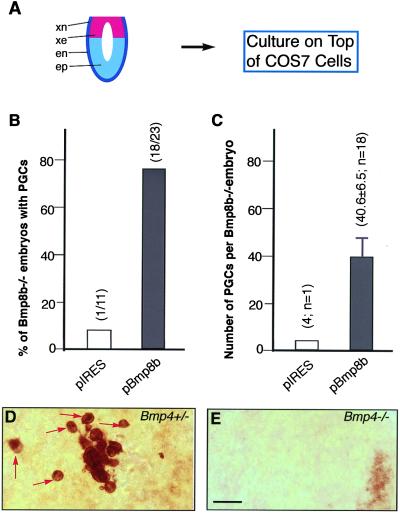
Rescue of PGC defects of Bmp8b and Bmp4 mutant embryos. (A) Diagram showing that Bmp8b or Bmp4 homozygous embryos at E6.0–6.25 were cocultured with COS cells. (B and C) PGCs were induced from Bmp8b−/− embryos after coculture with pBmp8b COS cells. Only one of 11 Bmp8b−/− embryos contained four PGCs after coculture with pIRES COS cells. However, 78% of the Bmp8b−/− embryos (18/23) produced an average 40.6 ± 6.5 PGCs/embryo after coculture with pBmp8b COS cells (P < 0.001, χ2 was used). Bmp8b mutants for this study were maintained on an 87.5% C56BL/6 background. (D) A Bmp4+/− embryo after coculture with pBmp4 COS cells contained about 20 PGCs (red arrows) in a small region. (E) A Bmp4−/− embryo contained no PGCs after coculture with pBmp4 COS cells. Bmp4 mutants were maintained on a mixed genetic background of 129 Sv × Black Swiss. (Bar = 40 μm in D and E.)
Figure 5
Figure 5
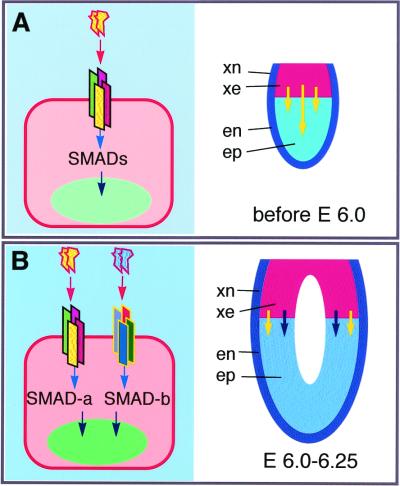
A sequential model for BMP4 and BMP8B signaling in PGC induction from epiblast cells during mouse embryogenesis. (A) Requirement of BMP4 signaling for the establishment of germ-line competency of the epiblast before E6.0. (Left) BMP4 proteins (indicated by a yellow head-shaped pair) bind to a tetrameric receptor complex on an early epiblast cell and signal through SMAD proteins. (Right) In the normal embryo, BMP4 proteins produced by extraembryonic ectoderm (or inner cell mass) instructs the epiblast cells to become germ-line competent. (B) Induction of PGCs by the synergistic action BMP4 and BMP8B at E6.0–6.25. (Left) A germ-line-competent epiblast cell containing two separate receptor complexes receives BMP4 and BMP8B (a blue head-shaped pair) proteins. These two tetrameric receptor complexes transduce signals through distinct SMAD proteins (SMAD-a and SMAD-b) from the cytoplasm to the nucleus to instruct the cell to become PGCs. (Right) At embryo level, BMP4 and BMP8B produced by the extraembryonic ectoderm synergistically signal the germ-line-competent proximal epiblast cells to become PGCs.

References

    1. Eddy E M. Int Rev Cytol. 1975;43:229–280. - PubMed
    1. Wylie C. Cell. 1999;96:165–174. - PubMed
    1. McLaren A. Genes Dev. 1999;13:373–376. - PubMed
    1. Weidinger G, Wolke U, Koprunner M, Klinger M, Raz E. Development (Cambridge, UK) 1999;126:5295–5307. - PubMed
    1. Kloc M, Bilinski S, Chan A P, Allen L H, Zearfoss N R, Etkin L D. Int Rev Cytol. 2001;203:63–91. - PubMed

Publication types

LinkOut - more resources