


Antibody from patients with acute human immunodeficiency virus (HIV) infection inhibits primary strains of HIV type 1 in the presence of natural-killer effector cells
- PMID: 11435575
- PMCID: PMC114423
- DOI: 10.1128/JVI.75.15.6953-6961.2001
Antibody from patients with acute human immunodeficiency virus (HIV) infection inhibits primary strains of HIV type 1 in the presence of natural-killer effector cells
Abstract
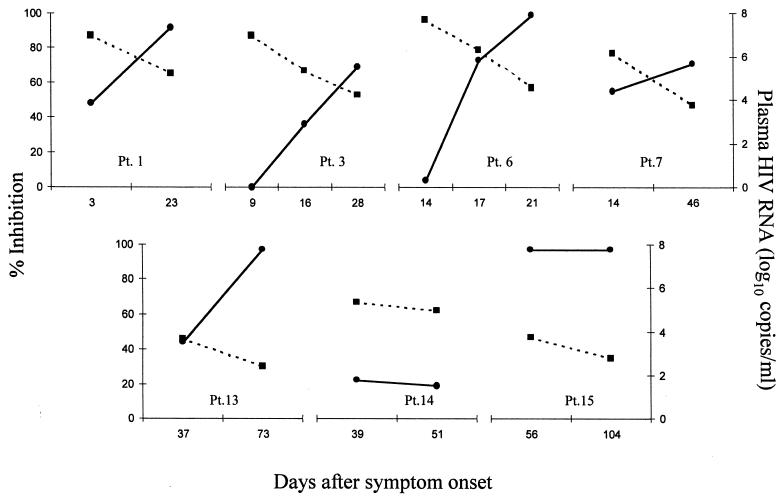
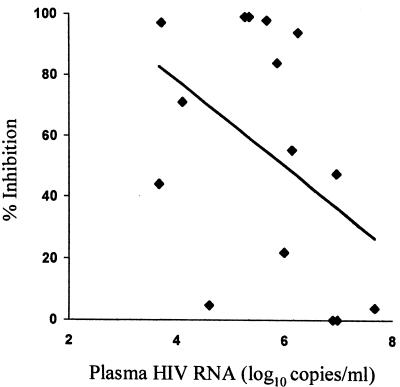
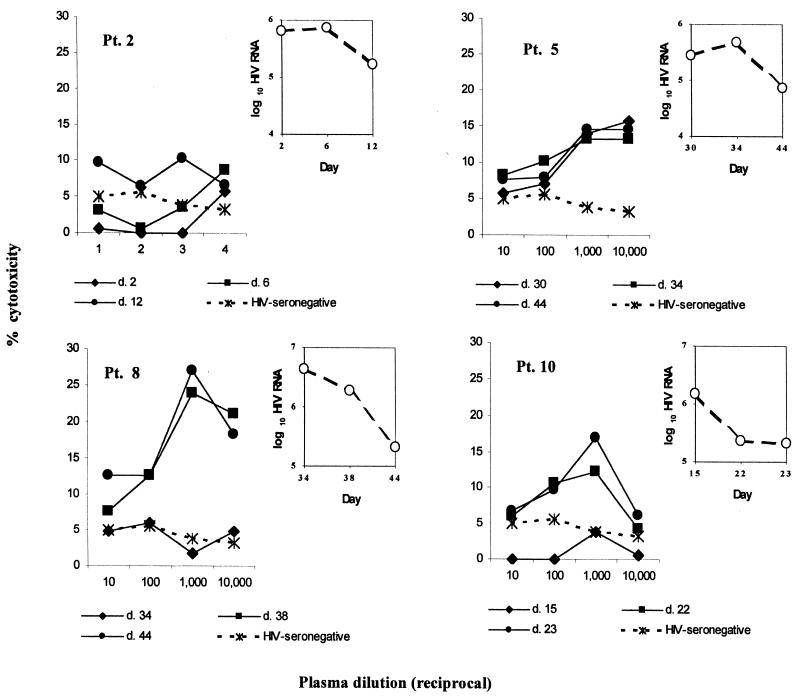
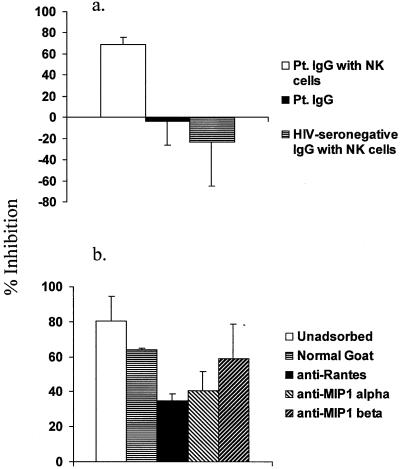
The partial control of viremia during acute human immunodeficiency virus type 1 (HIV-1) infection is accompanied by an HIV-1-specific cytotoxic T-lymphocyte (CTL) response and an absent or infrequent neutralizing antibody response. The control of HIV-1 viremia has thus been attributed primarily, if not exclusively, to CTL activity. In this study, the role of antibody in controlling viremia was investigated by measuring the ability of plasma or immunoglobulin G from acutely infected patients to inhibit primary strains of HIV-1 in the presence of natural-killer (NK) effector cells. Antibody that inhibits virus when combined with effector cells was present in the majority of patients within days or weeks after onset of symptoms of acute infection. Furthermore, the magnitude of this effector cell-mediated antiviral antibody response was inversely associated with plasma viremia level, and both autologous and heterologous HIV-1 strains were inhibited. Finally, antibody from acutely infected patients likely reduced HIV-1 yield in vitro both by mediating effector cell lysis of target cells expressing HIV-1 glycoproteins and by augmenting the release of beta-chemokines from NK cells. HIV-1-specific antibody may be an important contributor to the early control of HIV viremia.
Figures
References
-
- Allen T M, Vogel T U, Fuller D H, Mothé B R, Steffen S, Boyson J E, Shipley T, Fuller J, Hanke T, Sette A, Altman J D, Moss B, McMichael A J, Watkins D I. Induction of AIDS virus-specific CTL activity in fresh, unstimulated peripheral blood lymphocytes from rhesus macaques vaccinated with a DNA prime/modified vaccinia virus Ankara boost regimen. J Immunol. 2000;164:4968–4978. - PubMed
-
- Barouch D H, Santra S, Schmitz J E, Kuroda M J, Fu T-M, Wagner W, Bilska M, Craiu A, Zheng X X, Krivulka G R, Beaudry K, Lifton M A, Nickerson C E, Trigona W L, Punt K, Freed D C, Guan L, Dubey S, Casimiro D, Simon A, Davies M-E, Chastain M, Strom T B, Gelman R S, Montefiori D C, Lewis M G, Emini E A, Shiver J W, Letvin N L. Control of viremia and prevention of clinical AIDS in rhesus monkeys by cytokine-augmented DNA vaccination. Science. 2000;290:486–492. - PubMed
-
- Bauer S, Groh V, Wu J, Steinle A, Phillips J H, Lanier L L, Spies T. Activation of NK cells and T cells by NKG2D, a receptor for stress-inducible MICA. Science. 1999;285:727–729. - PubMed
-
- Baum L L, Cassutt K J, Knigge K, Khattri R, Margolick J, Rinaldo C, Kleeberger C A, Nishanian P, Henrard D R, Phair J. HIV-1 gp120-specific antibody-dependent cell-mediated cytotoxicity correlates with rate of disease progression. J Immunol. 1996;157:2168–2173. - PubMed
-
- Binley J M, Clas B, Gettie A, Vesanen M, Montefiori D C, Sawyer L, Booth J, Lewis M, Marx P A, Bonhoeffer S, Moore J P. Passive infusion of immune serum into simian immunodeficiency virus-infected rhesus macaques undergoing a rapid disease course has minimal effect on plasma viremia. Virology. 2000;270:237–249. - PubMed
Publication types
MeSH terms
Substances
Grants and funding
LinkOut - more resources
Full Text Sources
Other Literature Sources
Medical
