Cannabinoids for control of chemotherapy induced nausea and vomiting: quantitative systematic review
- PMID: 11440936
- PMCID: PMC34325
- DOI: 10.1136/bmj.323.7303.16
Cannabinoids for control of chemotherapy induced nausea and vomiting: quantitative systematic review
Abstract
Objective: To quantify the antiemetic efficacy and adverse effects of cannabis used for sickness induced by chemotherapy.
Design: Systematic review.
Data sources: Systematic search (Medline, Embase, Cochrane library, bibliographies), any language, to August 2000.
Studies: 30 randomised comparisons of cannabis with placebo or antiemetics from which dichotomous data on efficacy and harm were available (1366 patients). Oral nabilone, oral dronabinol (tetrahydrocannabinol), and intramuscular levonantradol were tested. No cannabis was smoked. Follow up lasted 24 hours.
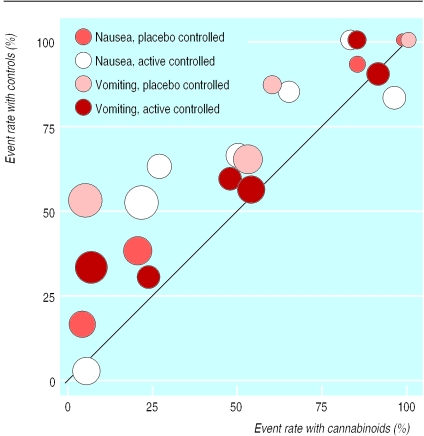
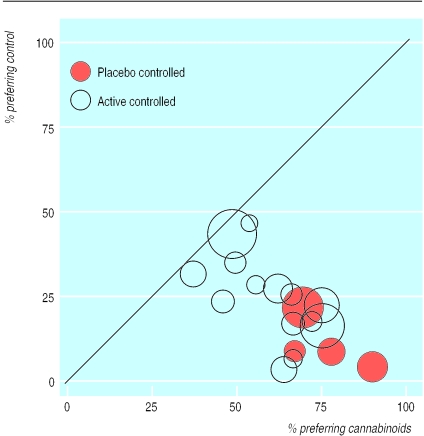
Results: Cannabinoids were more effective antiemetics than prochlorperazine, metoclopramide, chlorpromazine, thiethylperazine, haloperidol, domperidone, or alizapride: relative risk 1.38 (95% confidence interval 1.18 to 1.62), number needed to treat 6 for complete control of nausea; 1.28 (1.08 to 1.51), NNT 8 for complete control of vomiting. Cannabinoids were not more effective in patients receiving very low or very high emetogenic chemotherapy. In crossover trials, patients preferred cannabinoids for future chemotherapy cycles: 2.39 (2.05 to 2.78), NNT 3. Some potentially beneficial side effects occurred more often with cannabinoids: "high" 10.6 (6.86 to 16.5), NNT 3; sedation or drowsiness 1.66 (1.46 to 1.89), NNT 5; euphoria 12.5 (3.00 to 52.1), NNT 7. Harmful side effects also occurred more often with cannabinoids: dizziness 2.97 (2.31 to 3.83), NNT 3; dysphoria or depression 8.06 (3.38 to 19.2), NNT 8; hallucinations 6.10 (2.41 to 15.4), NNT 17; paranoia 8.58 (6.38 to 11.5), NNT 20; and arterial hypotension 2.23 (1.75 to 2.83), NNT 7. Patients given cannabinoids were more likely to withdraw due to side effects 4.67 (3.07 to 7.09), NNT 11.
Conclusions: In selected patients, the cannabinoids tested in these trials may be useful as mood enhancing adjuvants for controlling chemotherapy related sickness. Potentially serious adverse effects, even when taken short term orally or intramuscularly, are likely to limit their widespread use.
Figures
Comment in
-
Cannabinoids for pain and nausea.BMJ. 2001 Jul 7;323(7303):2-3. doi: 10.1136/bmj.323.7303.2. BMJ. 2001. PMID: 11440921 Free PMC article. No abstract available.
-
Review: cannabinoids control chemotherapy-induced nausea and vomiting but increase the risk for side effects.ACP J Club. 2002 Jan-Feb;136(1):19. ACP J Club. 2002. PMID: 11829560 No abstract available.
References
-
- Kassirer JP. Federal foolishness and marijuana (editorial) N Engl J Med. 1997;336:366. - PubMed
-
- Grinspoon L, Bakalar JB. Marihuana as medicine: a plea for reconsideration. JAMA. 1995;273:1875–1876. - PubMed
-
- Morris K. The cannabis remedy—wonder worker or evil weed? Lancet. 1997;350:1828. - PubMed
-
- Voth EA, Schwartz RH. Medicinal applications of delta-9-tetrahydrocannabinol and marijuana. Ann Intern Med. 1997;126:791–798. - PubMed
-
- Doblin RE, Kleiman MA. Marijuana as antiemetic medicine: a survey of oncologists' experiences and attitudes. J Clin Oncol. 1991;9:1314–1319. - PubMed
Publication types
MeSH terms
Substances
LinkOut - more resources
Full Text Sources
Other Literature Sources
Medical