. 2001 Jul 16;20(14):3716-27.
doi: 10.1093/emboj/20.14.3716.

Positive and negative regulation of Raf kinase activity and function by phosphorylation

Affiliations

Positive and negative regulation of Raf kinase activity and function by phosphorylation

H Chong et al. EMBO J. .

Abstract

Activating and inhibitory phosphorylation mechanisms play an essential role in regulating Raf kinase activity. Here we demonstrate that phosphorylation of C-Raf in the kinase activation loop (residues T491 and S494) is necessary, but not sufficient, for activation. C-Raf has additional activating phosphorylation sites at S338 and Y341. Mutating all four of these residues to acidic residues, S338D/Y341D/T491E/S494D (DDED), in C-Raf results in constitutive activity. However, acidic residue substitutions at the corresponding activation loop sites in B-Raf are sufficient to confer constitutive activity. B-Raf and C-Raf also utilize similar inhibitory phosphorylation mechanisms to regulate kinase activity. B-Raf has multiple inhibitory phosphorylation sites necessary for full kinase inhibition where C-Raf requires only one. We examined the functional significance of these inhibitory and activating phosphorylations in Caenorhabditis elegans lin-45 Raf. Eliminating the inhibitory phosphorylation or mimicking activating phosphorylation sites is sufficient to confer constitutive activity upon lin-45 Raf and induce multi-vulva phenotypes in C.elegans. Our results demonstrate that different members of the Raf family kinases have both common and distinct phosphorylation mechanisms to regulate kinase activity and biological function.


Figures
None
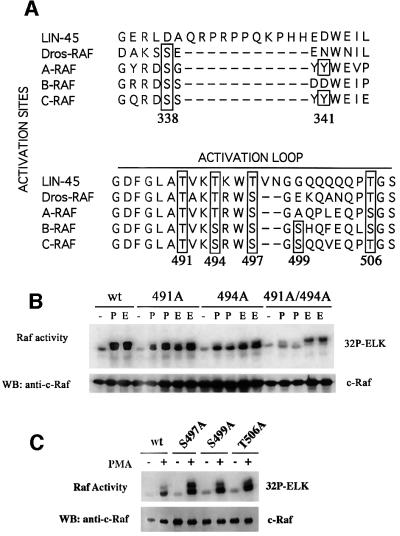
Fig. 1. (A) Alignment of sequences of C.elegans, Drosophila and human Raf proteins surrounding amino acids 338 and 341 and the activation loop of the kinase domain. The potential phosphorylation sites are boxed. The residue numbers are based on C-Raf sequence. (B) The effects of alanine substitution at residues 491 and 494 on C-Raf activation by PMA and EGF. HEK293 cells were transfected with wild-type, T491A, S494A or T491A/S494A C-Raf constructs. After 2 days, cells were treated with PMA (P) or EGF (E) and C-Raf proteins were immunoprecipitated from lysates and assayed for kinase activity in a coupled kinase assay (see Materials and methods). PMA- and EGF-stimulated alanine mutants were assayed in duplicate. C-Raf protein present in the immunoprecipitates was detected by western blotting (WB) with anti-C-Raf antibody. The results in this figure and all the other figures are a representative of at least three independent experiments. (C) Other putative phosphorylation sites in the activation loop have no effect on PMA-inducible activity. S497A, S499A and T506A constructs were assayed as mentioned in (B).
None
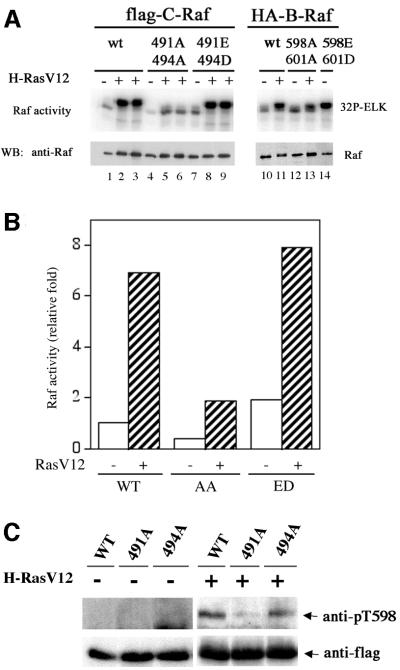
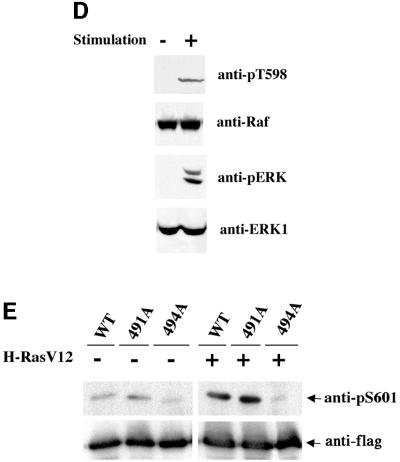
Fig. 2. (A) T491 and S494 are important for C-Raf kinase activation by RasV12. Alanine or acidic residue substitution mutants of C-Raf and B-Raf were transfected with or without RasV12. Raf proteins were immunoprecipitated and assayed for kinase activity as mentioned in Figure 1. C-Raf mutants co-transfected with Ras are shown in duplicate. (B) C-RafT491A/S494A mutant is not stimulated by RasV12. Raf kinase activity was determined by phosphoimage quantitation. The data presented are the average of duplicated assays from a representative experiment. (C) T491 in C-Raf is inducibly phosphorylated. C-Raf wild type, T491A and S494A were transfected with or without RasV12 and resolved for western blotting analysis using anti-pT598 antibody for phosphorylation and anti-Flag for Raf protein level. (D) Stimulation of T491 phosphorylation of endogenous C-Raf by EGF and Raf. HEK293 cells were stimulated with 50 ng/ml EGF and 10% fetal bovine serum for 5 min as indicated. Cell lysates were immunoblotted with anti-pT598 antibody or anti-phosphoERK antibody as indicated. The anti-pERK antibody recognizes phosphorylated forms of both ERK1 and ERK2 while the anti-ERK1 antibody recognizes ERK1 protein. (E) Phosphorylation of S494 in C-Raf is stimulated by RasV12. The experiments are similar to (C) except anti-pS601 antibody, which recognizes the phosphorylated S494 in C-Raf, was used.
None
Fig. 2. (A) T491 and S494 are important for C-Raf kinase activation by RasV12. Alanine or acidic residue substitution mutants of C-Raf and B-Raf were transfected with or without RasV12. Raf proteins were immunoprecipitated and assayed for kinase activity as mentioned in Figure 1. C-Raf mutants co-transfected with Ras are shown in duplicate. (B) C-RafT491A/S494A mutant is not stimulated by RasV12. Raf kinase activity was determined by phosphoimage quantitation. The data presented are the average of duplicated assays from a representative experiment. (C) T491 in C-Raf is inducibly phosphorylated. C-Raf wild type, T491A and S494A were transfected with or without RasV12 and resolved for western blotting analysis using anti-pT598 antibody for phosphorylation and anti-Flag for Raf protein level. (D) Stimulation of T491 phosphorylation of endogenous C-Raf by EGF and Raf. HEK293 cells were stimulated with 50 ng/ml EGF and 10% fetal bovine serum for 5 min as indicated. Cell lysates were immunoblotted with anti-pT598 antibody or anti-phosphoERK antibody as indicated. The anti-pERK antibody recognizes phosphorylated forms of both ERK1 and ERK2 while the anti-ERK1 antibody recognizes ERK1 protein. (E) Phosphorylation of S494 in C-Raf is stimulated by RasV12. The experiments are similar to (C) except anti-pS601 antibody, which recognizes the phosphorylated S494 in C-Raf, was used.
None
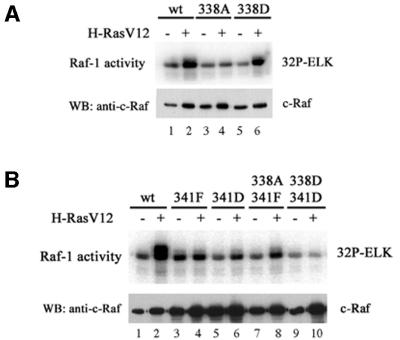
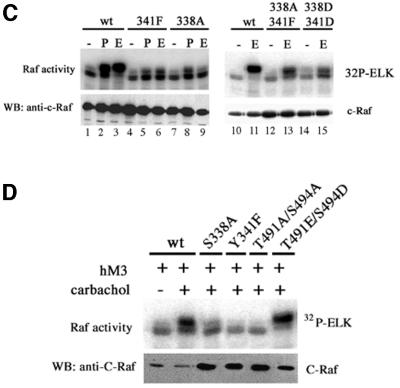
Fig. 3. (A) Effect of S338A and S338D on C-Raf kinase activation by RasV12. Cells were cotransfected with wild-type, S338A or S338D C-Raf constructs with or without RasV12 and assayed for kinase activity. (B) Y341F and Y341D diminishes C-Raf kinase activation by RasV12. Cells were transfected with wild-type, Y341F, Y341D, S338A/Y341F or S338D/Y341D C-Raf constructs with or without RasV12 and assayed for kinase activity. (C) Mutations at S338 and/or Y341 also affect PMA- and EGF-stimulated C-Raf kinase activity. Constructs noted were transfected and wild-type and mutant C-Raf proteins were assayed for kinase activity. Stimulation by PMA (P) and EGF (E) are indicated. (D) Alanine substitutions at S338, Y341 and T491/S494 also affect C-Raf kinase activation through the trimeric G-protein pathway. Cells were cotransfected with the human muscarinic receptor, hM3, and the C-Raf constructs noted. Twenty-four hours after transfection, cells were treated with carbachol and C-Raf proteins were assayed for kinase activity.
None
Fig. 3. (A) Effect of S338A and S338D on C-Raf kinase activation by RasV12. Cells were cotransfected with wild-type, S338A or S338D C-Raf constructs with or without RasV12 and assayed for kinase activity. (B) Y341F and Y341D diminishes C-Raf kinase activation by RasV12. Cells were transfected with wild-type, Y341F, Y341D, S338A/Y341F or S338D/Y341D C-Raf constructs with or without RasV12 and assayed for kinase activity. (C) Mutations at S338 and/or Y341 also affect PMA- and EGF-stimulated C-Raf kinase activity. Constructs noted were transfected and wild-type and mutant C-Raf proteins were assayed for kinase activity. Stimulation by PMA (P) and EGF (E) are indicated. (D) Alanine substitutions at S338, Y341 and T491/S494 also affect C-Raf kinase activation through the trimeric G-protein pathway. Cells were cotransfected with the human muscarinic receptor, hM3, and the C-Raf constructs noted. Twenty-four hours after transfection, cells were treated with carbachol and C-Raf proteins were assayed for kinase activity.
None
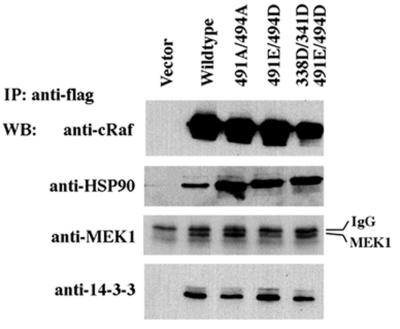
Fig. 4. C-Raf mutants can form complexes with HSP90, MEK and 14-3-3. Cells were transfected with vector, wild-type, T491A/S494A, T491E/S494E or DDED Flag-tagged C-Raf constructs. Immuno precipitates by anti-Flag antibody were resolved followed by western blotting analysis to detect associated endogenous proteins using anti-HSP90, anti-MEK and anti-14-3-3 antibodies.
None
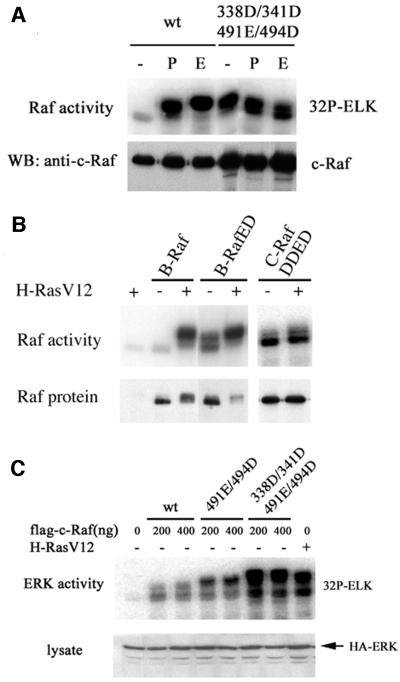
Fig. 5. (A) C-Raf DDED has constitutive activity. Cells were transfected with wild-type or DDED C-Raf constructs, treated with PMA (P) or EGF (E), and assessed for kinase activity. (B) B-Raf-ED and C-Raf DDED display residual activation by RasV12. The constitutively active B-Raf and C-Raf mutants were co-transfected with RasV12. Kinase activity was determined. (C) C-Raf DDED displays high activity to stimulate ERK activation. Cells were cotransfected with HA-ERK and wild-type, T491E/S494D or DDED C-Raf constructs at two different concentrations or RasV12. ERK was immunoprecipitated from lysates and assayed for kinase activity.
None
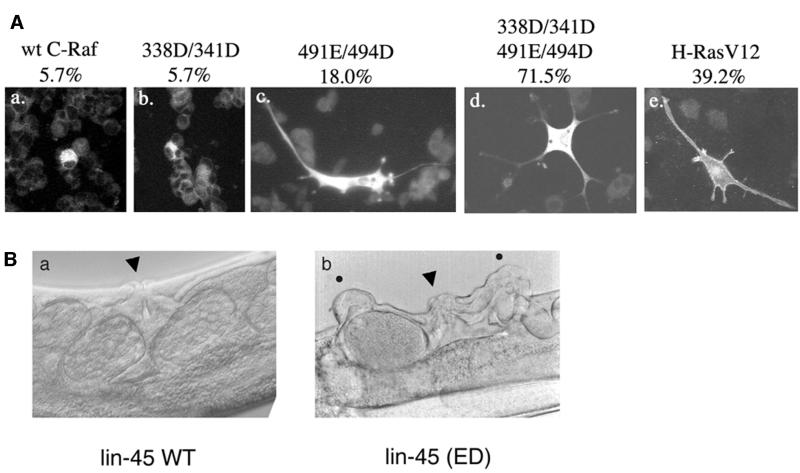
Fig. 6. (A) C-Raf DDED is sufficient to induce neurite outgrowths in PC12 cells. PC12 cells were transfected with (a) wild-type, (b) S338D/Y341D, (c) T491E/S494D or (d) DDED Flag-tagged C-Raf constructs or (e) HA-tagged H-RasV12. After 48 h in differentiation media, cells were fixed and incubated with anti-Flag or anti-HA antibody, washed and incubated with an anti-mouse IgG–Texas Red secondary antibody. Cells positive for expression were marked for neurite outgrowths. The percent of immunofluorescence-positive cells with neurites are indicated on top of each panel. (B) Effect of lin-45-ED transgene on C.elegans vulval induction. Normal vulva structures are indicated by an arrowhead in (a) a wild-type lin-45 transgenic line and (b) a lin-45-ED transgenic line where ectopic vulva structures are indicated by a black dot.
None
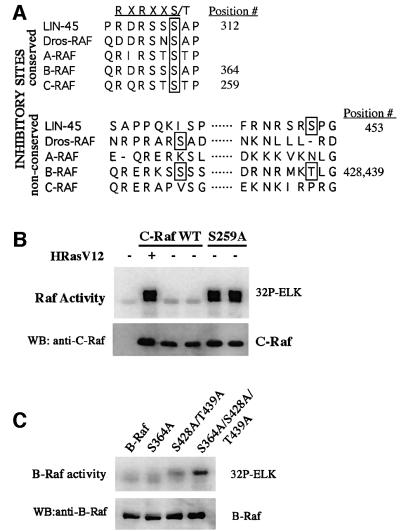
Fig. 7. (A) Alignment of sequences of C.elegans, Drosophila and human Raf proteins surrounding the inhibitory phosphorylation sites. Akt consensus recognition sequences are indicated in the top line. The putative inhibitory phosphorylation sites are boxed. (B) C-RafS259A has high basal kinase activity. Cells were transfected with wild-type C-Raf with or without RasV12 or with S259A C-Raf. C-Raf proteins were assayed for kinase activity. (C) Mutation of three inhibitory phosphorylation sites in B-Raf produces high basal kinase activity. Cells were transfected with wild-type, S364A, S428A/T439A or S364A/S428A/T439A B-Raf constructs and assayed for kinase activity.
None
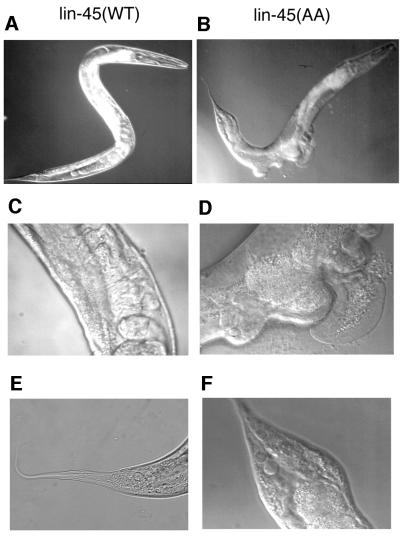
Fig. 8. Effect of lin-45-AA transgene on vulva induction. (A, C and E) A wild-type lin-45 transgenic line. (B, D and F) A lin-45-AA transgenic line shows a multi-vulva phenotype (D) and abnormal tail morphology (F).
None
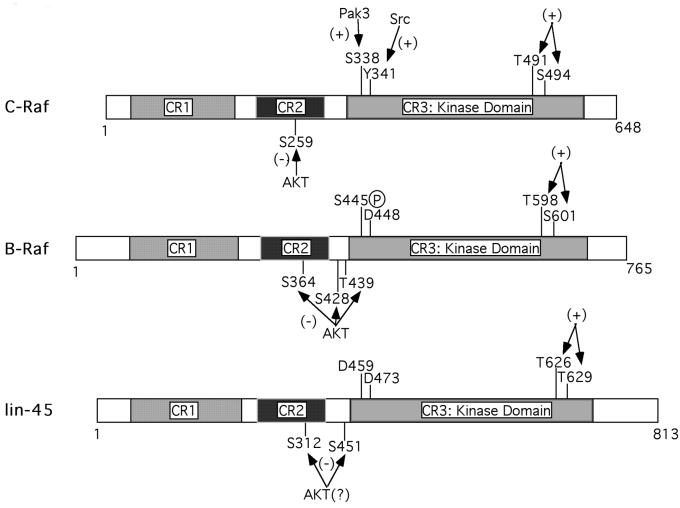
Fig. 9. Model showing similarities and differences in B-Raf, C-Raf and lin-45 kinase regulation.

References

    1. Abraham D. et al. (2000) Raf-1-associated protein phosphatase 2A as a positive regulator of kinase activation. J. Biol. Chem., 275, 22300–22304. - PubMed
    1. Alessi D.R., Saito,Y., Campbell,D.G., Cohen,P., Sithanandam,G., Rapp,U., Ashworth,A., Marshall,C.J. and Cowley,S. (1994) Identification of the sites in MAP kinase kinase-1 phosphorylated by p74 raf-1. EMBO J., 13, 1610–1619. - PMC - PubMed
    1. Barnard D., Diaz,B., Clawson,D. and Marshall,M. (1998) Oncogenes, growth factors and phorbol esters regulate Raf-1 through common mechanisms. Oncogene, 17, 1539–1547. - PubMed
    1. Beitel G.J., Clark,S.G. and Horvitz,H.R. (1990) Caenorhabditis elegans ras gene let-60 acts as a switch in the pathway of vulval induction. Nature, 348, 503–509. - PubMed
    1. Carroll M.P. and May,W.S. (1994) Protein kinase C-mediated serine phosphorylation directly activates Raf-1 in murine hematopoietic cells. J. Biol. Chem., 269, 1249–1256. - PubMed

Publication types

Substances