


Growth and development of tetracycline-resistant Chlamydia suis
- PMID: 11451674
- PMCID: PMC90631
- DOI: 10.1128/AAC.45.8.2198-2203.2001
Growth and development of tetracycline-resistant Chlamydia suis
Abstract
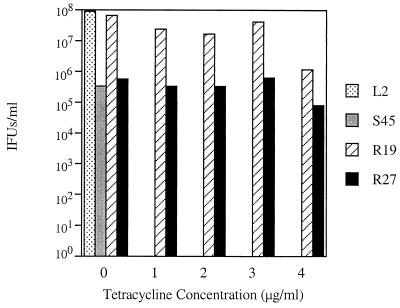
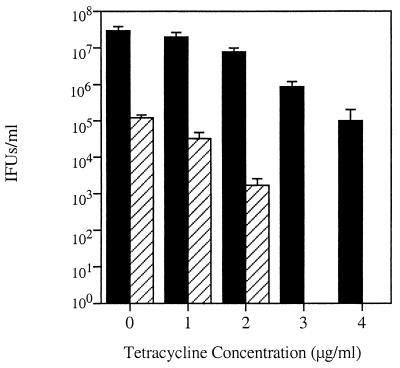
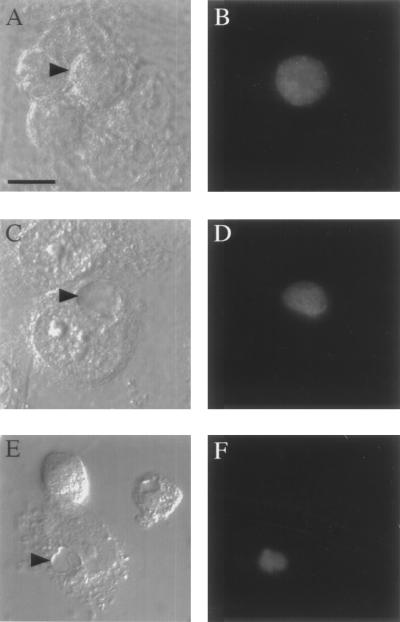
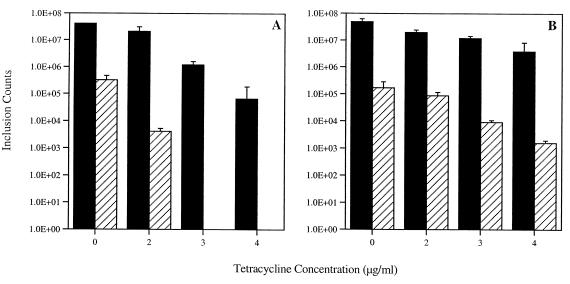
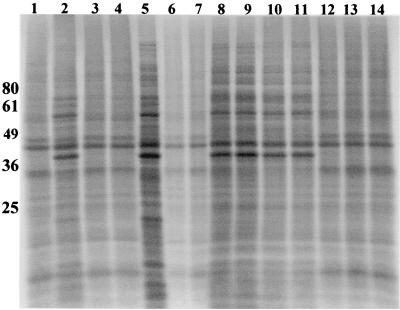
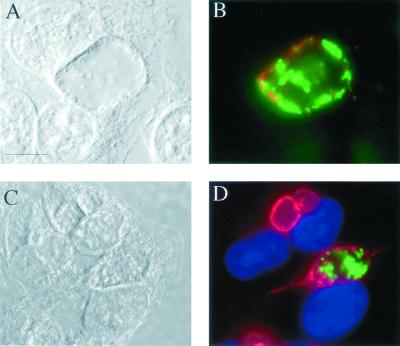
Tetracycline (TET) is a front-line antibiotic for the treatment of chlamydial infections in both humans and animals, and the emergence of TET-resistant (Tet(r)) Chlamydia is of significant clinical importance. Recently, several Tet(r) chlamydial strains have been isolated from swine (Sus scrofa) raised in production facilities in Nebraska. Here, the intracellular development of two Tet(r) strains, R19 and R27, is characterized through the use of tissue culture and immunofluorescence. The strains grow in concentrations of up to 4 microg of TET/ml, while a TET-sensitive (Tet(s)) swine strain (S45) and a strain of the human serovar L2 (LGV-434) grow in up to 0.1 microg of TET/ml. Although inclusions form in the presence of TET, many contain large aberrant reticulate bodies (RBs) that do not differentiate into infectious elementary bodies. The percentage of inclusions containing typical developmental forms decreases with increasing TET concentrations, and at 3 microg of TET/ml 100% of inclusions contain aberrant RBs. However, upon removal of TET the aberrant RBs revert to typical RBs, and a productive developmental cycle ensues. In addition, inclusions were found that contained both C. suis R19 and Chlamydia trachomatis L2 after sequential infection, demonstrating that two biologically distinct chlamydial strains could both develop within a single inclusion.
Figures
References
-
- Andersen A A, Rogers D G. Resistance to tetracycline and sulfadiazine in swine C. trachomatis isolates. In: Stephens R S, et al., editors. Chlamydial Infections. Proceedings of the Ninth International Symposium on Human Chlamydial Infection. 1998. pp. 313–316.
-
- Anonymous. Government advisory committee calls for a reduction in antibiotic use. Vet Rec. 1999;145:266–267. - PubMed
-
- Bannantine J P, Griffiths R S, Viratyosin W, Brown W J, Rockey D D. A secondary structure motif predictive of protein localization to the chlamydial inclusion membrane. Cell Microbiol. 2000;2:35–47. - PubMed
-
- Barth W F, Segal K. Reactive arthritis (Reiter's syndrome) Am Fam Physician. 1999;60:499–503. - PubMed
Publication types
MeSH terms
Substances
LinkOut - more resources
Full Text Sources
