Comparative Study
. 2001 Aug;45(8):2245-55.
doi: 10.1128/AAC.45.8.2245-2255.2001.

Natural antibiotic susceptibilities of Edwardsiella tarda, E. ictaluri, and E. hoshinae

Affiliations
Comparative Study

Natural antibiotic susceptibilities of Edwardsiella tarda, E. ictaluri, and E. hoshinae

I Stock et al. Antimicrob Agents Chemother. 2001 Aug.

Abstract

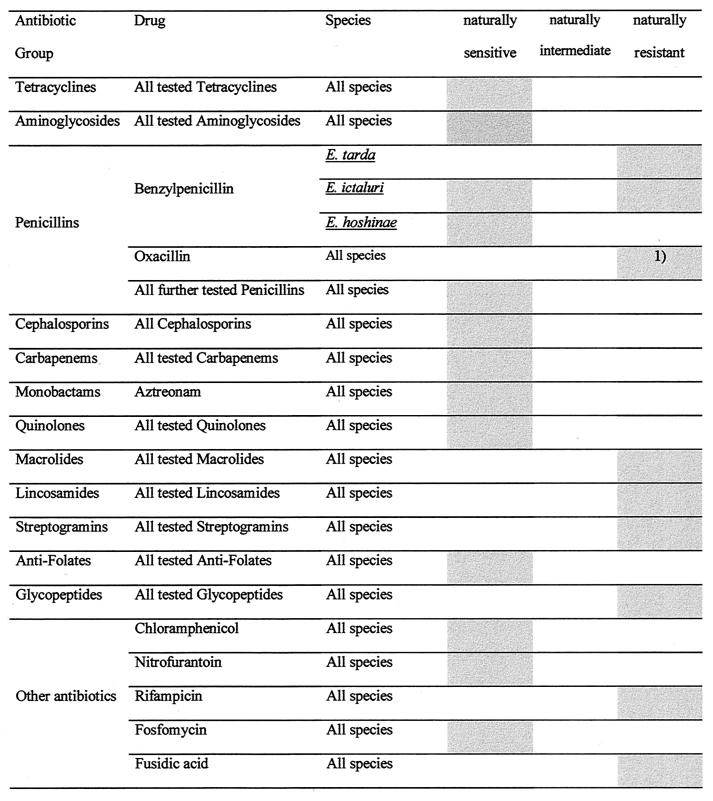
The natural antibiotic susceptibilities to 71 antibiotics of 102 Edwardsiella strains belonging to E. tarda (n = 42), E. ictaluri (n = 41), and E. hoshinae (n = 19) were investigated. MICs were determined using a microdilution procedure according to NCCLS criteria and German standards. All edwardsiellae were naturally sensitive to tetracyclines, aminoglycosides, most beta-lactams, quinolones, antifolates, chloramphenicol, nitrofurantoin, and fosfomycin. Edwardsiella species were naturally resistant to macrolides, lincosamides, streptogramins, glycopeptides, rifampin, fusidic acid, and oxacillin. Although slight species-dependent differences in natural susceptibilities to some antibiotics (e.g., macrolides and cefaclor) were seen, differences in natural susceptibility affecting clinical assessment criteria were only seen with benzylpenicillin. Whereas E. tarda was naturally resistant to benzylpenicillin, E. hoshinae was naturally sensitive. Natural sensitivity and resistance to this penicillin were found among the strains of E. ictaluri. The observed oxacillin sensitivity of E. ictaluri was attributed to the failure of the species to grow at higher salt concentrations found in oxacillin-containing microtiter plates. The present study describes a database concerning the natural susceptibility of Edwardsiella species to a wide range of antibiotics, which can be applied to validate forthcoming antibiotic susceptibility tests of these microorganisms.


Figures
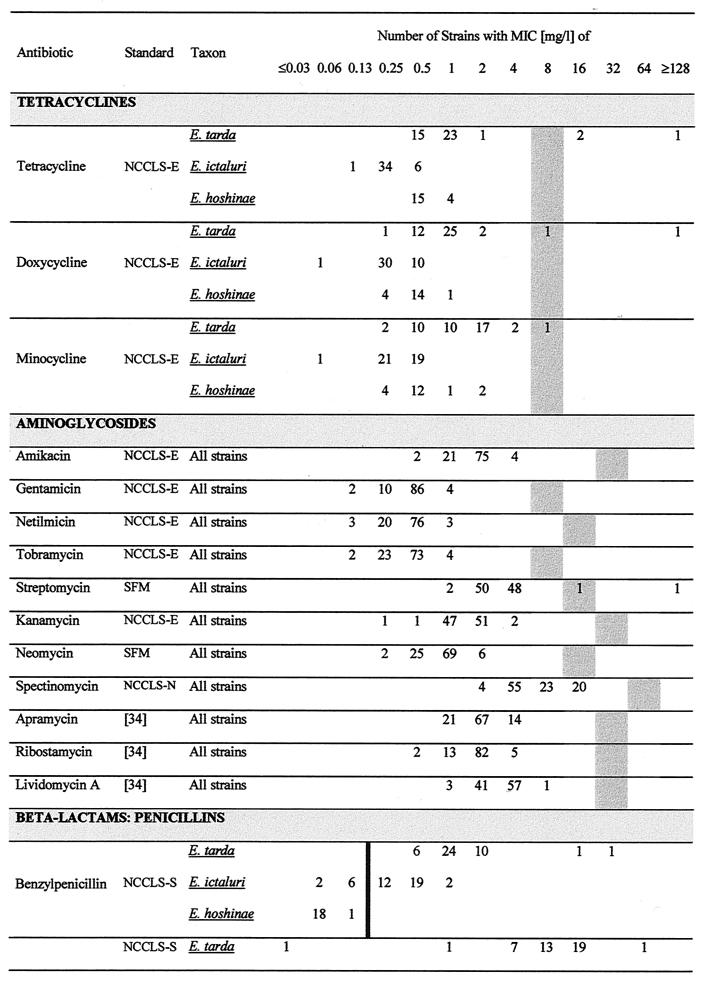
FIG. 1
FIG. 1
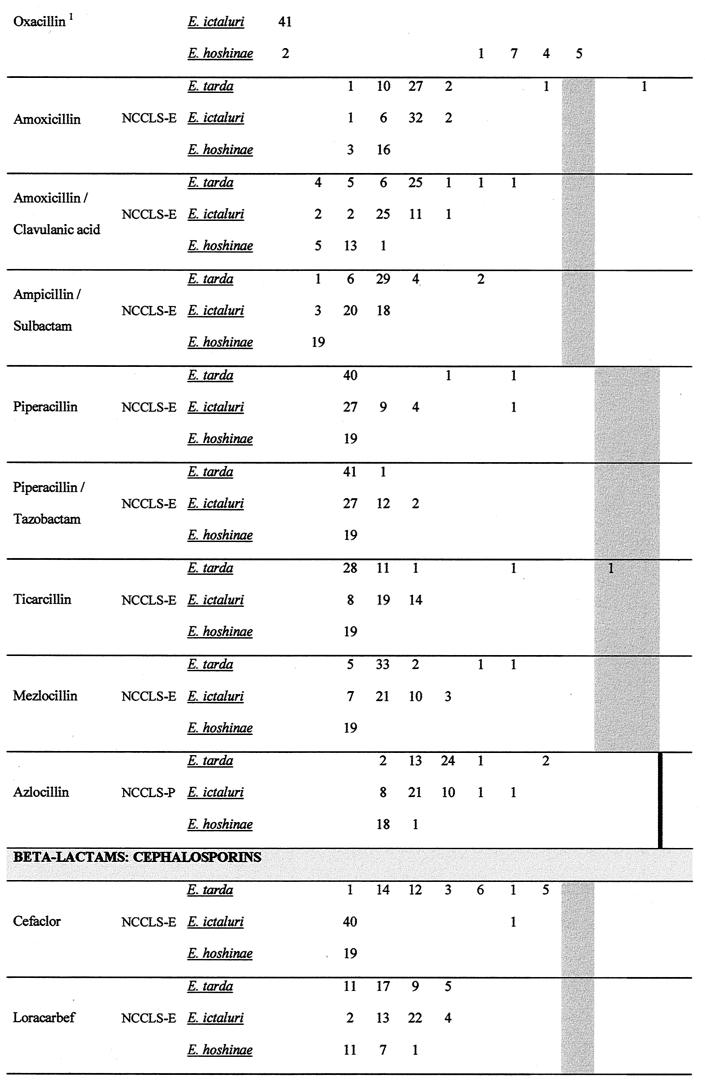
Antibiotic susceptibilities of E. tarda, E. ictaluri, and E. hoshinae. The number of strains for the corresponding MIC is cited. A number in the lowest concentration of the antibiotic represents the maximal MIC at this concentration (MIC = cmin → MIC ≤ cmin). An MIC higher than the highest concentration tested is cited in the subsequent higher concentration step. MICs in shaded areas indicate the clinically intermediate area according to the American standard (NCCLS) valid for Enterobacteriaceae (NCCLS-E) (18), Pseudomonas aeruginosa and other non-Enterobacteriaceae (NCCLS-P) (19), Neisseria gonorrhoeae (NCCLS-N) (21), and Staphylococcus spp. (NCCLS-S) (20). A black thick line indicates the breakpoint between the clinically sensitive and clinically resistant strains, if the intermediate interpretation does not exist. For antibiotics for which NCCLS clinical assessment criteria do not exist, breakpoints according to German (DIN) (7), French (SFM) (5), or Swedish (SWE) (25) standards were employed. Breakpoints for ribostamycin, apramycin, and lividomycin were used as published recently (34). A superscript 1 indicates susceptibility testing in the presence of sodium chloride (2%). Oxacillin breakpoints: susceptible, ≤2 mg/liter; resistant, ≥4 mg/liter. A superscript 2 indicates the MIC distribution for sulfamethoxazole for higher concentrations: MIC = 128 mg/liter, n = 18; MIC = 256 mg/liter, n = 9; MIC = 512 mg/liter, n = 17; MIC = 1,024 mg/liter, n = 22; breakpoint for sensitivity, ≤256 mg/liter (NCCLS-E).
FIG. 1
FIG. 1
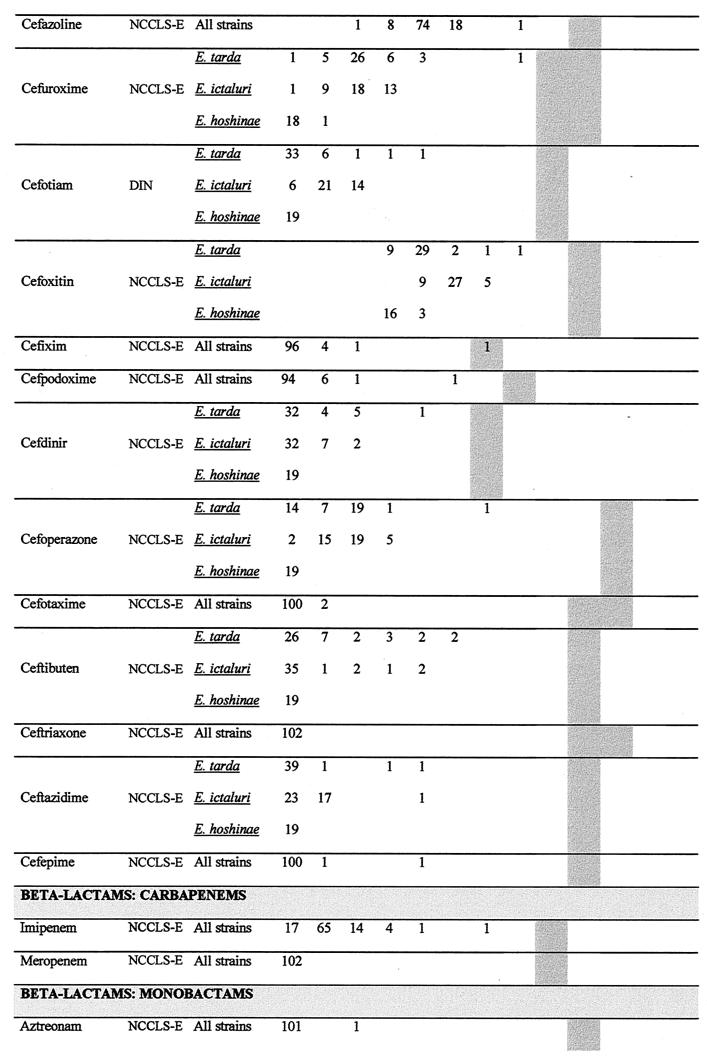
Antibiotic susceptibilities of E. tarda, E. ictaluri, and E. hoshinae. The number of strains for the corresponding MIC is cited. A number in the lowest concentration of the antibiotic represents the maximal MIC at this concentration (MIC = cmin → MIC ≤ cmin). An MIC higher than the highest concentration tested is cited in the subsequent higher concentration step. MICs in shaded areas indicate the clinically intermediate area according to the American standard (NCCLS) valid for Enterobacteriaceae (NCCLS-E) (18), Pseudomonas aeruginosa and other non-Enterobacteriaceae (NCCLS-P) (19), Neisseria gonorrhoeae (NCCLS-N) (21), and Staphylococcus spp. (NCCLS-S) (20). A black thick line indicates the breakpoint between the clinically sensitive and clinically resistant strains, if the intermediate interpretation does not exist. For antibiotics for which NCCLS clinical assessment criteria do not exist, breakpoints according to German (DIN) (7), French (SFM) (5), or Swedish (SWE) (25) standards were employed. Breakpoints for ribostamycin, apramycin, and lividomycin were used as published recently (34). A superscript 1 indicates susceptibility testing in the presence of sodium chloride (2%). Oxacillin breakpoints: susceptible, ≤2 mg/liter; resistant, ≥4 mg/liter. A superscript 2 indicates the MIC distribution for sulfamethoxazole for higher concentrations: MIC = 128 mg/liter, n = 18; MIC = 256 mg/liter, n = 9; MIC = 512 mg/liter, n = 17; MIC = 1,024 mg/liter, n = 22; breakpoint for sensitivity, ≤256 mg/liter (NCCLS-E).
FIG. 1
FIG. 1
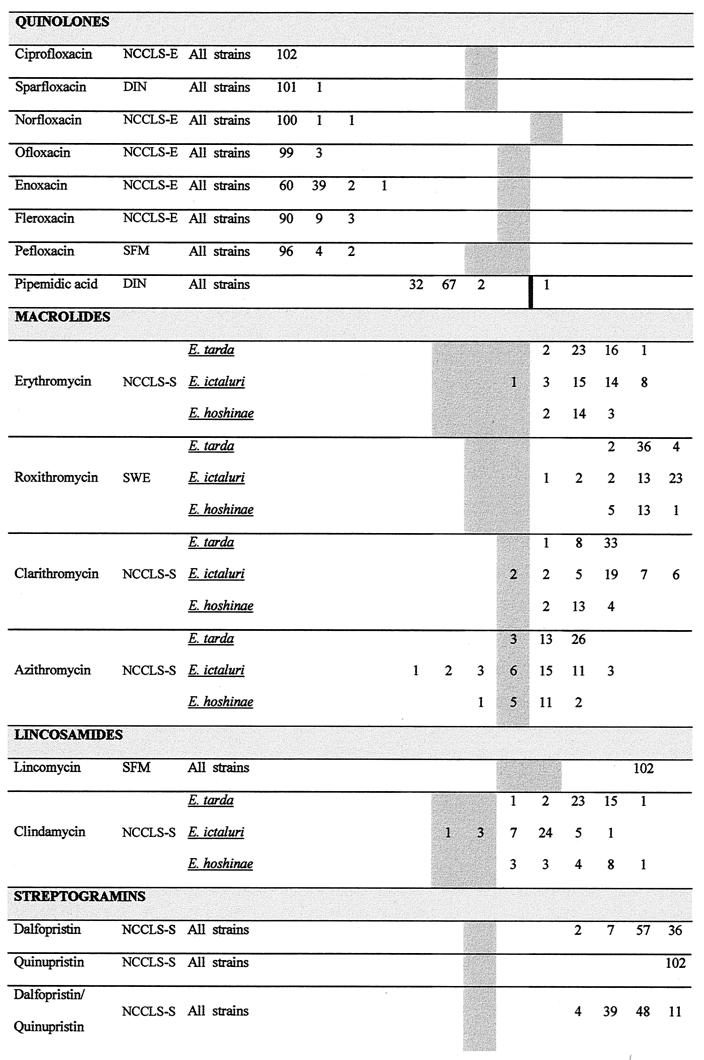
Antibiotic susceptibilities of E. tarda, E. ictaluri, and E. hoshinae. The number of strains for the corresponding MIC is cited. A number in the lowest concentration of the antibiotic represents the maximal MIC at this concentration (MIC = cmin → MIC ≤ cmin). An MIC higher than the highest concentration tested is cited in the subsequent higher concentration step. MICs in shaded areas indicate the clinically intermediate area according to the American standard (NCCLS) valid for Enterobacteriaceae (NCCLS-E) (18), Pseudomonas aeruginosa and other non-Enterobacteriaceae (NCCLS-P) (19), Neisseria gonorrhoeae (NCCLS-N) (21), and Staphylococcus spp. (NCCLS-S) (20). A black thick line indicates the breakpoint between the clinically sensitive and clinically resistant strains, if the intermediate interpretation does not exist. For antibiotics for which NCCLS clinical assessment criteria do not exist, breakpoints according to German (DIN) (7), French (SFM) (5), or Swedish (SWE) (25) standards were employed. Breakpoints for ribostamycin, apramycin, and lividomycin were used as published recently (34). A superscript 1 indicates susceptibility testing in the presence of sodium chloride (2%). Oxacillin breakpoints: susceptible, ≤2 mg/liter; resistant, ≥4 mg/liter. A superscript 2 indicates the MIC distribution for sulfamethoxazole for higher concentrations: MIC = 128 mg/liter, n = 18; MIC = 256 mg/liter, n = 9; MIC = 512 mg/liter, n = 17; MIC = 1,024 mg/liter, n = 22; breakpoint for sensitivity, ≤256 mg/liter (NCCLS-E).
FIG. 1
FIG. 1
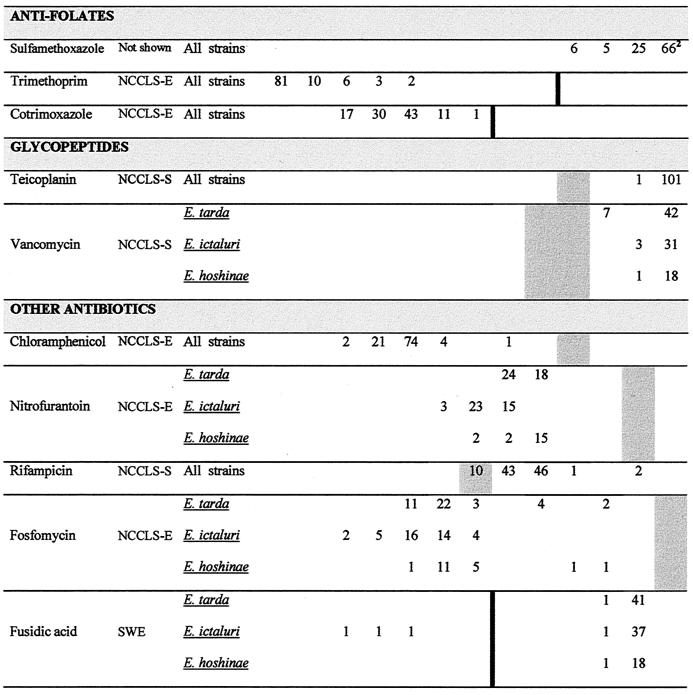
Antibiotic susceptibilities of E. tarda, E. ictaluri, and E. hoshinae. The number of strains for the corresponding MIC is cited. A number in the lowest concentration of the antibiotic represents the maximal MIC at this concentration (MIC = cmin → MIC ≤ cmin). An MIC higher than the highest concentration tested is cited in the subsequent higher concentration step. MICs in shaded areas indicate the clinically intermediate area according to the American standard (NCCLS) valid for Enterobacteriaceae (NCCLS-E) (18), Pseudomonas aeruginosa and other non-Enterobacteriaceae (NCCLS-P) (19), Neisseria gonorrhoeae (NCCLS-N) (21), and Staphylococcus spp. (NCCLS-S) (20). A black thick line indicates the breakpoint between the clinically sensitive and clinically resistant strains, if the intermediate interpretation does not exist. For antibiotics for which NCCLS clinical assessment criteria do not exist, breakpoints according to German (DIN) (7), French (SFM) (5), or Swedish (SWE) (25) standards were employed. Breakpoints for ribostamycin, apramycin, and lividomycin were used as published recently (34). A superscript 1 indicates susceptibility testing in the presence of sodium chloride (2%). Oxacillin breakpoints: susceptible, ≤2 mg/liter; resistant, ≥4 mg/liter. A superscript 2 indicates the MIC distribution for sulfamethoxazole for higher concentrations: MIC = 128 mg/liter, n = 18; MIC = 256 mg/liter, n = 9; MIC = 512 mg/liter, n = 17; MIC = 1,024 mg/liter, n = 22; breakpoint for sensitivity, ≤256 mg/liter (NCCLS-E).
FIG. 1
FIG. 1
Antibiotic susceptibilities of E. tarda, E. ictaluri, and E. hoshinae. The number of strains for the corresponding MIC is cited. A number in the lowest concentration of the antibiotic represents the maximal MIC at this concentration (MIC = cmin → MIC ≤ cmin). An MIC higher than the highest concentration tested is cited in the subsequent higher concentration step. MICs in shaded areas indicate the clinically intermediate area according to the American standard (NCCLS) valid for Enterobacteriaceae (NCCLS-E) (18), Pseudomonas aeruginosa and other non-Enterobacteriaceae (NCCLS-P) (19), Neisseria gonorrhoeae (NCCLS-N) (21), and Staphylococcus spp. (NCCLS-S) (20). A black thick line indicates the breakpoint between the clinically sensitive and clinically resistant strains, if the intermediate interpretation does not exist. For antibiotics for which NCCLS clinical assessment criteria do not exist, breakpoints according to German (DIN) (7), French (SFM) (5), or Swedish (SWE) (25) standards were employed. Breakpoints for ribostamycin, apramycin, and lividomycin were used as published recently (34). A superscript 1 indicates susceptibility testing in the presence of sodium chloride (2%). Oxacillin breakpoints: susceptible, ≤2 mg/liter; resistant, ≥4 mg/liter. A superscript 2 indicates the MIC distribution for sulfamethoxazole for higher concentrations: MIC = 128 mg/liter, n = 18; MIC = 256 mg/liter, n = 9; MIC = 512 mg/liter, n = 17; MIC = 1,024 mg/liter, n = 22; breakpoint for sensitivity, ≤256 mg/liter (NCCLS-E).
FIG. 2
FIG. 2
Grouping of natural populations of Edwardsiella spp. into the categories sensitive, intermediate, and resistant, according to the standards mentioned in the legend to Fig. 1. Note: if ≤30% of the strains belonging to a natural population were attributed to one of the clinical categories, these percentages were not taken into consideration. 1), see Discussion.

References

    1. Bengoechea J A, Brandenburg K, Seydel U, Diaz R, Moriyon I. Yersinia pseudotuberculosis and Yersinia pestis show increased outer membrane permeability to hydrophobic agents which correlates with lipopolysaccharide acyl-chain fluidity. Microbiology. 1998;144:1517–1526. - PubMed
    1. Bergan T, Lolekha S, Cheong M K, Poh C L, Doencham S, Charoenpipop D. Effect of recent antibacterial agents against bacteria causing diarrhoea. Scand J Infect Dis. 1988;56:7–10. - PubMed
    1. Bhat P, Myers M, Carpenter K P. Edwardsiella tarda in a study of juvenile diarrhoea. J Hyg. 1967;65:293–298. - PMC - PubMed
    1. Clark R B, Lister P D, Janda J M. In vitro susceptibilities of Edwardsiella tarda to 22 antibiotics and antibiotic-β-lactamase-inhibitor agents. Diagn Microbiol Infect Dis. 1991;14:173–175. - PubMed
    1. Comité de l'Antibiogramme de la Société Française de Microbiologie. Statement. Pathol Biol. 1998;46:I–XVI.

Publication types

MeSH terms

Substances

LinkOut - more resources