Testing for Helicobacter pylori in dyspeptic patients suspected of peptic ulcer disease in primary care: cross sectional study
- PMID: 11451780
- PMCID: PMC34540
- DOI: 10.1136/bmj.323.7304.71
Testing for Helicobacter pylori in dyspeptic patients suspected of peptic ulcer disease in primary care: cross sectional study
Abstract
Objectives: To develop an easily applicable diagnostic scoring method to determine the presence of peptic ulcers in dyspeptic patients in a primary care setting; to evaluate whether Helicobacter pylori testing adds value to history taking.
Design: Cross sectional study.
Setting: General practitioners' offices in the Utrecht area of the Netherlands.
Participants: 565 patients consulting a general practitioner about dyspeptic symptoms of at least two weeks' duration.
Main outcome measures: The presence or absence of peptic ulcer; independent predictors of the presence of peptic ulcer as obtained from history taking and the added value of H pylori testing were quantified by using multivariate logistic regression analyses.
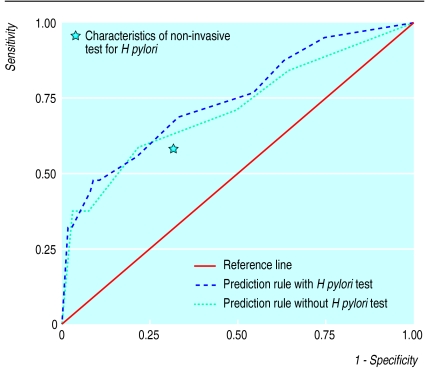
Results: A history of peptic ulcer, pain on an empty stomach, and smoking were strong and independent diagnostic determinants of peptic ulcer disease, with odds ratios of 5.5 (95% confidence interval 2.6 to 11.8), 2.8 (1.0 to 4.0), and 2.0 (1.4 to 6.0) respectively. The area under the receiver operating characteristic curve (ROC area) of these determinants together was 0.71. Adding the H pylori test increased the ROC area only to 0.75. However, in a group of patients at high risk, identified by means of a simple scoring rule based on history taking, the predictive value for the presence of peptic ulcer increased from 16% to 26% after a positive H pylori test.
Conclusions: In the total group of dyspeptic patients in primary care, H pylori testing has no value in addition to history taking for diagnosing peptic ulcer disease. In a subgroup of patients at high risk of having peptic ulcer disease, however, it might be useful to test for and treat H pylori infections.
Figures
Comment in
-
Testing for Helicobacter pylori in dyspeptic patients. Authors' suggestion muddies waters in debate.BMJ. 2001 Nov 3;323(7320):1066-7; author reply 1067-8. BMJ. 2001. PMID: 11713741 No abstract available.
-
Testing for Helicobacter pylori in dyspeptic patients. Did paper have statistical discrepancies?BMJ. 2001 Nov 3;323(7320):1066; author reply 1067-8. BMJ. 2001. PMID: 11713742 Free PMC article. No abstract available.
-
Testing for Helicobacter pylori in dyspeptic patients. Clinical importance of predictive values is dubious.BMJ. 2001 Nov 3;323(7320):1067-8. BMJ. 2001. PMID: 11713743 No abstract available.
-
Testing for Helicobacter pylori in dyspeptic patients. Authors' strategy would leave many patients with ulcer uncured.BMJ. 2001 Nov 3;323(7320):1067; author reply 1067-8. BMJ. 2001. PMID: 11713744 No abstract available.
References
-
- Heikkinen M, Pikkarainen P, Takala J, Rasanen H, Julkunen R. Etiology of dyspepsia: four hundred unselected consecutive patients in general practice. Scand J Gastroenterol. 1995;30:519–523. - PubMed
-
- Ciociola AA, McSorley DJ, Turner K, Sykes D, Palmer JB. Helicobacter pylori infection rates in duodenal ulcer patients in the United States may be lower than previously estimated. Am J Gastroenterol. 1999;94:1834–1840. - PubMed
-
- De Boer WA, Joosen EA. Disease management in ulcer disease. Scand J Gastroenterol. 1999;230(suppl):23–28. - PubMed
-
- Fraser AG, Ali MR, McCullough S, Yeates NJ, Haystead A. Diagnostic tests for Helicobacter pylori—can they help select patients for endoscopy? N Z Med J. 1996;109:95–98. - PubMed
Publication types
MeSH terms
Grants and funding
LinkOut - more resources
Full Text Sources
Medical