Randomised controlled trial of disclosure of emotionally important events in somatisation in primary care
- PMID: 11451784
- PMCID: PMC34544
- DOI: 10.1136/bmj.323.7304.86
Randomised controlled trial of disclosure of emotionally important events in somatisation in primary care
Abstract
Objective: To test whether a disclosure intervention improves subjective health and reduces medical consumption and sick leave in somatising patients in general practice.
Design: Non-blind randomised controlled trial.
Setting: 10 general practices in the Netherlands.
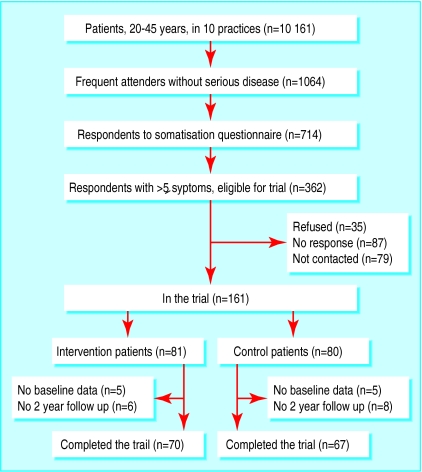
Participants: 161 patients who frequently attended general practice with somatising symptoms.
Intervention: Patients in the intervention group were visited two to three times and invited to disclose emotionally important events in their life. Control patients received normal care from their general practitioners.
Main outcome measures: Use of medical services (drugs and healthcare visits), subjective health, and sick leave assessed by self completion questionnaires after 6, 12, and 24 months.
Results: Of the 161 patients, 137 completed the trial (85%). Both groups were comparable at baseline. The intervention had no effect on the main outcome measures at any point. Intervention patients made one more visit to health care (95% confidence interval -4 to 6); the use of medicines did not change in both groups (-1 to 1); subjective health improved 3.6 points more in the control group (-11.2 to 4.3); and disclosure patients were on sick leave one more week (-1 to 3). Patients often had a depression or anxiety disorder for which they were not receiving adequate care.
Conclusion: Although the intervention was well received by patients and doctors, disclosure had no effect on the health of somatising patients in general practice.
Comment in
-
Somatisation in primary care. Solitary disclosure allows people to determine their own dose.BMJ. 2002 Mar 2;324(7336):544. BMJ. 2002. PMID: 11872562 Free PMC article. No abstract available.
-
Somatisation in primary care. Descriptive use of term should not be confused with its conceptualisation.BMJ. 2002 Mar 2;324(7336):544. BMJ. 2002. PMID: 11876178 No abstract available.
References
-
- Escobar JI, Rubio-Stipec M, Canino G, Karno M. Somatic symptom index (SSI): a new and abridged somatization construct. Prevalence and epidemiological correlates in two large community samples. J Nerv Ment Dis. 1989;177:140–146. - PubMed
-
- Portegijs PJM, van der Horst FG, Proot IM, Kraan HF, Gunther NC, Knottnerus JA. Somatization in frequent attenders of general practice. Soc Psychiatry Psychiatr Epidemiol. 1996;31:29–37. - PubMed
-
- Lipowski ZJ. Somatization: the concept and its clinical application. Am J Psychiatry. 1988;145:1358–1368. - PubMed
-
- Goldberg D, Bridges K. Somatic presentations of psychiatric illness in primary care setting. J Psychosom Res. 1988;32:137–144. - PubMed
-
- American Psychiatric Association. Diagnostic and statistical manual of mental disorders, 3rd edition, revised. Washington, DC: APA; 1987. pp. 261–264.
Publication types
MeSH terms
LinkOut - more resources
Full Text Sources
Medical