Increase in plasma adrenomedullin in patients with heart failure characterised by diastolic dysfunction
- PMID: 11454830
- PMCID: PMC1729865
- DOI: 10.1136/heart.86.2.155
Increase in plasma adrenomedullin in patients with heart failure characterised by diastolic dysfunction
Abstract
Objective: To investigate the relation between plasma adrenomedullin and the severity of diastolic dysfunction in patients with heart failure.
Design: Prospective study.
Setting: University teaching hospital.
Patients: 77 patients (mean (SEM) age 66.3 (1.2) years; 75% male) who were being followed in the outpatient clinic after admission to hospital for acute heart failure.
Interventions: Same day echocardiography with Doppler studies; determination of venous adrenomedullin concentration by radioimmunoassay.
Main outcome measures: Plasma adrenomedullin concentration and its correlation with systolic and diastolic function.
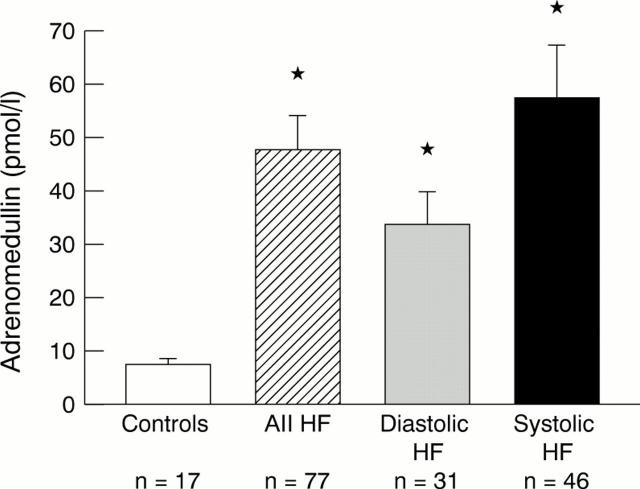
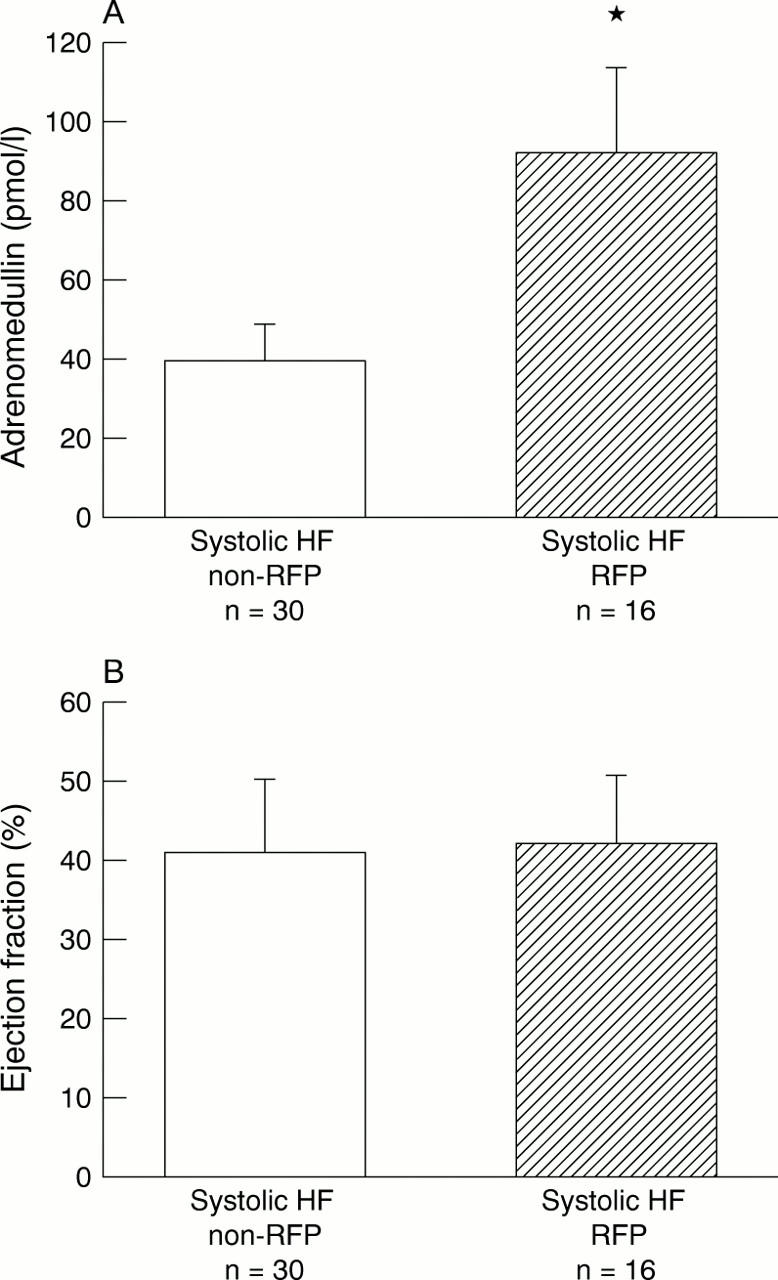
Results: 31 patients (40%) had isolated diastolic dysfunction (ejection fraction > 50%), and the remaining 46 had a depressed ejection fraction (< 50%). Of the patients with diastolic dysfunction, 17 had a restrictive filling pattern. In all but one of these there was coexisting systolic failure (chi(2) = 10.7, p = 0.001). Patients with systolic heart failure and a restrictive filling pattern (group 1, n = 16) had a higher plasma adrenomedullin than those with systolic failure and a non-restrictive filling pattern (group 2, n = 30) or with isolated diastolic heart failure and a non-restrictive filling pattern (group 3, n = 30) (mean (SEM): 91.7 (21.1) v 38.4 (8.8) v 34.0 (6.5) pmol/l, both p < 0.05). All heart failure values were higher (p < 0.01) than the control value (6.9 (1.2) pmol/l). Ejection fraction and left ventricular dimensions were similar in groups 1 and 2. Plasma adrenomedullin did not correlate with ejection fraction or New York Heart Association functional class. Stepwise multiple regression analysis showed that the presence of a restrictive filling pattern was the only independent variable associated with a high plasma adrenomedullin.
Conclusions: Plasma adrenomedullin concentrations in patients with heart failure are determined by the presence of diastolic dysfunction, and are especially raised in the presence of a restrictive filling pattern. There appears to be no correlation with systolic dysfunction.
Figures
References
Publication types
MeSH terms
Substances
LinkOut - more resources
Full Text Sources
Other Literature Sources
Medical