


ABCA1 overexpression leads to hyperalphalipoproteinemia and increased biliary cholesterol excretion in transgenic mice
- PMID: 11457883
- PMCID: PMC203026
- DOI: 10.1172/JCI12517
ABCA1 overexpression leads to hyperalphalipoproteinemia and increased biliary cholesterol excretion in transgenic mice
Abstract
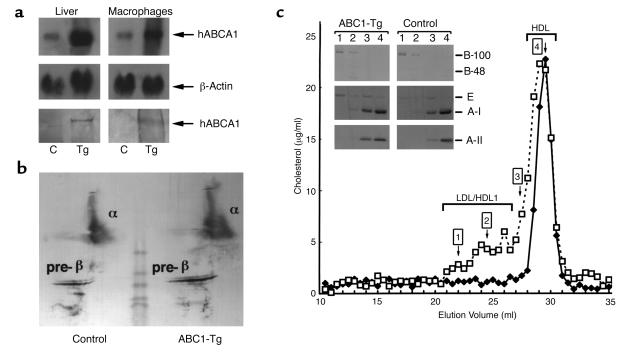
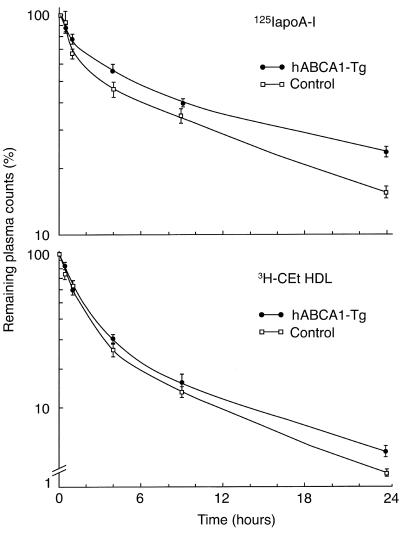
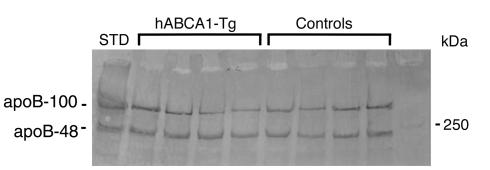
The discovery of the ABCA1 lipid transporter has generated interest in modulating human plasma HDL levels and atherogenic risk by enhancing ABCA1 gene expression. To determine if increased ABCA1 expression modulates HDL metabolism in vivo, we generated transgenic mice that overexpress human ABCA1 (hABCA1-Tg). Hepatic and macrophage expression of hABCA1 enhanced macrophage cholesterol efflux to apoA-I; increased plasma cholesterol, cholesteryl esters (CEs), free cholesterol, phospholipids, HDL cholesterol, and apoA-I and apoB levels; and led to the accumulation of apoE-rich HDL1. ABCA1 transgene expression delayed 125I-apoA-I catabolism in both liver and kidney, leading to increased plasma apoA-I levels, but had no effect on apoB secretion after infusion of Triton WR1339. Although the plasma clearance of HDL-CE was not significantly altered in hABCA1-Tg mice, the net hepatic delivery of exogenous 3H-CEt-HDL, which is dependent on the HDL pool size, was increased 1.5-fold. In addition, the cholesterol and phospholipid concentrations in hABCA1-Tg bile were increased 1.8-fold. These studies show that steady-state overexpression of ABCA1 in vivo (a) raises plasma apoB levels without altering apoB secretion and (b) raises plasma HDL-C and apoA-I levels, facilitating hepatic reverse cholesterol transport and biliary cholesterol excretion. Similar metabolic changes may modify atherogenic risk in humans.
Figures
References
-
- Miller NE. Associations of high-density lipoprotein subclasses and apolipoproteins with ischemic heart disease and coronary atherosclerosis. Am Heart J. 1987;113:589–597. - PubMed
-
- Fielding CJ, Fielding PE. Intracellular cholesterol transport. J Lipid Res. 1997;38:1503–1521. - PubMed
-
- Oram JF, Yokoyama S. Apolipoprotein-mediated removal of cellular cholesterol and phospholipids. J Lipid Res. 1996;37:2473–2491. - PubMed
-
- Dean M, Allikmets R. Evolution of ATP-binding cassette transporter genes. Curr Opin Genet Dev. 1995;5:779–785. - PubMed
-
- Decottignies A, Goffeau A. Complete inventory of the yeast ABC proteins. Nat Genet. 1997;15:137–145. - PubMed
MeSH terms
Substances
LinkOut - more resources
Full Text Sources
Other Literature Sources
Medical
Molecular Biology Databases
Miscellaneous
