. 2001 Jul;126(3):1061-71.
doi: 10.1104/pp.126.3.1061.

The wheat cDNA LCT1 generates hypersensitivity to sodium in a salt-sensitive yeast strain

Affiliations

The wheat cDNA LCT1 generates hypersensitivity to sodium in a salt-sensitive yeast strain

A Amtmann et al. Plant Physiol. 2001 Jul.

Abstract

Salinity affects large areas of agricultural land, and all major crop species are intolerant to high levels of sodium ions. The principal route for Na(+) uptake into plant cells remains to be identified. Non-selective ion channels and high-affinity potassium transporters have emerged as potential pathways for Na(+) entry. A third candidate for Na(+) transport into plant cells is a low-affinity cation transporter represented by the wheat protein LCT1, which is known to be permeable for a wide range of cations when expressed in yeast (Saccharomyces cerevisiae). To investigate the role of LCT1 in salt tolerance we have used the yeast strain G19, which is disrupted in the genes encoding Na(+) export pumps and as a result displays salt sensitivity comparable with wheat. After transformation with LCT1, G19 cells became hypersensitive to NaCl. We show that LCT1 expression results in a strong decrease of intracellular K(+)/Na(+) ratio in G19 cells due to the combined effect of enhanced Na(+) accumulation and loss of intracellular K(+). Na(+) uptake through LCT1 was inhibited by K(+) and Ca(2+) at high concentrations and the addition of these ions rescued growth of LCT1-transformed G19 on saline medium. LCT1 was also shown to mediate the uptake of Li(+) and Cs(+). Expression of two mutant LCT1 cDNAs with N-terminal truncations resulted in decreased Ca(2+) uptake and increased Na(+) tolerance compared with expression of the full-length LCT1. Our findings strongly suggest that LCT1 represents a molecular link between Ca(2+) and Na(+) uptake into plant cells.


Figures
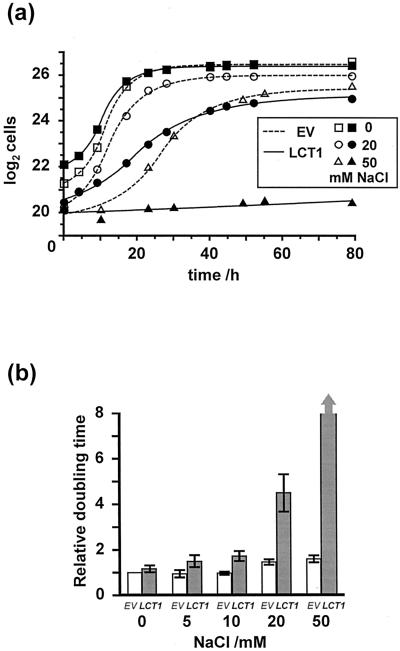
Figure 1
Figure 1
Salt sensitivity of G19 yeast transformed with LCT1. a, Typical growth of LCT1-transformed G19 cultures (black symbols and lines) and G19 cultures transformed with the empty pYES2 plasmid (EV, white symbols and dashed lines) in liquid AP medium containing 1 mm KCl, 0.2 mm CaCl2, and various concentrations of NaCl. b, Mean doubling times of G19 cultures transformed with EV (white bars) and LCT1 (black bars) in various concentrations of NaCl. Data are standardized with respect to the doubling times of EV cultures in Na+-free medium in the same experiment. Values for LCT1-transformed cultures in 50 mm NaCl were >100. Means of nine, three, four, five, and three experiments (for 0, 5, 10, 20, and 50 mm NaCl, respectively) ± se.
Figure 2
Figure 2
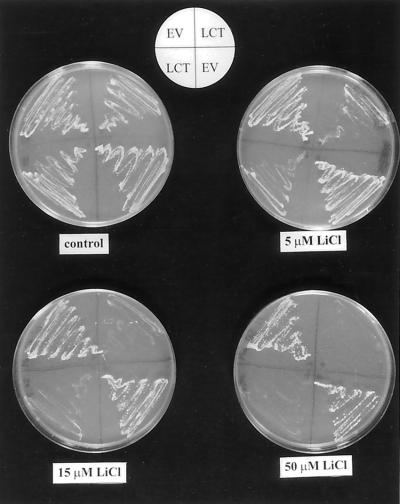
Li+ hypersensitivity of LCT1-transformed cells. Growth of G19 cells transformed with EV and LCT1 on plates containing AP medium with different concentrations of LiCl. Note that growth of LCT1-transformed cells is reduced at Li+ concentrations as low as 5 μm.
Figure 3
Figure 3
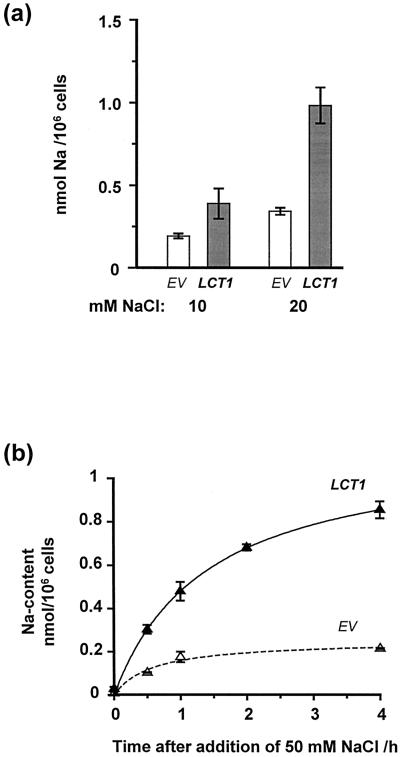
Na+ content of LCT1-transformed cells after growth in NaCl-containing media. a, Intracellular Na+ content of G19 cultures transformed with EV (white bars) or LCT1 (black bars) after growth in liquid AP medium containing 10 or 20 mm NaCl. For this experiment, precultures of G19 cells grown in Na+-free medium were diluted to an OD600 of 0.05 and were exposed to different NaCl concentrations. Two days later cells were harvested in the stationary phase. Means of three experiments ± sem are shown. b, Time course of Na+ accumulation in EV- (dashed curve) and LCT1- (black curve) transformed cells after addition of 50 mm NaCl. Prior to the experiment, the cultures had grown to the early stationary phase in Na+-free liquid AP medium. Means of three experiments ± se are shown.
Figure 4
Figure 4
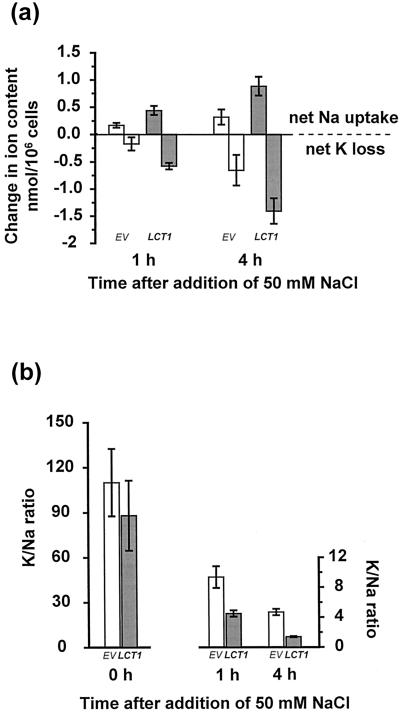
Changes in Na+ and K+ content of LCT1-transformed cells after addition of 50 mm NaCl. a, Net Na+ uptake and K+ loss of G19 cells transformed with EV (white bars) or LCT1 (black bars) at 1 and 4 h after addition of 50 mm NaCl. Values were calculated by subtracting Na+ and K+ contents at time 0 from Na+ and K+ contents at the given time. Means of five experiments ± sem are shown. b, Intracellular K+/Na+ ratios in G19 cells transformed with EV (white bars) and LCT1 (black bars) before and after addition of 50 mm NaCl. Means of five experiments ± se are shown.
Figure 5
Figure 5
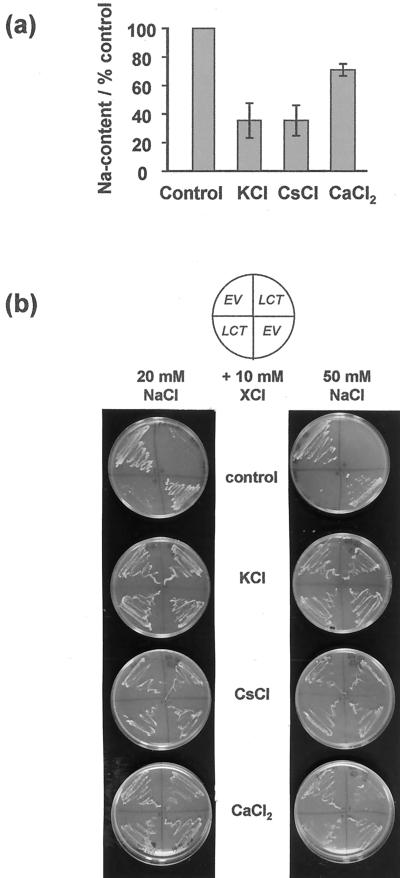
Effect of K+, Cs+, and Ca2+ on Na+ contents and Na+ sensitivity of LCT1-transformed cells. a, Na+ contents of LCT1-transformed G19 cells 7 h after addition of 50 mm NaCl alone (control) or together with 50 mm KCl, CsCl or CaCl2. Values are standardized with respect to Na+ contents in 50 mm NaCl with no other cations added. Means of three experiments ± se are shown. b, Addition of 10 mm KCl, CsCl, or CaCl2 restores growth of LCT1-transformed cells on agar plates containing AP medium with 20 or 50 mm NaCl added.
Figure 6
Figure 6
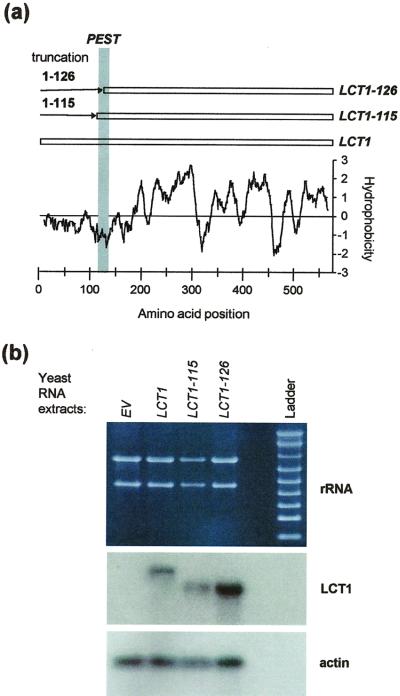
Construction of N terminally truncated LCT1 genes and expression in yeast. a, Positions of PEST sequence and N-terminal truncations on the hydropathy plot of LCT1. b, Agarose-formamide gel and northern blots of total RNA extracted from G19 cells transformed with EV (first lane), full length LCT1 (second lane), and N-terminal truncations LCT1-115 (third lane), and LCT1-126 (fourth lane). Top, Bands for ribosomal RNA on agarose-formaldehyde gel. Middle, Hybridization of blot with LCT1 probe. Bottom, Hybridization with actin probe. Note that differences in band intensities for LCT1 constructs are mainly due to different loading.
Figure 7
Figure 7
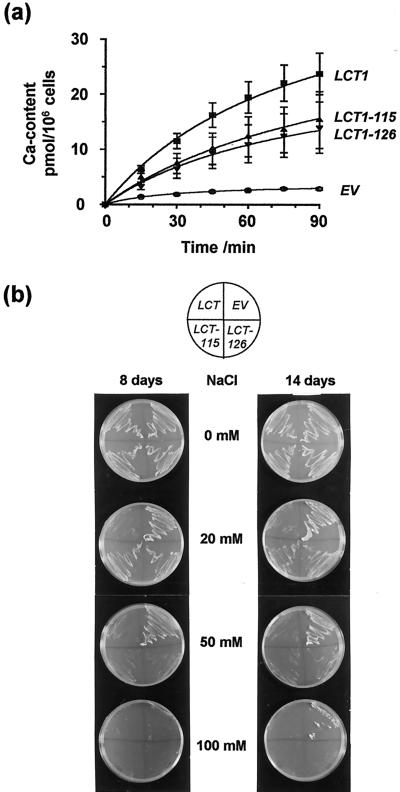
Ca2+ uptake and Na+ sensitivity of yeast cells transformed with wild-type LCT1 or N-terminally truncated LCT1 genes. a, 45Ca2+ uptake of JKmc cells transformed with EV, wild-type LCT1, or N-terminally truncated LCT1 genes (LCT1-115, LCT1-126, compare with Fig. 6) in liquid uracil-free synthetic medium (SD) medium containing 100 μm CaCl2. Means of nine experiments ± se are shown. b, Growth of G19 cells transformed with EV, wild-type LCT1, or N-terminally truncated LCT1 (LCT-115 and LCT-126) on plates containing AP medium with various concentrations of NaCl. Note that the truncated LCT1 constructs resemble EV on 20 mm NaCl and LCT1 on higher NaCl. Growth after 8 and 14 d is shown to demonstrate sustainability of phenotypes.
Figure 8
Figure 8
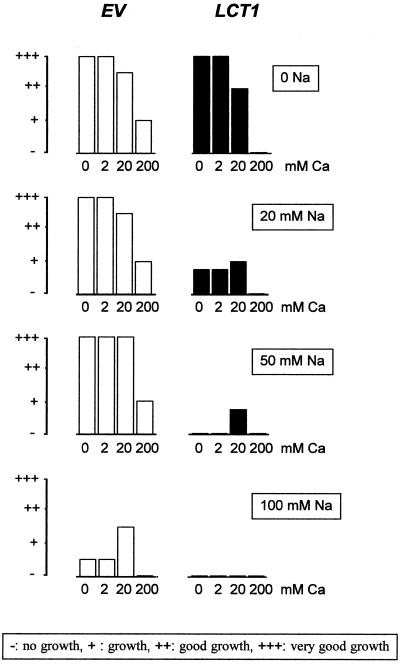
Combined effects of Na+ toxicity, Ca2+ rescue, and Ca2+ toxicity on growth of EV- and LCT1–transformed G19 cells. Growth of G19 cells transformed with EV and LCT1 on plates containing AP medium with different concentrations of NaCl and or CaCl2. Bars are qualitative measures for colony density on the plates (see box for description). Each transformant was streaked twice in the same conditions (compare with Fig. 5). Growth was identical for both replica in all conditions. Note hypersensitivity of LCT1 transformants to Na+ and Ca2+, lack of effect of 2 mm Ca2+ on Na+ sensitivity, and rescue of LCT1 and control cultures on high Na+ by 20 mm Ca2+.

References

    1. Amtmann A, Sanders D. Mechanisms of Na+ uptake by plant cells. Adv Bot Res. 1999;29:76–112.
    1. Anderson JA, Huprikar SS, Kochian LV, Lucas WJ, Gaber RF. Functional expression of a probable Arabidopsis thaliana potassium channel in Saccharomyces cerevisiae. Proc Natl Acad Sci USA. 1992;89:3736–3740. - PMC - PubMed
    1. Apse MP, Aharon GS, Snedden WA, Blumwald E. Salt tolerance conferred by overexpression of a vacuolar Na+/H+ antiport in Arabidopsis. Science. 1999;285:1256–1258. - PubMed
    1. Bañuelos MA, Sychrova H, Bleykasten-Grosshans C, Souciet J-L, Potier S. The Nha1 antiporter of Saccharomyces cerevisiae mediates sodium and potassium efflux. Microbiology. 1998;144:2749–2758. - PubMed
    1. Bertl A, Bihler H, Reid JD, Kettner C, Slayman CL. Physiological characterization of the yeast plasma membrane outward rectifying K+ channel, Duk1 (Tok1), in situ. J Membr Biol. 1998;162:67–80. - PubMed

Publication types

MeSH terms

LinkOut - more resources