. 2001 Jul 31;98(16):9226-30.
doi: 10.1073/pnas.151174198. Epub 2001 Jul 17.

Immunosuppression by CD4+ regulatory T cells induced by chronic retroviral infection

Affiliations

Immunosuppression by CD4+ regulatory T cells induced by chronic retroviral infection

M Iwashiro et al. Proc Natl Acad Sci U S A. .

Abstract

Normal levels of CD4(+) regulatory T cells are critical for the maintenance of immunological homeostasis and the prevention of autoimmune diseases. However, we now show that the expansion of CD4(+) regulatory T cells in response to a chronic viral infection can lead to immunosuppression. Mice persistently infected with Friend retrovirus develop approximately twice the normal percentage of splenic CD4(+) regulatory T cells and lose their ability to reject certain tumor transplants. The role of CD4(+) regulatory T cells was demonstrated by the transmission of immunosuppression to uninfected mice by adoptive transfers of CD4(+) T cells. CD4(+) T cells from chronically infected mice were also immunosuppressive in vitro, inhibiting the generation of cytolytic T lymphocytes in mixed lymphocyte cultures. Inhibition occurred at the level of blast-cell formation through a mechanism or mechanisms involving transforming growth factor-beta and the cell surface molecule CTLA-4 (CD152). These results suggest a possible explanation for HIV- and human T cell leukemia virus-I-induced immunosuppression in the absence of T cell depletion.


Figures
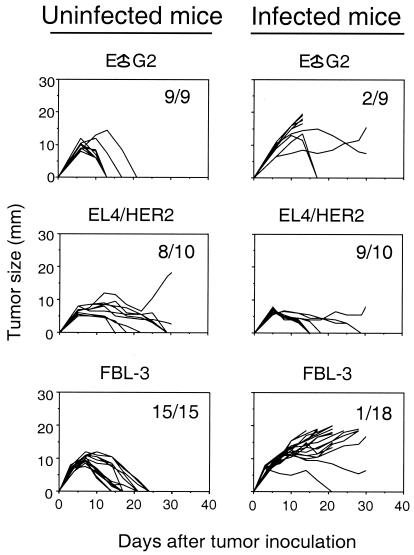
Figure 1
Figure 1
Growth curves of tumors in uninfected mice and FV-infected mice. Each line represents tumor growth in a single animal transplanted with AKV-induced E♂G2 tumor cells, human oncogene-transfected EL4/HER2 tumor cells, or FV-induced FBL-3 tumor cells, as indicated. Numbers in the boxes indicate the number of mice that rejected their tumors over the total number of mice tested. Mice with complications caused by tumor metastasis or tumor size greater than 20-mm diameter were euthanized for humanitarian reasons.
Figure 2
Figure 2
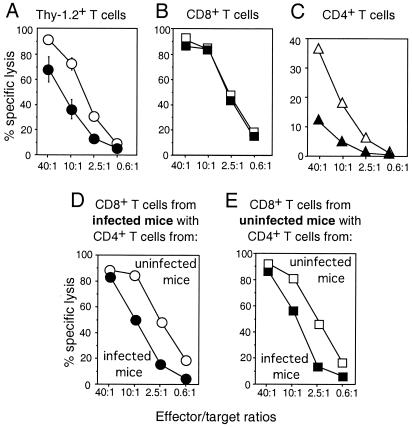
Alloantigen-specific cytotoxic reactivity by MLC cells. T cells from spleens of either uninfected mice or chronically infected (B10 × A.BY)F1 (H-2b) mice were pooled, purified, cultured in MLC for 5 days, and tested for alloantigen-specific cytotoxic reactivity. (A) Thy-1.2+ T cells from uninfected (○) or infected mice (●) were cultured and tested against P815 (H-2d) target cells. Means and standard errors of five mice are shown. Two independent experiments showed similar results with statistically significant differences at the 40:1, 10:1, and 2.5:1 ratios (P < 0.05 by Student's t test). (B) Purified CD8+ cells from pooled spleen cells of either uninfected (□) or infected (■) mice were cultured and tested against P815 target cells. Results shown for B and C are means from duplicate samples; two independent experiments gave similar results. (C) Purified CD4+ cells from pooled spleen cells of either uninfected (▵) or infected (▴) mice were cultured and tested against LB27.4 (H-2d) MHC class II+ target cells. (D and E) Pooled and purified CD8+ cells from either infected (D) or uninfected (E) mice were cultured with purified CD4+ cells from either uninfected mice (○, □) or infected mice (●, ■) in MLC and tested for cytotoxic reactivity against P815 targets. Results shown in D and E are means from duplicate samples; three independent experiments gave similar results.
Figure 3
Figure 3
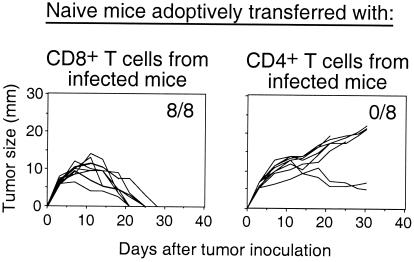
Adoptive transfer of suppression. Purified CD8+ T cells (Left) or purified CD4+ cells (Right) from spleens of chronically infected/FBL-3 transplanted mice were transferred into uninfected mice. The recipients were inoculated intradermally with 1 × 10⁷ FBL-3 tumors on the same day of the cell transfer. Numbers in the boxes indicate the number of mice that rejected their tumors over the total number of mice tested.
Figure 4
Figure 4
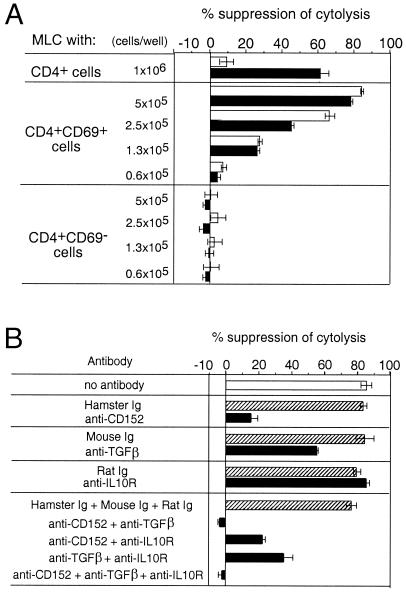
CD4+CD69+ T cell-mediated suppression of alloantigen-specific CTL generation. (A) Purified CD8+ T cells from uninfected (B10 × A.BY)F1 mice and the indicated numbers of purified CD4+ T cell subsets from either chronically infected (black bars) or uninfected (B10 × A.BY)F1 mice (white bars) were cultured in MLC. Cultured cells were tested for cytolytic activity against P815 target cells. The bars show percent suppression of specific cytolysis at a 40:1 effector-to-target ratio at the specific lysis of 92.7%. Error bars were determined from triplicate wells of a single assay. Similar results were obtained from this experiment at the 10:1 effector-to-target ratio and also from multiple target-to-effector ratios in an independent experiment. CD4+ T cells from spleens of the infected mice in this assay were 31.8% CD69+, whereas the CD4+ T cells from spleens of the uninfected mice were 17.5% CD69+. The purity of all purified T cell subsets was greater than 92%. (B) Blocking of CD4+CD69+ cell-mediated suppression with mAbs. Anti-CD152 mAb, anti-TGF-β mAb, or anti-IL-10 (IL10R) receptor mAb were added to MLC containing CD8+ T cells from uninfected mice and 3 × 10⁵ CD4+CD69+ cells from chronically infected (B10 × A.BY)F1 mice. The same concentrations of control antibodies were added as indicated. Cultured MLC cells were harvested and tested for cytotoxicity against P815 cells, and the percentage of suppression of specific lysis was calculated for the 40:1 effector-to-target ratio. Error bars were determined from triplicate wells of cytotoxic assay; similar results were obtained from the 10:1 effector-to-target ratio as well as from an independent experiment.

References

    1. Polk B F, Fox R, Brookmeyer R, Kanchanaraksa S, Kaslow R, Visscher B, Rinaldo C, Phair J. N Engl J Med. 1987;316:61–66. - PubMed
    1. Schulz T F, Boshoff C H, Weiss R A. Lancet. 1996;348:587–591. - PubMed
    1. Beral V, Peterman T, Berkelman R, Jaffe H. Lancet. 1991;337:805–809. - PubMed
    1. Kozuru M, Uike N, Muta K, Goto T, Suehiro Y, Nagano M. Cancer. 1996;78:1119–1124. - PubMed
    1. Maiman M, Fruchter R G, Guy L, Cuthill S, Levine P, Serur E. Cancer. 1993;71:402–406. - PubMed