Review
. 2001 Jul 17;98(15):8255-62.
doi: 10.1073/pnas.151008198.

Break-induced replication: a review and an example in budding yeast

Affiliations
Review

Break-induced replication: a review and an example in budding yeast

E Kraus et al. Proc Natl Acad Sci U S A. .

Abstract

Break-induced replication (BIR) is a nonreciprocal recombination-dependent replication process that is an effective mechanism to repair a broken chromosome. We review key roles played by BIR in maintaining genome integrity, including restarting DNA replication at broken replication forks and maintaining telomeres in the absence of telomerase. Previous studies suggested that gene targeting does not occur by simple crossings-over between ends of the linearized transforming fragment and the target chromosome, but involves extensive new DNA synthesis resembling BIR. We examined gene targeting in Saccharomyces cerevisiae where only one end of the transformed DNA has homology to chromosomal sequences. Linearized, centromere-containing plasmid DNA with the 5' end of the LEU2 gene at one end was transformed into a strain in which the 5' end of LEU2 was replaced by ADE1, preventing simple homologous gene replacement to become Leu2(+). Ade1(+) Leu2(+) transformants were recovered in which the entire LEU2 gene and as much as 7 kb of additional sequences were found on the plasmid, joined by microhomologies characteristic of nonhomologous end-joining (NHEJ). In other experiments, cells were transformed with DNA fragments lacking an ARS and homologous to only 50 bp of ADE2 added to the ends of a URA3 gene. Autonomously replicating circles were recovered, containing URA3 and as much as 8 kb of ADE2-adjacent sequences, including a nearby ARS, copied from chromosomal DNA. Thus, the end of a linearized DNA fragment can initiate new DNA synthesis by BIR in which the newly synthesized DNA is displaced and subsequently forms circles by NHEJ.


Figures
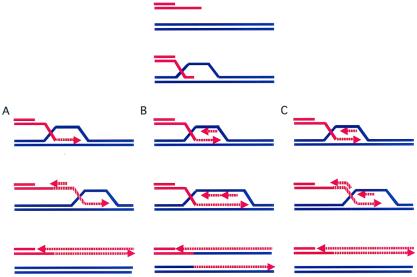
Figure 1
Figure 1
Alternative BIR mechanisms. A broken chromosome end will be resected by 5′ to 3′ exonucleases, allowing the 3′ end to interact with various recombination proteins to carry out strand invasion. (A) The 3′ end of the invading strand initiates DNA replication, leading to a migrating D-loop “bubble” as described by Formosa and Alberts (5). the displaced newly synthesized DNA strand can then be made double-stranded. (B) Strand invasion sets up a replication fork that will result in semiconservatively synthesized molecules. A Holliday junction will be resolved at some point. (C) Strand invasion sets up a replication fork in which branch migration enzymes displace both newly synthesized DNA strands as the replication structure migrates down the template.
Figure 2
Figure 2
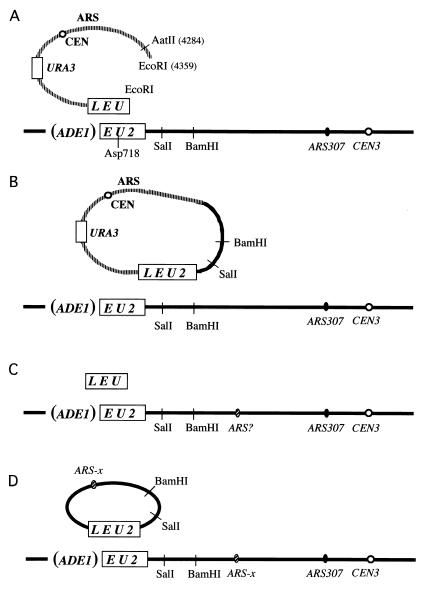
BIR-dependent formation of LEU2 recombinants. (A) EcoRI-digested plasmid pWYL37 has homology only at one end to sites in the yeast genome. (B) The “LEU” segment at one end of the DSB may initiate new DNA synthesis, but the completion of the event requires that the newly synthesized DNA is displaced from the template and must rejoin to the other end of the DSB by a nonhomologous end-joining event. (C) A <1-kb “LEU” DNA fragment was transformed into the same strain shown in A. This fragment has no ARS sequence and cannot replicate autonomously. (D) Hit-and-run transformants containing a circular derivative of chromosome III sequences were recovered. A putative origin of replication, designated ARS-x, is apparently responsible for the ability of these all-yeast circles to replicate.
Figure 3
Figure 3
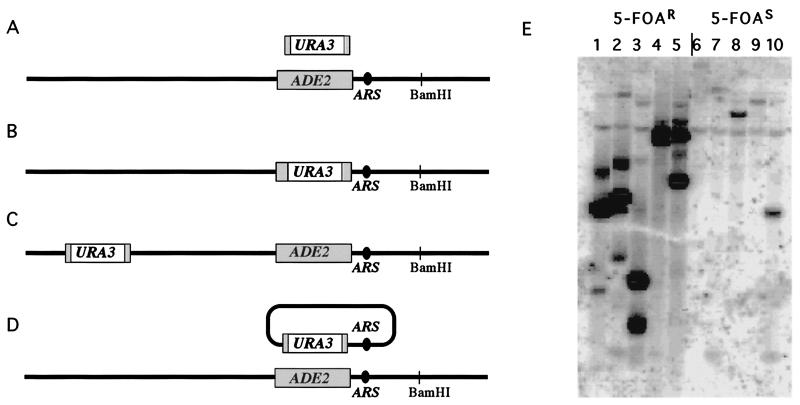
(A) Gene targeting at the ADE2 locus using an URA3 gene carrying only 50 bp of ADE2 sequences on either end. (B) An ARS sequence lies just upstream of the ADE2 gene, which is transcribed right to left. Three types of transformants were recovered. About half had replaced ADE2 with URA3 sequences. (C) Another group had inserted the URA3 nonhomologously at different sites in the genome. (D) A third group had formed unstable, apparently circular autonomously replicating sequences in which the ADE2-adjacent ARS had been copied onto the DNA of the transforming fragment, presumably by a BIR-like event. (E) Examples of BamHI-digested DNA from 5-FOA-resistant (5-FOAR) colonies harboring an unstable replicating URA3 gene (lanes 1 to 5), which is present in high copy number when probed with URA3 sequences. There is no BamHI site within 5000 bp upstream and 2200 bp downstream of the ADE2 gene. Supercoiled, nicked circular and linearized forms are evident. In lanes 6–10 are 5-FOA-sensitive colonies where the URA3 gene had integrated at unknown locations, present at single copy.

References

    1. Meselson M, Weigle J. Proc Natl Acad Sci USA. 1961;47:857–868. - PMC - PubMed
    1. Skalka A. In: Mechanisms in Recombination. Grell R F, editor. New York: Plenum; 1974. pp. 421–432.
    1. Mosig G, Werner R. Proc Natl Acad Sci USA. 1969;64:747–754. - PMC - PubMed
    1. Mosig G. Annu Rev Genet. 1998;32:379–413. - PubMed
    1. Formosa T, Alberts B M. Cell. 1986;47:793–806. - PubMed

Publication types