


Evidence that replication fork components catalyze establishment of cohesion between sister chromatids
- PMID: 11459963
- PMCID: PMC37431
- DOI: 10.1073/pnas.131022798
Evidence that replication fork components catalyze establishment of cohesion between sister chromatids
Abstract
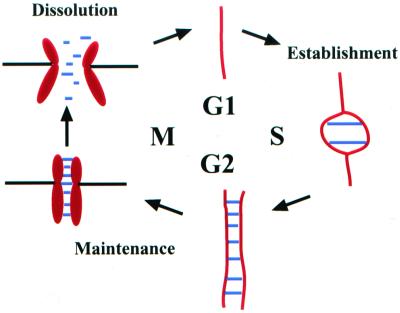
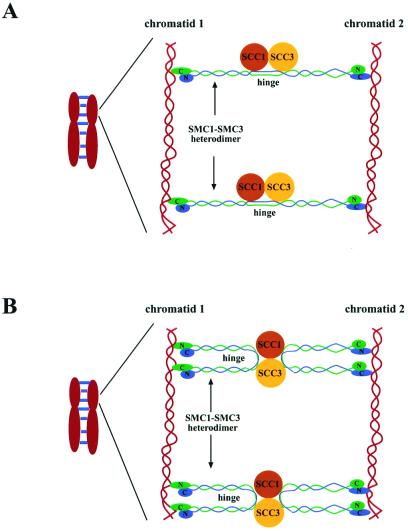
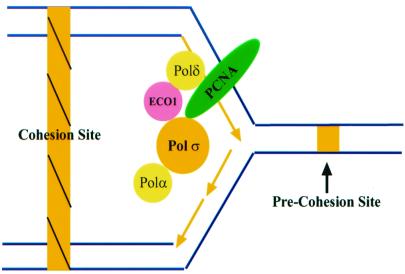
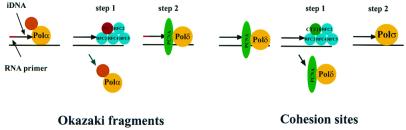
Accurate chromosome segregation requires that replicated sister chromatids are held together until anaphase, when their "cohesion" is dissolved, and they are pulled to opposite spindle poles by microtubules. Establishment of new cohesion between sister chromatids in the next cell cycle is coincident with replication fork passage. Emerging evidence suggests that this temporal coupling is not just a coincident timing of independent events, but rather that the establishment of cohesion is likely to involve the active participation of replication-related activities. These include PCNA, a processivity clamp for some DNA polymerases, Trf4/Pol final sigma (formerly Trf4/Pol kappa), a novel and essential DNA polymerase, and a modified Replication Factor C clamp--loader complex. Here we describe recent advances in how cohesion establishment is linked to replication, highlight important unanswered questions in this new field, and describe a "polymerase switch" model for how cohesion establishment is coupled to replication fork progression. Building the bridges between newly synthesized sister chromatids appears to be a fundamental but previously unrecognized function of the eukaryotic replication machinery.
Figures
References
Publication types
MeSH terms
Substances
LinkOut - more resources
Full Text Sources
Molecular Biology Databases
Miscellaneous
