


DNA replication meets genetic exchange: chromosomal damage and its repair by homologous recombination
- PMID: 11459990
- PMCID: PMC37458
- DOI: 10.1073/pnas.151260698
DNA replication meets genetic exchange: chromosomal damage and its repair by homologous recombination
Abstract
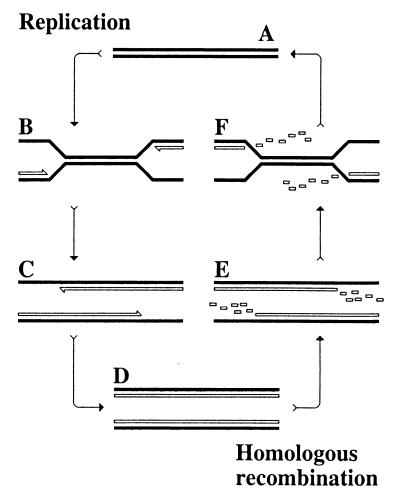
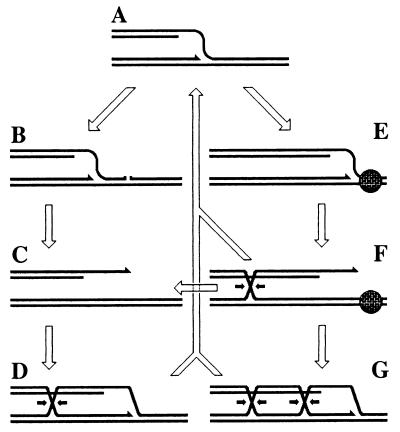
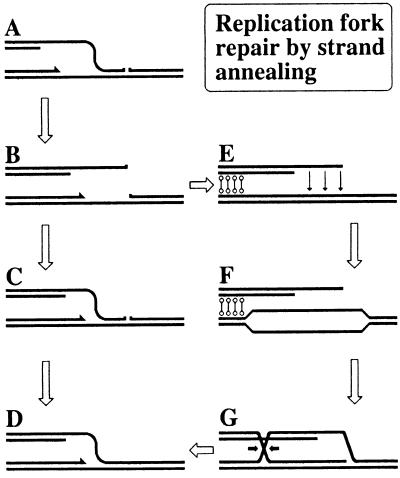
Proceedings of the National Academy of Sciences Colloquium on the roles of homologous recombination in DNA replication are summarized. Current findings in experimental systems ranging from bacteriophages to mammalian cell lines substantiate the idea that homologous recombination is a system supporting DNA replication when either the template DNA is damaged or the replication machinery malfunctions. There are several lines of supporting evidence: (i) DNA replication aggravates preexisting DNA damage, which then blocks subsequent replication; (ii) replication forks abandoned by malfunctioning replisomes become prone to breakage; (iii) mutants with malfunctioning replisomes or with elevated levels of DNA damage depend on homologous recombination; and (iv) homologous recombination primes DNA replication in vivo and can restore replication fork structures in vitro. The mechanisms of recombinational repair in bacteriophage T4, Escherichia coli, and Saccharomyces cerevisiae are compared. In vitro properties of the eukaryotic recombinases suggest a bigger role for single-strand annealing in the eukaryotic recombinational repair.
Figures
References
-
- Szybalski W. Abh Dtsch Akad Wiss Berlin, Kl Med. 1964;4:1–19.
-
- Hanawalt P C. Photochem Photobiol. 1966;5:1–12. - PubMed
-
- Strauss B S. In: DNA-Repair Mechanisms. Altmann H, editor. Stuttgart: F.K. Schattauer; 1972. pp. 151–171.
-
- Skalka A. In: Mechanisms in Recombination. Grell R F, editor. New York: Plenum; 1974. pp. 421–432.
-
- Higgins N P, Kato K, Strauss B. J Mol Biol. 1976;101:417–425. - PubMed
Publication types
MeSH terms
Substances
LinkOut - more resources
Full Text Sources
Other Literature Sources
Molecular Biology Databases
