Third generation oral contraceptives and risk of venous thrombosis: meta-analysis
- PMID: 11463678
- PMCID: PMC34722
- DOI: 10.1136/bmj.323.7305.131
Third generation oral contraceptives and risk of venous thrombosis: meta-analysis
Abstract
Objective: To evaluate quantitatively articles that compared effects of second and third generation oral contraceptives on risk of venous thrombosis.
Design: Meta-analysis.
Studies: Cohort and case-control studies assessing risk of venous thromboembolism among women using oral contraceptives before October 1995.
Main outcome measures: Pooled adjusted odds ratios calculated by a general variance based random effects method. When possible, two by two tables were extracted and combined by the Mantel-Haenszel method.
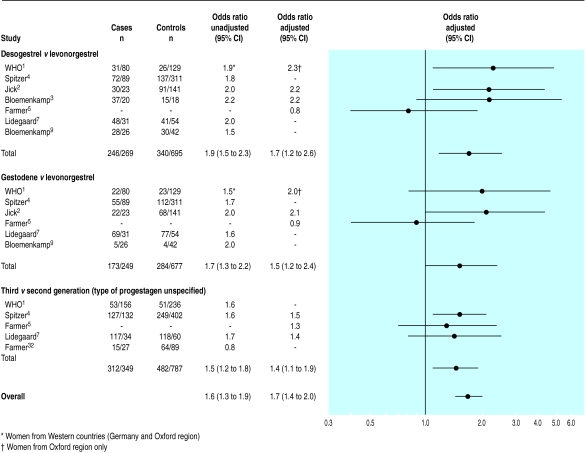
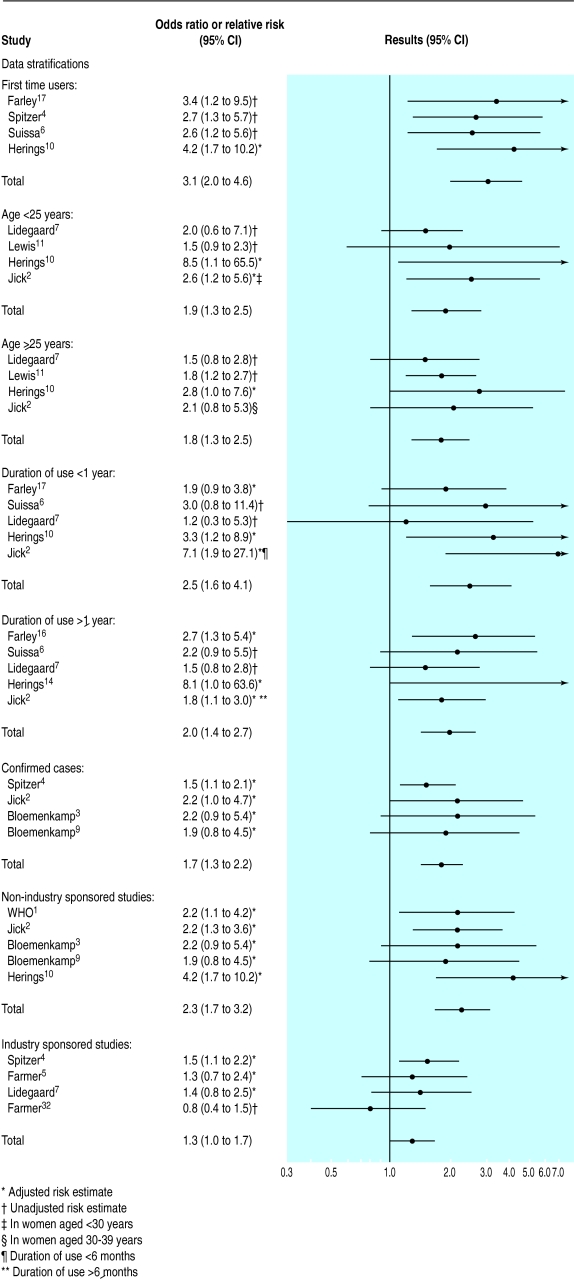
Results: The overall adjusted odds ratio for third versus second generation oral contraceptives was 1.7 (95% confidence interval 1.4 to 2.0; seven studies). Similar risks were found when oral contraceptives containing desogestrel or gestodene were compared with those containing levonorgestrel. Among first time users, the odds ratio for third versus second generation preparations was 3.1 (2.0 to 4.6; four studies). The odds ratio was 2.5 (1.6 to 4.1; five studies) for short term users compared with 2.0 (1.4 to 2.7; five studies) for longer term users. The odds ratio was 1.3 (1.0 to 1.7) in studies funded by the pharmaceutical industry and 2.3 (1.7 to 3.2) in other studies. Differences in age and certainty of diagnosis of venous thrombosis did not affect the results.
Conclusions: This meta-analysis supports the view that third generation oral contraceptives are associated with an increased risk of venous thrombosis compared with second generation oral contraceptives. The increase cannot be explained by several potential biases.
Figures
Comment in
-
The third generation pill controversy ("continued").BMJ. 2001 Jul 21;323(7305):119-20. doi: 10.1136/bmj.323.7305.119. BMJ. 2001. PMID: 11463662 Free PMC article. No abstract available.
References
-
- World Health Organization Collaborative Study of Cardiovascular Disease and Steroid Hormone Contraception. Venous thromboembolic disease and combined oral contraceptives: results of international multicentre case-control study. Lancet. 1995;346:1575–1582. - PubMed
-
- Jick H, Jick SS, Gurewich V, Myers MW, Vasilakis C. Risk of idiopathic cardiovascular death and nonfatal venous thromboembolism in women using oral contraceptives with differing progestagen components. Lancet. 1995;346:1589–1593. - PubMed
-
- Bloemenkamp KW, Rosendaal FR, Helmerhorst FM, Buller HR, Vandenbroucke JP. Enhancement by factor V Leiden mutation of risk of deep-vein thrombosis associated with oral contraceptives containing a third-generation progestagen. Lancet. 1995;346:1593–1596. - PubMed
-
- Farmer RD, Lawrenson RA, Thompson CR, Kennedy JG, Hambleton IR. Population-based study of risk of venous thromboembolism associated with various oral contraceptives. Lancet. 1997;349:83–88. - PubMed
Publication types
MeSH terms
Substances
LinkOut - more resources
Full Text Sources
Other Literature Sources
Medical