. 2001 Aug;183(16):4761-70.
doi: 10.1128/JB.183.16.4761-4770.2001.

Domain interactions in the yeast ATP binding cassette transporter Ycf1p: intragenic suppressor analysis of mutations in the nucleotide binding domains

Affiliations

Domain interactions in the yeast ATP binding cassette transporter Ycf1p: intragenic suppressor analysis of mutations in the nucleotide binding domains

J M Falcón-Pérez et al. J Bacteriol. 2001 Aug.

Abstract

The yeast cadmium factor (Ycf1p) is a vacuolar ATP binding cassette (ABC) transporter required for heavy metal and drug detoxification. Cluster analysis shows that Ycf1p is strongly related to the human multidrug-associated protein (MRP1) and cystic fibrosis transmembrane conductance regulator and therefore may serve as an excellent model for the study of eukaryotic ABC transporter structure and function. Identifying intramolecular interactions in these transporters may help to elucidate energy transfer mechanisms during transport. To identify regions in Ycf1p that may interact to couple ATPase activity to substrate binding and/or movement across the membrane, we sought intragenic suppressors of ycf1 mutations that affect highly conserved residues presumably involved in ATP binding and/or hydrolysis. Thirteen intragenic second-site suppressors were identified for the D777N mutation which affects the invariant Asp residue in the Walker B motif of the first nucleotide binding domain (NBD1). Two of the suppressor mutations (V543I and F565L) are located in the first transmembrane domain (TMD1), nine (A1003V, A1021T, A1021V, N1027D, Q1107R, G1207D, G1207S, S1212L, and W1225C) are found within TMD2, one (S674L) is in NBD1, and another one (R1415G) is in NBD2, indicating either physical proximity or functional interactions between NBD1 and the other three domains. The original D777N mutant protein exhibits a strong defect in the apparent affinity for ATP and V(max) of transport. The phenotypic characterization of the suppressor mutants shows that suppression does not result from restoring these alterations but rather from a change in substrate specificity. We discuss the possible involvement of Asp777 in coupling ATPase activity to substrate binding and/or transport across the membrane.


Figures
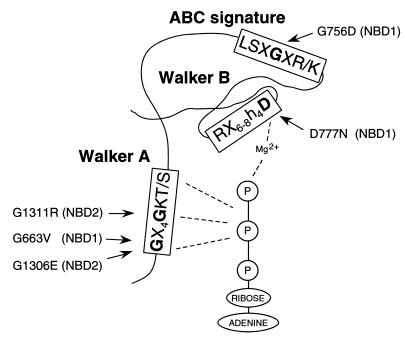
FIG. 1
FIG. 1
Ycf1p mutations chosen for the intragenic suppression analysis. The amino acid substitutions and their position in the conserved motifs of Ycf1p NBDs, NBD1 and NBD2, are indicated in a schematic representation of the predicted topology of an NBD (3, 13, 23, 24, 61). The consensus sequences for Walker A, Walker B, and ABC signature motifs are indicated. Interactions of bound ATP with Walker A and Walker B regions are represented by dashed lines.
FIG. 2
FIG. 2
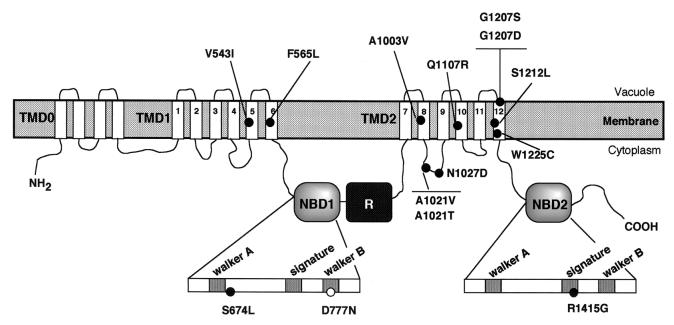
Location of the suppressor mutations found in revertants of the D777N mutant. The positions of the amino acid substitutions are included in the predicted model for the domain structure of Ycf1p based on the structural model that was previously proposed (58). In the additional TMD0 domain, four TM segments have been represented, but it is predicted to contain four to six segments. The highly conserved regions of the NBDs, Walker A, ABC signature, and Walker B, are indicated, as well as the position of the original D777N mutation.
FIG. 3
FIG. 3
Resistance profile of the revertants of the D777N mutant. Cells of yeast strain Δycf1 were transformed with the episomal plasmid pRS425 (Δycf1), pRS425-YCF1-HA (wild type), or pRS425-ycf1-HA (revertant listed) and grown on SD plates. Drops of each diluted strain (see Materials and Methods) were placed onto SD drop-out plates containing the indicated CdCl2 or diamide concentrations, grown for 48 h (diamide) or 72 h (CdCl2) at 30°C, and photographed. For quantitative determination of CdCl2 and diamide tolerance, MIC measurement was performed as described (see Materials and Methods) after growth of each strain at 30°C on microtiter plates containing medium with different concentrations of the compounds. Values are the means of independent duplicate experiments.
FIG. 4
FIG. 4
Expression levels of wild-type and mutant Ycf1p in yeast vacuolar membranes. (A) Vacuolar membrane vesicles of the Δycf1 strain transformed with pRS425 (Δycf1), pRS425-YCF1-HA (wild type), or related plasmids encoding each of the revertant mutant enzymes were isolated as described (see Materials and Methods), subjected to sodium dodecyl sulfate-polyacrylamide gel electrophoresis (2.5 μg of protein/lane), and immunodetected with an anti-HA monoclonal antibody and a second antibody coupled to alkaline phosphatase. (B) Vacuolar membrane vesicles of the Δycf1 strain transformed with pRS315 (Δycf1), pRS315-YCF1-HA (wild type), or related plasmids encoding each of the isolated suppressor mutant enzymes were prepared, electrophoresed (4 μg of protein/lane), and immunodetected as described for panel A.
FIG. 5
FIG. 5
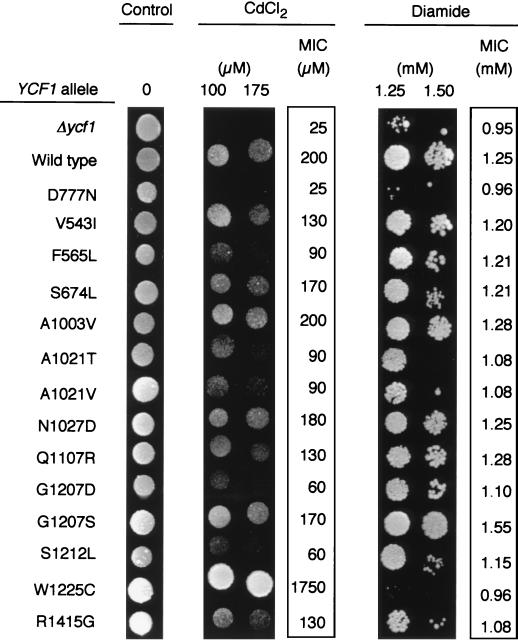
Resistance profile of the second-site mutants. Cells of the Δycf1 yeast strain were transformed with the centromeric plasmid pRS315 (Δycf1), pRS315-YCF1-HA (wild type), or pRS315-ycf1-HA (revertant listed) and grown on SD plates. Drops of each diluted strain (see Materials and Methods) were placed onto SD drop-out plates containing the indicated CdCl2 or diamide concentrations, grown for 48 h (diamide) or 72 h (CdCl2) at 30°C, and photographed. For quantitative determination of CdCl2 and diamide tolerance, MIC measurement was performed as described (see Materials and Methods) after growth of each strain at 30°C on microtiter plates containing medium with different concentrations of the compounds. Values are the mean of independent duplicate experiments.

References

    1. Aebersold R H, Leavitt J, Saavedra R A, Hood L E, Kent S B H. Internal amino acid sequence analysis of proteins separated by one- or two-dimensional gel electrophoresis after in situ protease digestion on nitrocellulose. Proc Natl Acad Sci USA. 1987;84:6970–6974. - PMC - PubMed
    1. Anderson M P, Gregory R J, Thompson S, Souza D W, Paul S, Mulligan R C, Smith A E, Welsh M J. Demonstration that CFTR is a chloride channel by alteration of its anion selectivity. Science. 1991;253:202–205. - PubMed
    1. Armstrong S, Tabernero L, Zhang H, Hermodson M, Stauffacher C. Powering the ABC transporter: the 2.5 Å crystallographic structure of the ABC domain of RBSA. Pediatr Pulmonol. 1998;26:91–92.
    1. Baichwal V, Liu D, Ames F L. The ATP-binding component of a prokaryotic traffic ATPase is exposed to the periplasmic (external) surface. Proc Natl Acad Sci USA. 1993;90:620–624. - PMC - PubMed
    1. Blake M S, Johnston K H, Russell-Jones G H, Gotschlich E C. A rapid, sensitive method for detection of alkaline phosphatase-conjugated anti-antibody on Western blots. Anal Biochem. 1984;136:175–179. - PubMed

Publication types

MeSH terms

Substances

LinkOut - more resources