


Firing rates of hippocampal neurons are preserved during subsequent sleep episodes and modified by novel awake experience
- PMID: 11470910
- PMCID: PMC55430
- DOI: 10.1073/pnas.161274398
Firing rates of hippocampal neurons are preserved during subsequent sleep episodes and modified by novel awake experience
Abstract
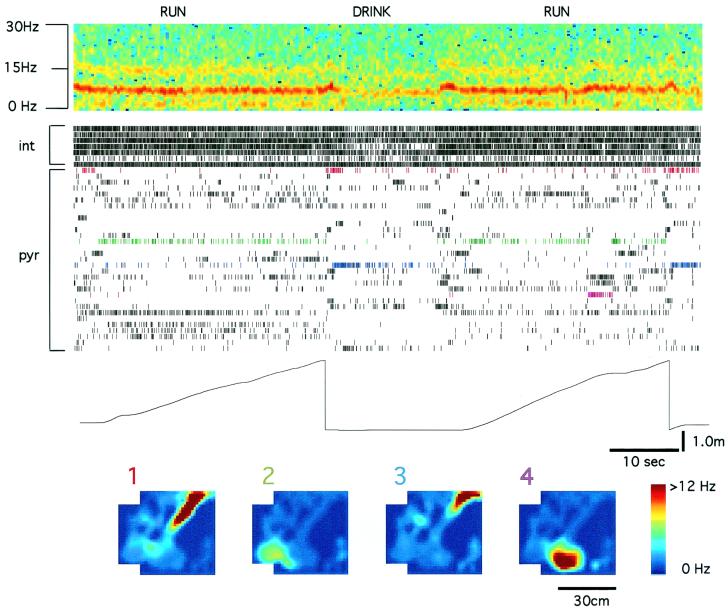
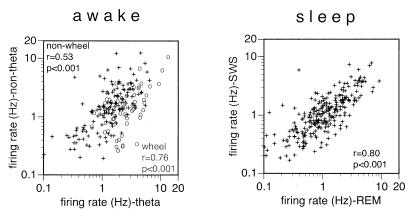
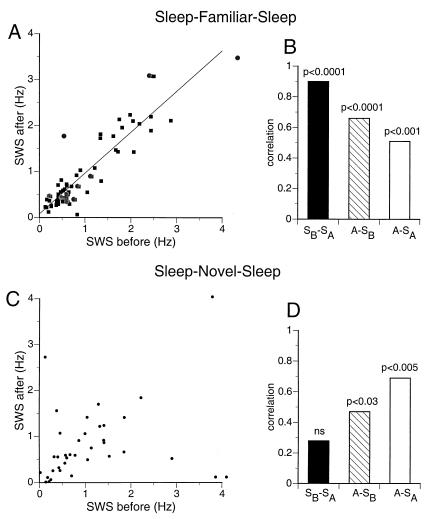
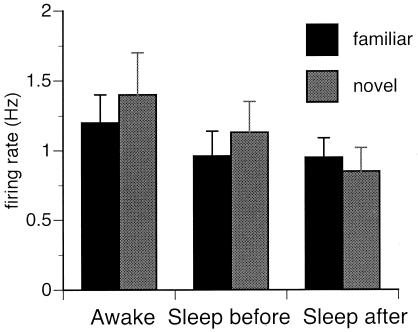
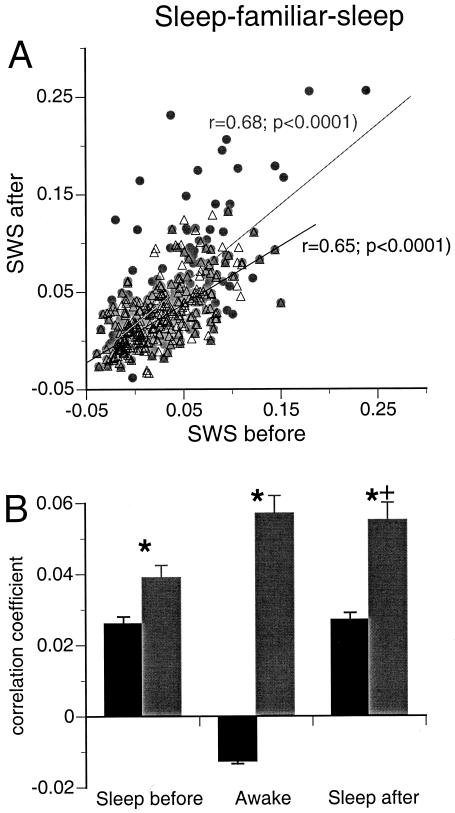
What determines the firing rate of cortical neurons in the absence of external sensory input or motor behavior, such as during sleep? Here we report that, in a familiar environment, the discharge frequency of simultaneously recorded individual CA1 pyramidal neurons and the coactivation of cell pairs remain highly correlated across sleep-wake-sleep sequences. However, both measures were affected when new sets of neurons were activated in a novel environment. Nevertheless, the grand mean firing rate of the whole pyramidal cell population remained constant across behavioral states and testing conditions. The findings suggest that long-term firing patterns of single cells can be modified by experience. We hypothesize that increased firing rates of recently used neurons are associated with a concomitant decrease in the discharge activity of the remaining population, leaving the mean excitability of the hippocampal network unaltered.
Figures
References
-
- Turrigiano G G, Leslie K R, Desai N S, Rutherford L C, Nelson S B. Nature (London) 1998;391:892–896. - PubMed
-
- Squire L R, Alvarez P. Curr Opin Neurobiol. 1995;2:169–177. - PubMed
-
- Eichenbaum H. Behav Brain Res. 1999;103:123–133. - PubMed
-
- Marr D. Philos Trans R Soc London B. 1971;262:23–81. - PubMed
-
- Buzsáki G. Neuroscience. 1989;31:551–570. - PubMed
Publication types
MeSH terms
Grants and funding
LinkOut - more resources
Full Text Sources
Miscellaneous
